
Adnan Mirhanoğlu* and Eray Çaylı**
In Mesopotamia, a region central to mainstream historiographies of agriculture’s role in civilization as state building, hydrology has figured prominently in understandings of whether and/or how long states survive. “Civilizational collapse” has been attributed to irrigation practices that distribute water unevenly, such that some lands are overirrigated while others are desertified and salinized (Hillel 2000; Jacobsen and Adams 1958; Postel 1999). Turkey’s so-called Southeastern Anatolia Project or GAP is often treated as the latest case in point (Bilgili et al. 2018; Özerol and Bressers 2017). Initiated in 1977 amidst incipient armed conflict in the region, GAP’s founding premise was that “the Eastern Question” (as the problems plaguing this region were then called in Turkey) was the result of underdevelopment. GAP’s solution has mainly involved the construction of 22 dams and 19 hydroelectric power plants on the Euphrates and Tigris rivers, along with large-scale irrigation canals serving 1.8 million hectares of land (Bilgen 2020). Several decades on, GAP remains an ongoing project (46% of the areas where the masterplan proposed to build irrigation canals have yet to receive coverage) as does the question it has aimed to solve.
Beyond its physical effects, GAP’s most fundamental impact has been to turn water into an object of desire. In areas where the canals are already in operation, GAP’s social and environmental effects have included inundation of villages, small farmers’ being deprived of water, and loss of topsoil and nutrients due to overirrigation (Akıncı et al. 2020; Bilgen 2021; Harris 2009; Harris 2012). In the Harran Plain where the construction of large-scale irrigation canals was completed in 1995, abundant access to water has become celebrated and the soil overirrigated. The plain now faces serious issues such as salinization, soil erosion and contamination of water with nitrates and pesticides (Bilgili et al. 2018). In regions where canals are incomplete, farmers switched from dry agriculture to irrigated farming by using their own techniques. One of the most common techniques involves digging boreholes to extract groundwater. Water pumps are used for this extraction. For economic reasons, electrically operated pumps are preferred to those that work with diesel or gasoline. According to a geomatic engineer and Mardin Ecology Association member, the boreholes dug in the Qoser/Kızıltepe Plain over the past two decades (amounting to 20 thousand holes in total and with depths varying between 350 and 700 metres) have used up 500 centuries’ worth of archaeological groundwater.
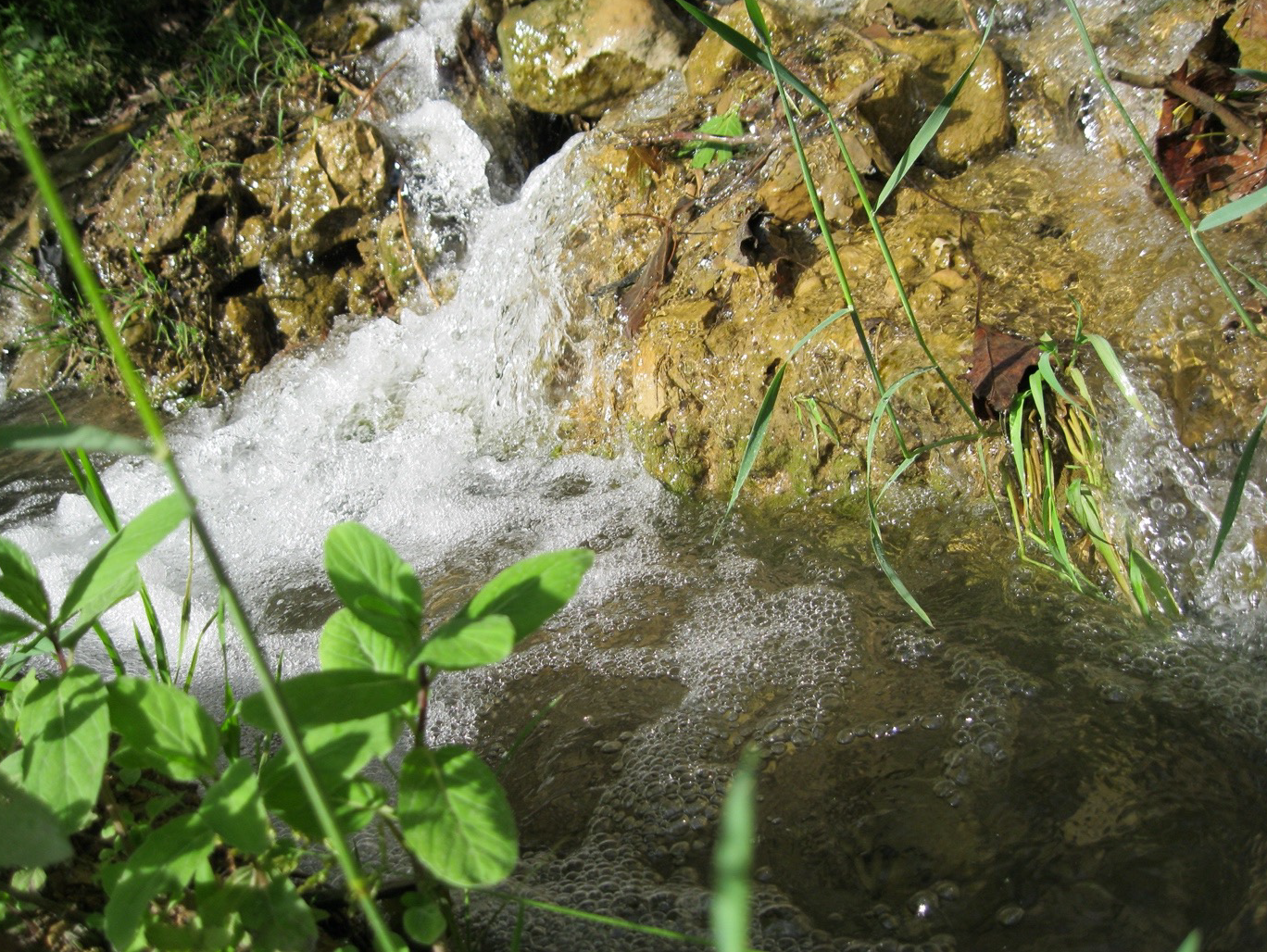
If using electrical pumps is meant to resolve farmers’ water access issues in regions where irrigation canals are still under construction, it confronts them with another issue: electricity access. Around 70% of the whole electricity provided to the region today is consumed by farmers who are under pressure to satisfy the productivity expectations of a marketized agricultural paradigm. In 2004, Turkey privatised electricity provision and the following year Dicle Electric Distribution Company or DEDAŞ began operating in the Kurdish-majority region encompassing the provinces of Diyarbakır, Şanlıurfa, Siirt, Mardin, Batman and Şırnak. Privatization introduced new fees and costs for consumers. Under these circumstances, some consumers have allegedly resorted to smuggling electricity. The allegation, however, is contested by those who argue that the existing electricity infrastructure has crumbled under the pressure of increased demand (due not only to agricultural reasons but also to an exponential rise in urbanization), leading to leakages that DEDAŞ recasts as theft. Indeed, the past few years have seen DEDAŞ use power cuts and exorbitant fines increasingly frequently as a punitive method. A case in point is the Qoser/Kızıltepe Plain which is part of GAP but has yet to witness the completion of irrigation canals. Power cuts, which have occurred increasingly frequently in the recent years, are particularly damaging during the summer months when temperatures reach up to 43°C and the use of water and electricity become ever more crucial for plant, animal, and human livelihoods. On 14 May of this year alone, DEDAŞ cut power to more than 40 neighbourhoods in Mardin’s Kızıltepe and Derik districts to penalize them for electricity debts. A farmer living here has spoken of having faced a 375,000₺ bill for his electricity consumption over the course of just 11 weeks in 2020, amounting to nearly 21 times his total earnings during the same period. Coupled with the Ministry of Agriculture and Forestry’s designation of the Qoser/Kızıltepe Plain in 2017 as a “great plain protection area,” electricity-related penalties have rendered farmer-led irrigation practically impossible.
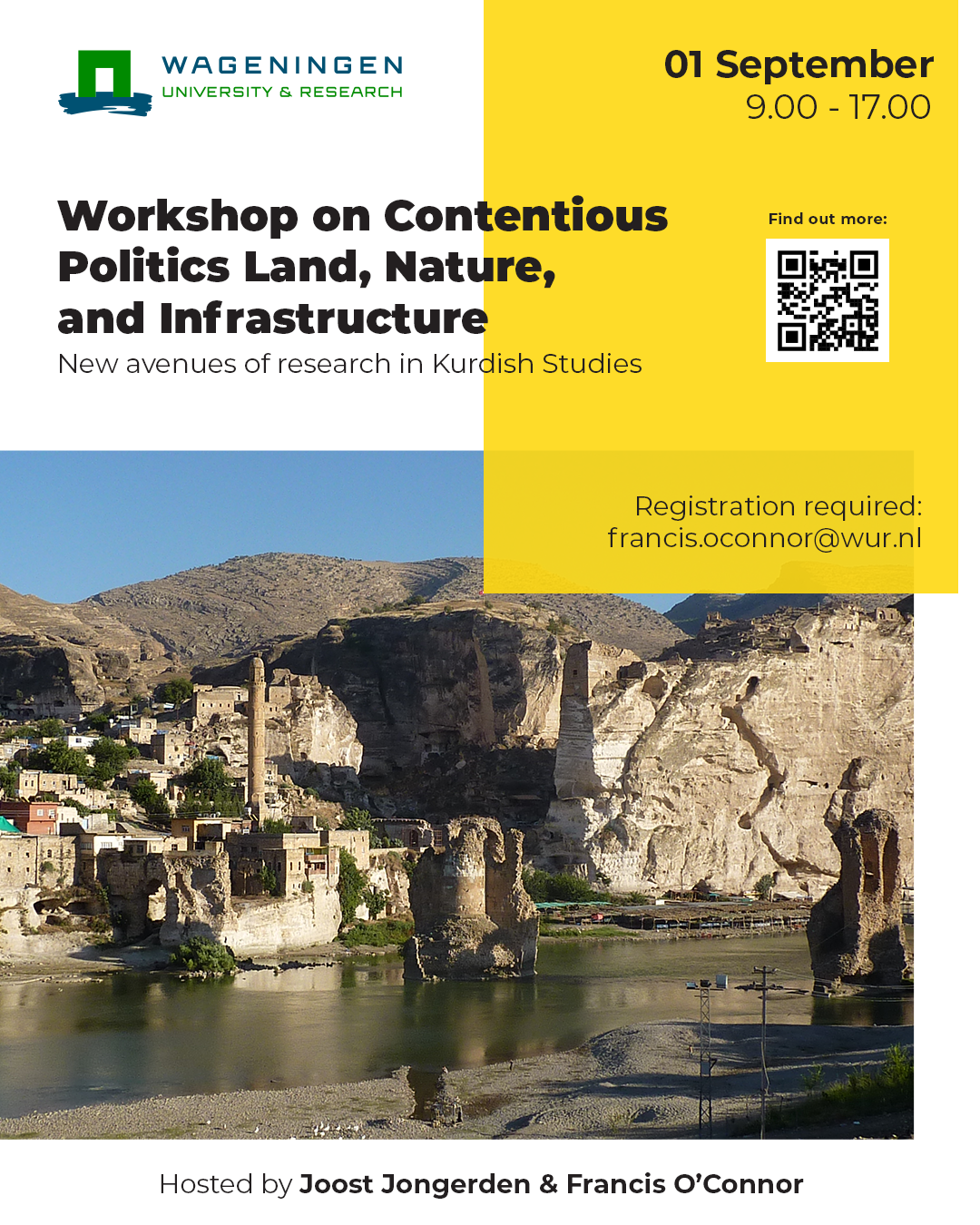
During the conference “Contentious Politics Land, Nature, and Infrastructure: New avenues of research in Kurdish Studies,” we wish to formulate GAP and specifically its irrigation infrastructures as a question that includes but is not limited to quantifiably rationalizable issues such as productivity, consumption, or the numbers of people served or underserved by the project’s promise of economic development. Focusing on the Qoser/Kızıltepe Plain, we are interested in reformulating GAP as a question that is more fundamentally about freedom: communities’ freedom to decide on how land, water, and the relations between the two are best understood, navigated, and inhabited. We argue that the instances narrated above oblige us to ask not simply whether water is made accessible or not and whether land is protected or not, but rather on whose terms such protection and access are conceived and put into practice. It is with this question in mind that we propose to approach the situation unfolding in the Qoser/Kızıltepe Plain in conversation with recent scholarship on infrastructural violence and biopolitics as implemented and experienced differentially due to (and as an extension of) longstanding injustices—a proposition that our contribution to the conference will detail.
*Adnan Mirhanoğlu is a researcher in the Department of Earth and Environmental Sciences at KU Leuven, Belgium.
**Eray Çaylı is a professor of Human Geography with a Focus on Violence and Security in the Anthropocene, Hamburg University, Germany.
A paper by Adnan Mirhanoğlu and Eray Çaylı will be presented at the workshop titled “Contentious Politics in Kurdish Studies: Land, Nature, and Infrastructure”, September 1 2023. For more information and the program, see: https://ruralsociologywageningen.nl/2023/05/23/contentious-politics-in-kurdish-studies-workshop-land-nature-and-infrastructure/
References
Akıncı, Z.S., Bilgen, A., Casellas, A., & Jongerden, J. (2020). Development through design: Knowledge, power, and absences in the making of southeastern Turkey. Geoforum, 114, 181–188.
Bilgen, A. (2021). “Concrete” steps toward modernization: Dam-, state-, and nation-building in southeastern Turkey. The Routledge Handbook on Contemporary Turkey (London: Routledge), pp.297-308.
Bilgen, A. (2020). Turkey’s Southeastern Anatolia Project (GAP): A qualitative review of the literature. British Journal of Middle Eastern Studies, 47(4), 652–671.
Bilgili, A.V., Yeşilnacar, İ., Akihiko, K., Nagano, T., Aydemir, A., Hızlı, H.S., & Bilgili, A. (2018). Post-irrigation degradation of land and environmental resources in the Harran plain, southeastern Turkey. Environmental monitoring and assessment, 190, 1–14.
Harris, L.M. (2009). States at the limit: Tracing contemporary state-society relations in the borderlands of southeastern Turkey. European Journal of Turkish Studies. Social Sciences on Contemporary Turkey, 10, doi: 10.4000/ejts.4122
Harris, L.M. (2012). State as socionatural effect: Variable and emergent geographies of the state in southeastern Turkey. Comparative Studies of South Asia, Africa and the Middle East, 32(1), 25–39.
Hillel, D. (2000). Salinity Management for Sustainable Irrigation: Integrating Science, Environment and Economics. Washington, DC: World Bank.
Jacobsen, T., & Adams R.M. (1958). Salt and silt in ancient Mesopotamian agriculture. Science, 128, 1251–1258.
Özerol, G., & Bressers H. (2017). How do farmers align with the agri-environmental changes in irrigated agriculture? A case study from the Harran Plain, Turkey. Irrigation and Drainage, 66, 45–59.
Postel, S. (1999). Pillars of Sand. New York: Norton & Company.
 Rural Sociology Wageningen University