
Kamuran Akin*
My research “In/visible Colonization: On infrastructure, surveillance and destruction in northern Kurdistan”[i], aims to understand the implications of infrastructural projects on the Kurdish issue, specifically under the AKP government since the early 2000s. I show how specific examples of coloniality in northern Kurdistan harness in intricate ways institutional racism, population control and ecological destruction.
At the centre of my research design is a historical analysis of the Kurdish issue. Through a historical reading, I trace the history of – what has been called in the literature – the “operational and mental continuity” [ii] of the Turkish state and discuss why the policies of extermination and denial against the Kurds should be considered within a colonial context. I analyze the colonial governorships in the early years of the republic, known as general inspectorates, and relate them to contemporary equals such as the trustee regime. Furthermore, I present the geospatial military policies of the 1990s such as forced displacements, curfews, and the establishment of the village guard system. Then, by way of looking at the policies during the 2000s, I show that while the policies of the 1990s continued, in addition, the so-called “Turkey-style neoliberalization”[iii] took place under the AKP government. Here the novelty is that despotic power gives countenance to infrastructural power as a central means of implementation.
Against this historical background, I look at three empirical manifestations of infrastructural projects in northern Kurdistan. 1. The construction of hydroelectric power plants under the name of “security dams” in places where there is no or very low water. 2. High security military posts and checkpoints, kalekols, which I call in the dissertation military infrastructural projects. 3. Forest fires and deforestation activities carried out by the state in times and places without active conflict.
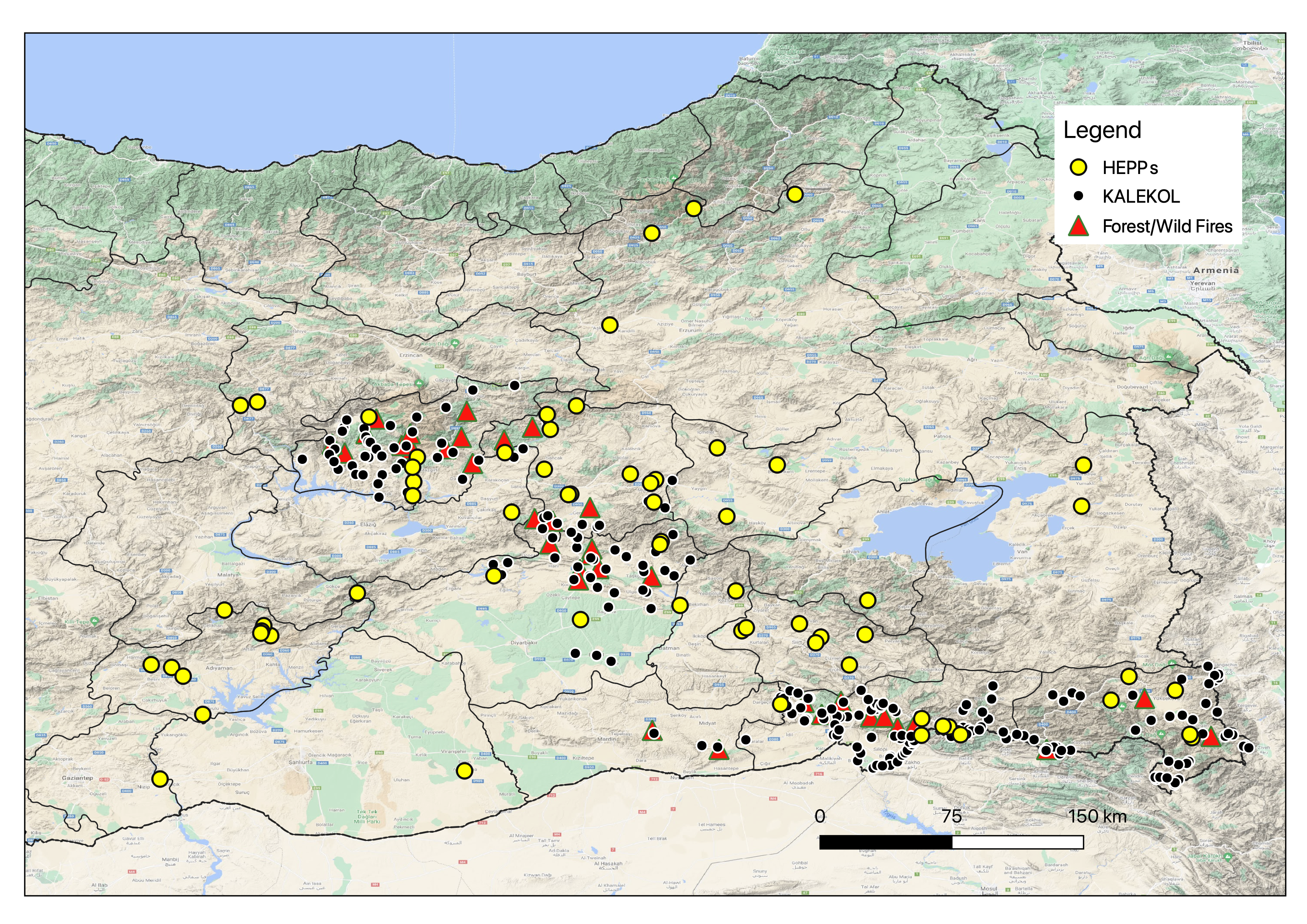
In his novel By the Sea Nobel Prize-winning writer Abdulrazak Gurnah used maps for describing the destruction caused by the colonizer. According to him maps not only show a territory “to be plundered”, but they are also what make a territory seem like “something that could be possessed”[iv]. In this sense, they depict occupation and colonialism. However, today, thanks to new technologies, mapping can be prepared according to target users and different purposes in order to illustrate reality, “on the basis of harmony and discord with the ideologies and policies”[vi of the map creators. In this sense, mapping is “an interpretative act” in which the map creator communicates they intentions and views[vi].
Due to the risks of conducting fieldwork in conflict areas and the limited access to these areas, or when it was thought that I would not be able to create alternative maps for my research through ‘ordinary mapping’ methods in the field, mapping via GIS (Geographical Information Systems) plays a key role in allowing me continue my fieldwork remotely. In order to confirm the accuracy of the interviewees’ statements, I prepared maps showing the distribution of hydroelectric power plants, forest fires and military mountain posts (kalekols) in the region. By looking at these maps one can see the intensity of infrastructural projects and military engagement of the Turkish state in Kurdish geography. These maps also show us the contemporary spatial practices of Turkish colonial governmentality in northern Kurdistan.
I argue that the concept of “colonial governmentality” allows for a more flexible, complex and heterogeneous definition of colonialism as a type of government rather than different classifications of colonialism. I show how the Turkish state’s approach to the Kurds can account for intersecting types of colonial domination and settings of control, from settler colonialism to internal colonialism and even orientalist approaches. In this sense, I define colonial governmentality in northern Kurdistan, which changes according to time and conjuncture, as a practice of governing and controlling that emerged as a result of the incomplete or non-completed nation-state project, which includes a dialectic of both acceptance and denial (i.e. colonial citizenship), and which has the mission of turning Kurds into colonised subjects in a long-term process by trying to erase their ethno-cultural identity and their relationship with space.
The fact that the socially and ecologically devastating dimensions of the daily ecocide occurring in northern Kurdistan are somehow rendered invisible by ideologies that perpetuate the colonial legacy of the past (through methodological nationalism, legislation, media power, social endorsement, etc.) points to a newer and more brutal version of colonial control and surveillance aimed at preventing us from seeing the fact that infrastructural projects are part of structural colonial violence. In addition to physical violence and structural exclusion similar to colonial practices of the past, pointing out how the state and its nepotistic relations with war and plunder-driven capitalism reproduce new colonial practices, and how these colonial interventions, which update themselves with new tactics and strategies and are more lethal, also allow us to see to what extent a systematic social resistance against a colonial continuity is or should be effective.
*Kamuran Akin is an independent researcher who recently defended his PhD at the Institut für Europäische Ethnology, Humboldt Universität zu Berlin. He is scheduled to speak at the workshop titled “Contentious Politics in Kurdish Studies: Land, Nature, and Infrastructure”, September 1, 2023. For the complete program, see: https://ruralsociologywageningen.nl/category/events/
[i] https://edoc.hu-berlin.de/handle/18452/27404.
[ii] Cihangir Gündoğdu and Vural Genç, Dersim’de Osmanli Siyaseti : Izale-i Vahset, Tashih-i Itikad ve Tasfiye-i Ezhan 1880-1913 (Kağıthane, İstanbul: Kitap Yayinevi, 2013).
[iii] Erik Swyngedouw, “Epilogue: Post-Truth and The Politics of Auotocratic Neoliberalisation.,” in Neoliberal Turkey and Its Discontents: Economic Policy and the Environment under Erdoğan, ed. Fikret Adaman, Bengi Akbulut, and Murat Arsel (London : New York: I.B Tauris, 2017), 254–61.
[iv] Abdulrazak Gurnah, By the Sea, Paperback edition (London New Delhi New York Sydney: Bloomsbury, 2002), 35.
[v] N. Collins-Kreiner, Y. Mansfeld, and N. Kliot, “The Reflection of a Political Conflict in Mapping: The Case of Israel’s Borders and Frontiers,” Middle Eastern Studies 42, no. 3 (2006): 405.
[vi] Pickles 1992 cited in N. Collins-Kreiner, Y. Mansfeld, and N. Kliot, “The Reflection of a Political Conflict in Mapping: The Case of Israel’s Borders and Frontiers,” Middle Eastern Studies 42, no. 3 (2006): 405.
 Rural Sociology Wageningen University