
Marcin Skupiński* & Dobrosława Wiktor-Mach**
The conflicts over the land and the environment spark all across Turkey as many local communities oppose large scale development projects, often supported by the state. Yet in the Kurdish inhabited areas of Turkey, the end of the Turkish-Kurdish peace process heavily limited possibilities of action for activists seeking to implement their ideas of ecology and autonomy. However, even in such a hostile environment many of our interlocutors adhere to the strategy of “building a new world in the shell of the old” and are seeking to build up more sustainable structures.
Ecology and paradigm shift
The paradigm shift within the PKK and the broader Kurdish Freedom Movement that started in 1990’s has thrust the concept of ecology into the forefront of political discourse in Kurdistan (cf. Akkaya, Jongerden, 2012; Hunt, 2021). With crucial inspiration coming from social ecology as developed by american libertarian-leftist intellectual Murray Bookchin (2005) and reinterpreted and contextualized by Abdullah Ocalan (2018), the connection between the domination of human over the environment and human over human became widely recognised as part of Kurdish political discourse and another perspective of looking at the conflict with the Turkish state. This transition has provided considerable ideological backing for activists who aim to prioritize environmental concerns and confront the capitalist modes of progress. Meanwhile the Justice and Development Party (Adalet ve Kalkınma Partisi, AKP) advocates for its own vision of progress and development, which largely rests upon large-scale investments in infrastructure and continuing extraction of natural resources. These controversial projects have sparked extensive protests and campaigns, ranging from the nationwide Gezi uprising to more localized struggles such as the Kurdish resistance in Hasankeyf which to date remains the most pronounced example of the environmental conflict in the context of northern Kurdistan.
Women and intersectionality
In our research we focused mostly, albeit not exclusively on women activists who touch upon the problems of ecology and environment in their work. We noticed that many of our interlocutors perceive various areas of activities as intertwined. The connection between ecological concerns and the pursuit of women’s liberation is particularly noteworthy. This connection was expressed in various ways, with some participants highlighting the essentialist notion of womanhood found in both societal norms and Ocalan’s ideology, while others emphasized a more nuanced understanding of individual and collective autonomy and well-being. The perceived connection between femininity and ecology was often based on the idea of women as a caregiver as well as an original farmer while men were supposed to be more detached from the environment. However some of our interlocutors rejected such an essentialized vision of womanhood, seeing it even as another form of patriarchal oppression, leaving more responsibilities in the hands of women. In spite of differences in all cases, the positionality of our interlocutors as Kurds active in the public sphere helped them to see various challenges as interconnected, thus not treating ecology as a completely separated field of activism.
Prefigurative politics
In contrast to the project-based approach often adopted by NGOs, Bakuri activists opt for a more reflective approach to ecology, engaging in debates on the meaning of this concept and seeking more sustainable ways to put their ideas into practice. This is demonstrated through actions such as establishing collective gardens, socially responsible entrepreneurship, and recurring events aiming at educating society and advocating the rights to the city or land. The violent crackdown on Kurdish autonomous structures in 2015-16 seriously limited possibilities for Kurdish activists, especially limiting the support from the municipalities to initiatives like cooperatives and communal gardens. However, even in such a hostile environment many of our interlocutors adhere to the strategy of “building a new world in the shell of the old” and are seeking to build up more sustainable structures. Interestingly in doing so they often refer to local knowledge and heritage. Thus they give their way of social change or “development” a very localized appeal which brings them closer to indigenous movements known from other parts of the world.
The state’s progress and alternative modes of development
Our experience in north Kurdistan shows an interesting connection between ecology, gender and indigeneity. The examples that we studied show how the notion of ecology can be incorporated in everyday activism and serve as a strong tool for critique of both the state and one’s own political elites. In the context of neoliberal vision of progress championed by the AKP on the one side and growing environmental disaster on the other, groups and individuals we encountered in Bakur create alternative modes of “development” which can undermine the mainstream vision of progress and pave the way for new paradigms for the state and society (cf. Ranta, 2022). .
This note was based on our fieldwork study carried out in 2021 and 2022 in north Kurdistan, an area known for Kurdish people as Bakur (South-East Turkey) with additional conversations made in Istanbul. Our research was carried on within the interdisciplinary project “Activism And Its Moral and Cultural Foundation: Alternative Citizenship and Women’s Roles in Kurdistan and the Diaspora” (ALCITfem) (2020-2024) in which our main focus were ecofeminism and ecological aspects in current activism of kurdish women.
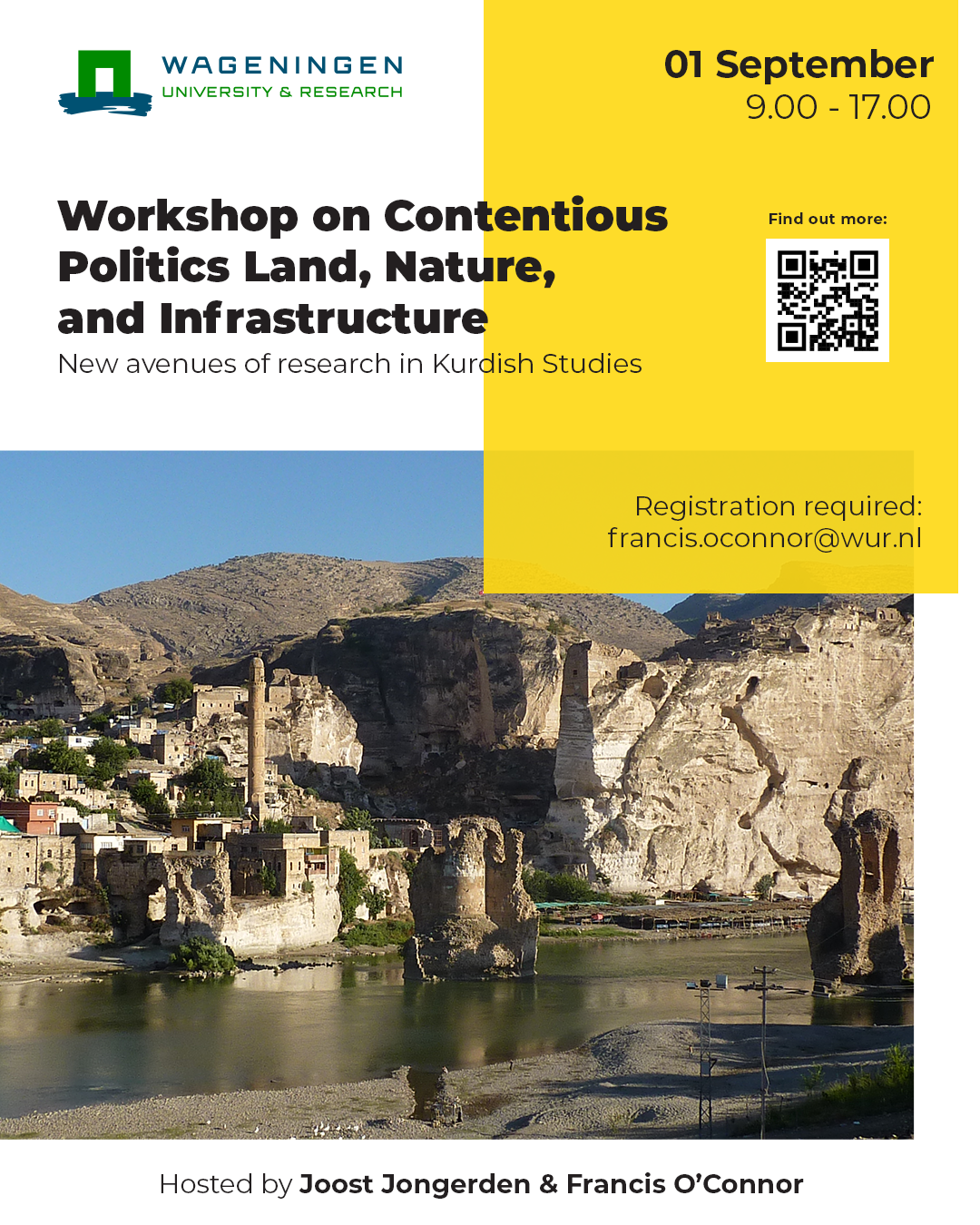
* Marcin Skupiński is a Ph.D. candidate at Warsaw University, Poland.He is scheduled to speak at the workshop titled “Contentious Politics in Kurdish Studies: Land, Nature, and Infrastructure”, September 1, 2023. For the complete program, see: https://ruralsociologywageningen.nl/2023/05/23/contentious-politics-in-kurdish-studies-workshop-land-nature-and-infrastructure/
** Dobrosława Wiktor-Mach is professor of Economics, Cracow University, Poland.
References
Akkaya, A. H., & Jongerden, J. (2012). Reassembling the Political: The PKK and the project of Radical Democracy. European Journal of Turkish Studies. Social Sciences on Contemporary Turkey, (14).
Bookchin, M. (2005). The Ecology of Freedom. The Emergence and Dissolution of Hierarchy. Oakland, CA: AK Press.
Hunt, S. E. (ed.) (2021). Ecological Solidarity and the Kurdish Freedom Movement: Thought, Practice, Challenges, and Opportunities, Lexington Books.
Öcalan A. (2018). Manifesto for a Democratic Civilization, Volume 1: Civilization: The Age of Masked Gods and Disguised Kings, New Compass Press
Ranta, E. (2022). “Alternative development approaches. Utopias, co-options, transitions”, in: The Routledge Handbook on the History of Development, edited By Corinna R. Unger, Iris Borowy, Corinne A. Pernet, p. 52-65.
 Rural Sociology Wageningen University