
Zeynep Oguz*
Turkish and Kurdish studies have been moving in important directions in the past decade. Studies of the importance of space and placemaking in Kurdish issue (Gambetti and Jongerden 2015) have been complemented by sustained engagements with material culture, nature, and environments in Kurdistan, as well as how they are central to colonial practices, state violence, and resistance. Today, from the study of ruins and ruination in burial sites and ghosts and, therefore, the interaction between the material and the symbolic, one can learn from anthropological and historical studies of how forests and forest fires, water and rivers, mountains, and animals have been entangled with power and resistance in Kurdistan (See Adalet 2022, Bozcali 2020, Biner 2019, Çaylı 2021, Oguz 2021, Suni 2023).
How can we understand the complex spectrum of power and resistance in the geographies of Kurdistan, by following the social and political worlds constituted around oil and the underground? My work is centered around the social and political significance of oil in Turkey, but somehow in a counterintuitive way. And that is because Turkey is an oil-poor nation-state. Focusing on a different story than that of the petrostates, where oil is abundant, I take the materially elusive yet symbolically ubiquitous existence of oil in Turkey as my central focus, and trace how the terrain and the absent presence of oil become contested grounds for territorial imaginaries & conflicts as well as struggles for freedom.
Due to its geological setting, where two major tectonic plates collide, the earth’s crust has folded and faulted, and petroleum has often escaped through these cracks or settled in unreachable depths, Turkey remains an oil-poor state. Current domestic oil production supplies only about seven percent of Turkey’s annual consumption. However, more than eighty-five percent of these humble domestic oil reserves are found in Northern Kurdistan. So, at the center of my anthropological questions lies this paradox:Despite Turkey’s perceived deficit of oil reserves, the prospect of yet-to-be-discovered abundant oilfields has never lost its popularity in political and public life. Namely, oil’s absent presence has been at the center of the following political imaginaries and projects: Turkish nationalist mythmaking and its territorial effects rely heavily on speculations about oil’s hidden abundance, as does its counter-narrative of Kurdish anti-colonial resistance in Turkish Kurdistan under Turkish colonial occupation.
In 2013, after almost four decades of armed conflict, the Turkish state finally initiated peace agreement negotiations with the PKK for the first time in the history of the conflict. This unprecedented process led to the declaration of a mutually recognized cease-fire, opening a space for deliberation on the political and collective rights that the Kurds would enjoy in post-conflict Turkey. But the peace process collapsed quite dramatically with the Turkish state’s strong military offensive beginning in July 2015, claiming over two thousand lives and displacing about half a million, and shattering hopes of peace, justice, and democracy in Turkey. This period also marked the AKP government’s slide to authoritarianism and an aggressive foreign policy in the Middle East and the Eastern Mediterranean.
The peace process between the Turkish state and Kurdish guerillas, and its eventual collapse created new territorial and political opportunities for the AKP government. Between 2013 and 2015, the Turkish state forged new frontiers in the previously inaccessible terrains of Anatolia’s war-ridden southeast and launched intensive plans for oil exploration in previously unexplored areas of the former war zone, where the Turkish state’s sovereignty over these terrains had been highly fragile. As the war shifted to urban spaces, the Turkish military reclaimed some of the rural and mountainous areas that were once controlled by the Kurdish resistance movement, the PKK. Pro-government media often portray these exploratory drillings under sensational headlines, declaring that mountainous areas “freed from terrorism” are now frontiers of oil discovery, regional development, and potential energy independence —national aspirations against which the Kurdish freedom movement is juxtaposed.
Recently, for example, pro-government & nationalist newspapers declared that Turkey was “finally set to drill for oil in area freed of terror.” One article claimed that Turkish Petroleum had finally begun exploration following “successful operations” near a highland against the PKK on the outskirts of Mount Herekol in the Eruh district of the province of Siirt. Garnished with colorful photos of the newly erected drill rig, group pictures of soldiers, the governor of Siirt, and Turkish Petroleum employees, the article quoted the governor of Siirt, who remarked that the area had been “a high-terrorist-activity zone and was almost impossible to reach.” But things had changed: “As terrorism is eradicated from the region, resources are being utilized to contribute to Turkey’s economy.” According to the Turkish pro-state media, the subsoil of Eruh could finally be re-territorialized as resource frontiers and spaces of hydrocarbon potentiality.
Harnessing the absent presence of oil and transforming unruly spaces into resource frontiers may be central to the territorial claims of the Turkish nation-state and the sustenance of colonial power relations in Kurdistan. Yet, taking place on indeterminate grounds, earth politics in Turkey has a flipside. Kurdish political activists, farmers, workers, and villagers also have been collaborating with the indeterminacies of oil and the geologic. They challenge the state’s territorial projects in ways ranging from spontaneous acts of disruption to organized movements of insurgency. In addition to frequent instances of theft and pipeline sabotage, the protection barriers built around oil wells, for example, are broken into or cut to be used for another construction project by the villagers, or for leisure. And sometimes, they are reappropriated as shooting targets. Almost all the dark green painted metal cages placed around the wells in Diyarbakır are riddled with hundreds of bullet holes.
When I asked Nizam Usta, a Kurdish senior technical worker at a production camp in Diyarbakir about what the countless bullet holes on the caged oil wells meant, he said, “It’s just target practice. It’s also a way of saying to the state ‘I was able to shoot a thousand bullets in this space, and not any one of you were able to stop me.’ And on another day, Nizam would recount another story: A couple of years ago, twenty empty oil barrels were stolen from a near petroleum storage facility. The barrels were going to be discarded by the camp’s workers, as they had corroded and couldn’t be used for petroleum storage anymore. The engineers couldn’t make sense of the disappearance of the barrels and the military had no leads. Two weeks later, the barrels reappeared; this time in the middle of the ruins of a deserted village due to forced displacement. The barrels were covered with bullet holes, but upon close inspection, the soldiers realized that the holes were left on the barrels in a particular way that represented letters; and when ordered in a certain way, they clearly read “Azadî (Freedom)”.
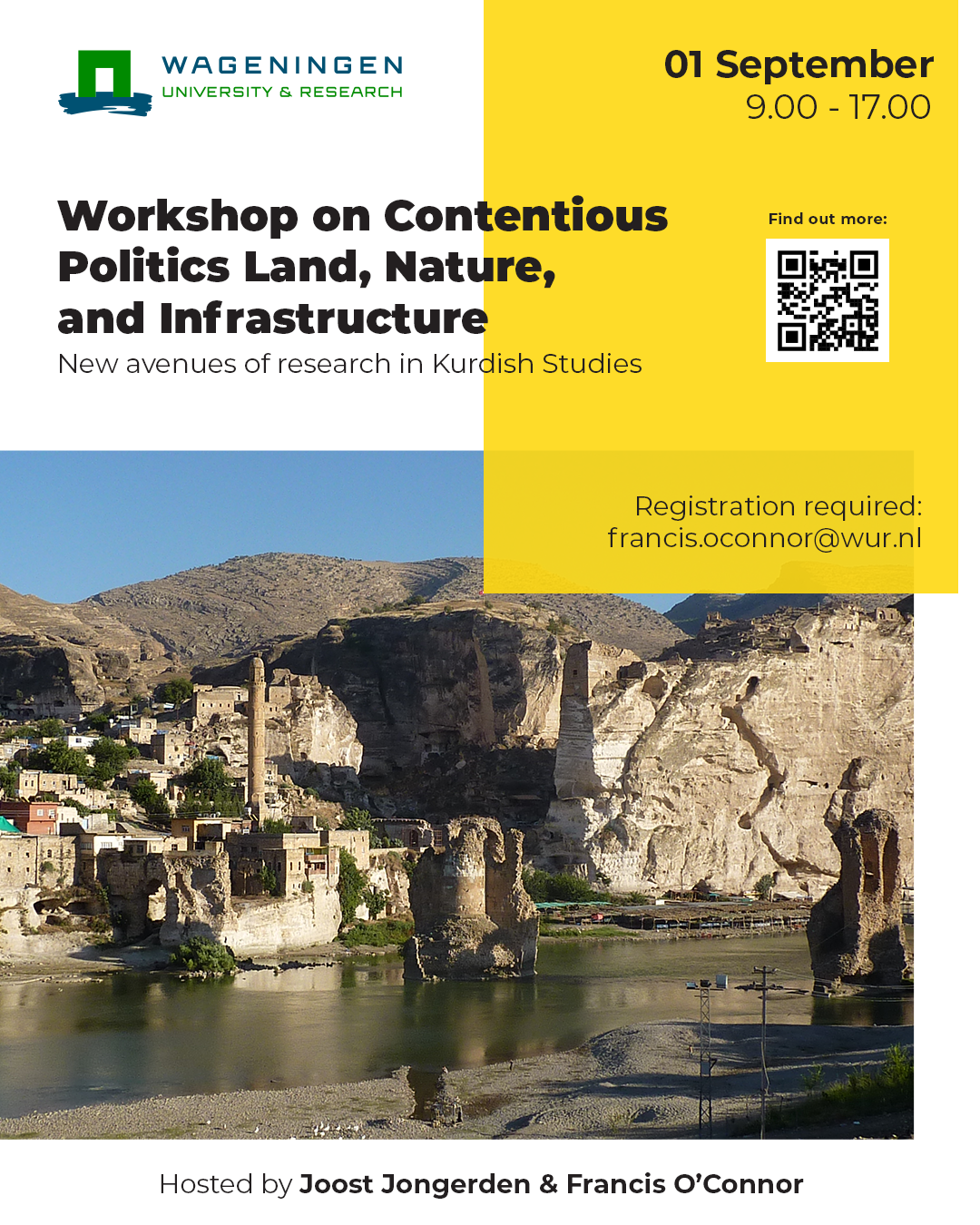
* Zeynep Oguz is a lecturer in Social Anthropology at the University of Edinburgh. She speaks at the workshop titled “Contentious Politics in Kurdish Studies: Land, Nature, and Infrastructure”, September 1, 2023.
References
Adalet, Begüm. “Agricultural infrastructures: Land, race, and statecraft in Turkey.” Environment and Planning D: Society and Space 40.6 (2022): 975-993
Bozcali, Firat. “Probabilistic borderwork: Oil smuggling, nonillegality, and techno‐legal politics in the Kurdish borderlands of Turkey.” American Ethnologist 47.1 (2020): 72-85
Biner, Zerrin Ozlem. States of dispossession: Violence and precarious coexistence in Southeast Turkey. University of Pennsylvania Press, 2019.
Çaylı, Eray. “The aesthetics of extractivism: Violence, ecology, and sensibility in Turkey’s Kurdistan.” Antipode 53.5 (2021): 1377-1399
Çaylı, Eray. “Contemporary art and the geopolitics of extractivism in Turkey’s Kurdistan.” Transactions of the Institute of British Geographers 46.4 (2021): 929-943
Duruiz, Deniz. “Tracing the conceptual genealogy of Kurdistan as international colony.” Middle East Report 295 (2020)
Gambetti, Zeynep, and Joost Jongerden, eds. The Kurdish issue in Turkey: A spatial perspective. Routledge, 2015.
Oguz, Zeynep. “Cavernous politics: Geopower, territory, and the Kurdish question in Turkey.” Political Geography 85 (2021): 102331.
Peters, Kimberley, Philip Steinberg, and Elaine Stratford, eds. Territory Beyond Terra. Rowman & Littlefield, 2018.
Schäfers, Marlene. Voices That Matter: Kurdish Women at the Limits of Representation in Contemporary Turkey. University of Chicago Press, 2022
Sunca, Jan Yasin. Colonial continuities in the Kurdish liberation. The Commentaries, 3(1), (2023): 71–89.
Suni, Anoush Tamar. “Palimpsests of Violence: Ruination and the Afterlives of Genocide in Anatolia.” Comparative Studies in Society and History 65.1 (2023): 192-218
Yoltar, Çağrı, and Erdem Yörük. “Contentious welfare: The Kurdish conflict and social policy as counterinsurgency in Turkey.” Governance 34.2 (2021): 353-371
 Rural Sociology Wageningen University