
This June, the Rural Sociology Group (RSO) hosted its first ever Food Commons Summer School. In a new blog, Rohit Dash shares his experiences and insights from the event.

What if food could be shared like stories. What if, we could build the truly proverbial village in our communities to raise a farm of delicious, cared for and nutritious food. Imagine a world, where food systems were entirely “Commoned” stripped from the materialist notions of private ownership, instead nurtured by care and collective stewardship. How do we get to this utopia? Was there ever a precedent to such an utopia? or are there examples of islands of utopia that remain hidden in plain sight?
This June, the Rural Sociology Group (RSO) hosted its first ever Food Commons Summer school – a 5 day journey across the Netherlands that brought together PhD researchers from around the world to explore these kinds of questions.
However this wasn’t the usual summer school constrained within Air Conditioned lecture halls, earmarked coffee breaks or boring corporate caterirng. The Food Commons Summer school didn’t market itself as a panacea or an oracle with solutions and instructions that lead to a commoned food system. Instead – it was designed as a sanctuary to question, to immerse and to discover – answers, paths and even discover newer questions.
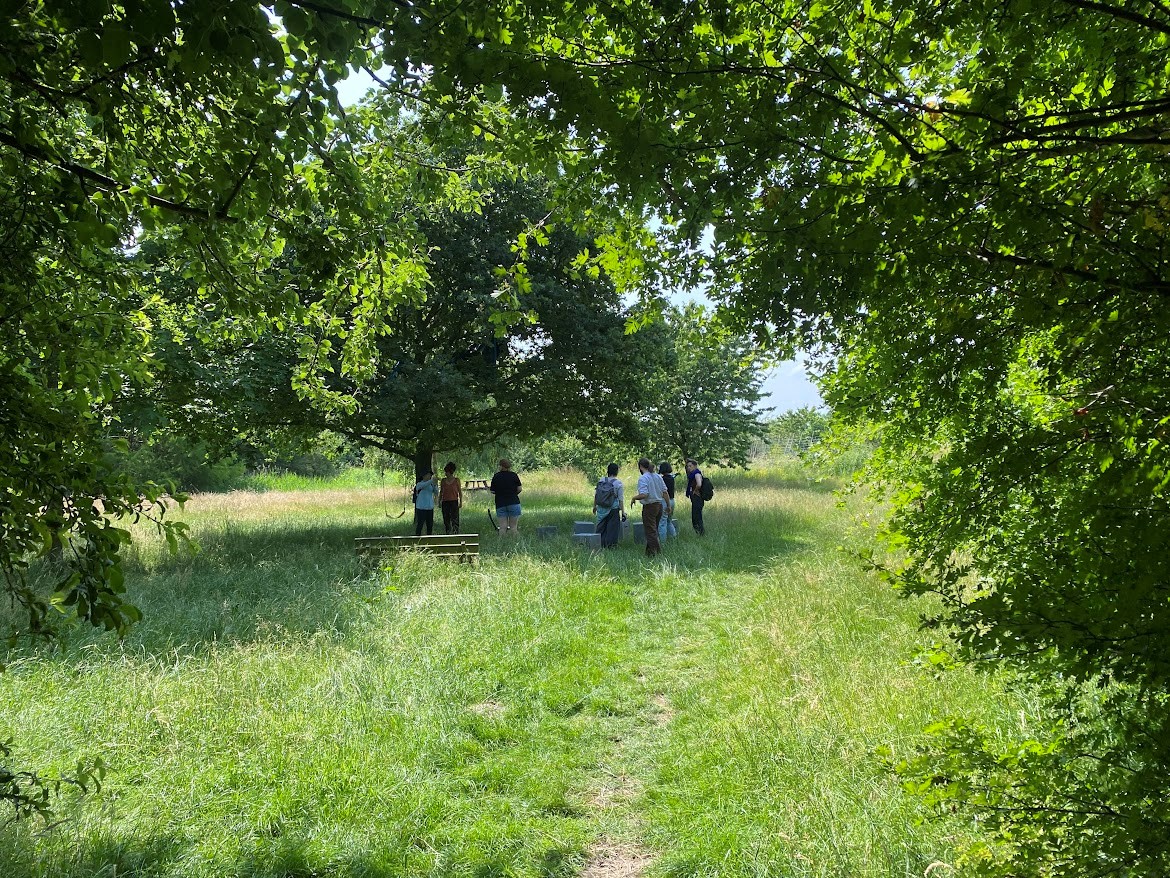
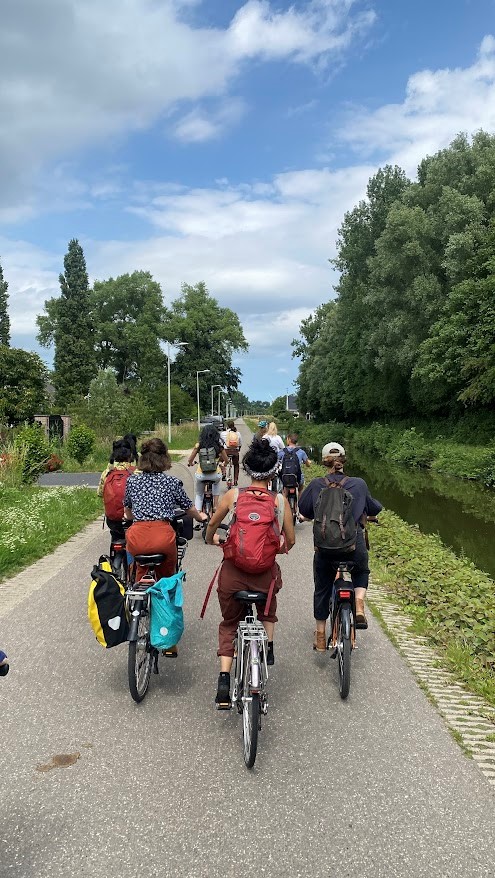
In these intense 5 days, we cycled to farms, cooked together, wandered through a Seed Library, urban gardens and even to walled estates. We cooked, discussed and debated. Unpacked the legal, political, emotional and personally embodied dimensions of food, land and commons – sometimes over theory-laden readings, sometimes over a bowl of self-made hummus under a willow tree that has seen it all.
With a healthy dollop of theory as pre read and hands on visits in Wageningen, Nijmegen and Amsterdam, we immersed ourselves in the messy, hopeful and often contradictory world of commoning – all within the still dominant landscape of capitalist food systems.
This blog is my attempt to share a few threads from the week – hopefully tickle that dreamy, ambitious and gentle part of your brain.
This is not a summary, but a collage of questions, places and people that left their indelible mark on this Summer school. I hope they leave you curious and empowered too.
👣 The Cast – A Cohort of Commons Seekers
With 11 PhD researchers – from Europe and Asia, this summer school was the confluence of many disciplines and practices. Some had spent years knee-deep in ethnographic fieldwork, others came from the lab, the courtroom, the farm or the spreadsheet from disciplines as varied as feminist economics, legal theory, agriculture, geography and agrifood engineering.
Yet, what connected us was the unease with accepting the dominant capitalist relations to food systems and beyond. The de-humanisation it wrought on things as intimate as food, land and environment.
We were strangers on day one. But over shared reflections, home-cooked meals, and long train rides between cities, a kind of quiet familiarity began to form — the kind that emerges when people feel they can be honest, uncertain, and hopeful at the same time.
Furthermore, since the emphasis of the commons was on “Food Systems”, even the logistics reflected the politics. There were no corporate catering contracts. Instead we collectively prepared meals, sourced food from local initiatives and brought pieces of our culinary traditions – however fragmented – to the table. For e.g.: Our Indonesian themed lunch on day one, cooked communally in a CSA was its own form of commons that prioritised conviviality and community of the hegemony of structural homogeneity imposed by corporate overlords.
🧭 The Crew – Navigators of the Pluriverse
Behind the scenes were a group of facilitators whose expertise spanned law, geography, feminist theory, ecology, and urban planning.
Each brought their own lens: from exploring land as a legal fiction, to rethinking food through care work, to examining the invisible infrastructures that support commoning. The readings they curated reflected this diversity ( reading list )- from historical critiques to ethnographic insights. Our daily reflections weren’t box-checking exercises; they became tools to sharpen the questions we carried into each site visit.
What emerged wasn’t a singular narrative about the commons – but a mosaic of tensions, contradictions, and possibilities.
📚 The Content
Day 1 – Commons as Contradiction
What is “Commons”? Is it a noun, a verb, a “tangible” resource, or an “intangible” relationship? Readings like Silvia Federici’s Re-enchanting the world challenges us to see commons not as scraps of resources without a owner, but as a relation, a process – nej resistance.
Later on, we visited Tuinderij het Lichtveen – a regenerative farm, that employs a no plough method to farming. This was a site where we witnessed “Care” in action – of the land and the multitude it carries. Learning of the ongoing practices employed there, made us see how a simple shift in perspective can change our relationship with land and the fruits they bear.
We saw farming reimagined as collaboration, with the ingredients of nature, neighbours, seasons and soil. Even tenancy, often a mark of precarity became a site for trust. After the communal lunch, we closed the day with a plenary session. It wasn’t designed to give answers but led to a word cloud of emerging themes – law, land, care and precarity – our own evolving commons vocabulary.
Day 2 – Seeds, Systems and Spectrum
We explored seed commons and questioned how preservation, access and sovereignty intersect. At the Centre for Genetic Resources (CGN), we learned about seed drying, germination tests and legal constraints on sharing biodiversity. Albeit being state funded – CGN works with relative independence even when surrounded by the spectre of enclosure, in the form of national sovereignty. Later, in a community garden – with a side of homemade hummus, bread and coffee – we discussed whether initiatives like CGN exist on a spectrum of commoning, unlike rigid categories. Could a “commoning health score” exist – much like the Nutri score we see on food packages. The day ended under a tree, discussing the difference between Commons based Food system and a Food system as commons. The silence after that conversation said as much as any lecture could.
Day 3 – Land, Law and Limit”less” generosity
The day began with a gezzelig bus ride to Nijmegen where we were hosted at a Feudal estate. There we dove into the ontologies of land : what is it, who defines it and who governs it? Drawing from theory and real-world examples like Herenboeren and other CSAs we saw how even “generous” landlords reproduce the precarity of the dominant property regime. We questioned – how can we use the master’s tools to dethrone the master – if at all it were possible. Are there unexplored angles within the contemporary legal apparatus that could take forward the fight for the Commons.
A video clip from San Francisco showed how legal claims empowered by modern legal systems can dethrone age old claims from community memory.
The contradictions of this day were the sharpest, making it even more necessary to sit with.
Day 4 – Fermentation, Identity and the Urban Commons
We made pickles with cucumbers.
It wasn’t a detour as much as a deep dive into identity, memory, nostalgia and gender. Readings on Northeast Indian food cultures revealed how fermentation practices are both cherished and marginalised. We were asked to bring recipes that brought with them memories of our being. This workshop reminded and spoke to the fact recipes too are commons, often stewarded invisibly and thanklessly by women. Later, in Amsterdam’s Voedselpark we explored how urban land – even a willow tree can become a site of protest, memory and resistance. We stood in the “last farm of Amsterdam” cornered by geometric brutalist “Warehouses” that feed Netherland’s giant Supermarkets. Similar to how “Enclosures” took over from the Commons in England around the 15th century.
The day however ended with stories of wins, of capital emancipating itself from the cycle of “growth” into regenerative urban futures. The wins, were the glimmer of sun in the cloudy question of “Can we revert back to the Commons at the birthplace of modern Capitalism, in Amsterdam?”
Day 5 – Futures Rooted in Soil and Solidarity
Our final day took us to De Ommuurde Tuin and the eco-village of Ppauw. Both challenged ideas of scale, success, and what sustainability _looks_ like. At Ommuurde Tuin, we saw agroecology in action — radial garden designs, participatory guarantee systems, and labour practices that centre care. The majority of workers? Women. The majority of metrics used in policymaking? Still industrial. At Ppauw, creativity met constraint: mud houses, community kitchens, and co-ownership as quiet resistance. By the end, we weren’t looking for clean conclusions — just clearer commitments to building outside the logic of extraction.
Conclusion and questions
This summer school didn’t give me a definition of the commons — it gave me a relationship to it. A relationship full of tension, tenderness, and unfinished questions.
It reminded me that commoning isn’t a “model” to be replicated. It is practice that gets perfected with every iteration, that it needs adaptation to the local contexts & needs. My values found articulation and validation. That food can be a verb, not a product. That land can be loved, not just owned. And that regeneration isn’t just about soil – it’s about systems, people, and time.
If you’ve made it this far, I’ll leave you with an overarching questions I am carrying with me :
– Can the commons survive in a world built for enclosure – or must it quietly transform it from within?
There are no easy or straightforward answers. But maybe that’s not the point.
 Rural Sociology Wageningen University