
By Georgia Diamanti, with Jessica Duncan, Lucia Demicheli
On the chilly, sunny morning of October 2nd 2025, a team from RSO, including Jessica Duncan, Jasmijn Bakker, Lucia Demicheli, and Georgia Diamanti, boarded a train to Brussels together with Lotte Opdam, from Toekomstboeren.
We were headed to the SWIFT project’s fourth and final policy dialogue, to be held at the Spanish National Research Council, in the center of Brussels. Three such policy dialogues had already taken place at the national level of different EU member states; in Spain, Austria and Poland (read the SWIFT policy brief here). Only the EU-level policy dialogue remained.
We arrived with a few hours to spare before the start of the event, and so we went about helping with the small tasks that remained; such as setting the interpretation devices to the different language channels. For the food sovereignty movement, there is no revolution without interpretation and indeed, having professional interpretation was critical to ensuring participants could engage effectively.

Georgia, Lucia and Jasmijn help set up the interpretation devices
Upon re-entering the main space where the dialogue was to take place (and in whose empty space we had previously sat, fidgeting with the interpretation devices) we now encountered a much livelier sight. This time the room was filled with people, chattering away. Soon Louise Legein (our SWIFT partner from Oxfam Solidarité) took the floor, and, welcoming us all to Brussels, signaled the start of the event.

Louise Legein presenting the SWIFT project ©Tineke Dhaese/Oxfam
Following a brief overview of the SWIFT project from Louise, Brussels-based journalist, Natascha Foote, took the floor. Here, Natasha took us along on a quick dive into the draft proposal for the upcoming CAP (an impressive feat to take on in 15 minutes – one which she nevertheless took on with an exceedingly engaging and humorous demeanor). Though she outlined various aspects of the CAP that are set to change (among the biggest of them, the scrapping of the Rural Development pillar and an overall drop in the EU CAP budget compared to the last programming period) it was also emphasised that this is only the first draft, which will serve as the basis for upcoming negotiations and that as such, “the road ahead is still a long one”.
Having by now warmed up, it was time to break out into rooms and proceed with the dialogue. And so, we were split into five groups; the aim was to have stakeholders representing different points of view in each group (farmers, policymakers and representatives of EU institutions, civil society, researchers). We had just over an hour to discuss the following question: “What are the opportunities in the CAP (and related policies) to better support gender equality?”
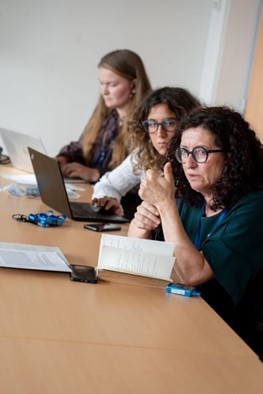
Break out group discussion ©Tineke Dhaese/Oxfam
Lively conversations ensued, the dialogues were a precious opportunity for farmers to engage with people on the policy side of the CAP.15 minutes left. 5 minutes left. The Oxfam facilitators discreetly slipped in and out of the breakout rooms, holding up signs that silently informed us that discussions were nearing their end. And so we reconvened back into the main room to share the fruits of our discussions.
Common themes that permeated discussions between the different groups were; generational renewal, social security, social conditionality, and the divide between EU policy and farm-level reality. Within multiple discussion groups, farmers were clear that if the CAP failed to address structural inequalities and area based payments, there would be no opportunities for them.
Finally, groups highlighted the tension between the EU trying to address critique that it governs from Brussels by renationalizing many responsibilities and the concern that the EU should be the moral compass and upholding broader values and standards like gender equality and environmental protection, but that this seems to be less and less the case.
After the dialogue, there was a social gathering. Reflecting on the event, we spoke of mixed feelings; on the one hand, the inspiration and hope that came from sharing this space, on the other hand, feeling overwhelmed at the work ahead if we are to really move towards a Common Agricultural Policy for Europe that respects the diverse way women and non-binary people farm.

Sharing discussion results ©Tineke Dhaese/Oxfam
 Rural Sociology Wageningen University