
In this article published in Agrarian South the authors focus on two ways in which smallholders—rural families, the peasantry—are responding to the contemporary neoliberal environment in Turkey by resisting commodification. This comprises the maintenance of non-commodity circuits, but also through engagement in labour relations. The latter emerges through manifold, variegated, and informal linkages structured around kin and community and enabled by mobility and migration. Thus, superseding the rural–urban division of space and going beyond capitalistic relations, these comprise a contemporary form of ‘solidarity-network-based social commons’. Presented in this example from Turkey, therefore, are different ways in which smallholder farming operates as a locus of resilience for extended family and village/locality interconnectivity that offers a distance from markets, even as it utilizes them with novel forms of communally oriented autonomies in a more generalized re-spatialization that extends to the urban and goes beyond capital.
Author Archives: Joost Jongerden
Technological Mediation and Power: Postphenomenology, Critical Theory, and Autonomist Marxism
This article focuses on the power of technological mediation from the point of view of autonomist Marxism (Hardt, Negri, Virno, Berardi, Lazzarrato). The first part of the article discusses the theories developed on technological mediation in postphenomenology (Ihde, Verbeek) and critical theory of technology (Feenberg) withregard to their respective power perspectives and ways of coping with relations of power embedded in technical artifacts and systems. Rather than focusing on the clashes between the hermeneutic postphenomenological approach and the dialectics of criticaltheory, it is argued that in both the category of resistance amidst power-relations is at least similar in one regard: resistance to the power of technology is conceptualized as areactive force. The second part of the article reads technological mediation through theMithun Bantwal Rao, Joost Jongerden, Pieter Lemmens and Guido Ruivenkamp published an article in which they sketched the contours of an autonomist-Marxist philosophy of technology (Hardt, Negri, Virno, Berardi, Lazzarrato). The article is part of a NWO sponsored research project on open source and commons. The first part of the article discusses the theories developed on technological mediation in postphenomenology (Ihde, Verbeek) and critical theory of technology (Feenberg) with regard to their respective power perspectives and ways of coping with relations of power embedded in technical artifacts and systems. The second part of the article reads technological mediation through the lens of the antagonistic power-perspective on class struggle developed in autonomist Marxism. It is argued that antagonistic resistance should be understood as a (technically mediated) practice of challenging, displacing, and thwarting capitalist relation of production and subjectification by a subversion of the circuit of production itself. In so doing, we sketched the contours of an autonomist philosophy of technology. Technologically mediated practices such as open source and commons-based production are reshuffling such concepts as designer/user, or public/private, and they are definitely changing the very face of capitalism.
The article is published open access: http://link.springer.com/article/10.1007/s13347-015-0190-2/fulltext.html
PhD course on spatial thinking in the social sciences (with Andy Merrifield)
Social sciences have gained a renewed interest in space and place. In this course we will discuss the loss of a spatial consciousness in social theory in the 20th century and the re-emergence of spatial thinking today. Discussing the changing character of the city and the village, the urban and the rural, this course will give a critical introduction into relational approaches and bring our thinking beyond common levels of understanding.
We question the idea that places, indifferent whether it is a city, a village or a nature park, can be defined in terms of an entity with clear boundaries, single identities and internal cohesion, and propose a spatial imaginary which is relational, open, internally multiple and externally stretched out. We will do this by discussing key-thinkers and key-concepts and unravel debates in seminar like meetings.
The course “new perspectives on the urban and the rural: spatial thinking in the social sciences ” is meant for PhD students in the social, environmental and political sciences. In the course we will switch between close reading of texts, workshops, and discussion. Students following this course will not only learn to think about place as an analytical category, but also learn to ‘work with place’ by applying various perspectives to concrete cases. The course will also give ample attention to the question how to develop research methodology.
Andy Merrifield will be one of the teachers in his course. Andy Merrifield is author of among others The Politics of the Encounter: Urban Theory and Protest under Planetary Urbanization. (University of Georgia Press, 2013) and Magical Marxism: Subversive Politics and the Imagination (Pluto Press, 2011)
For a full description of the course or registration see: http://www.wageningenur.nl/en/activity/WASS-PhD-course-New-perspectives-on-the-urban-and-the-rural-spatial-thinking-in-the-social-sciences.htm
Program of the International Graduate Workshop on Food, Farm and Rural Development
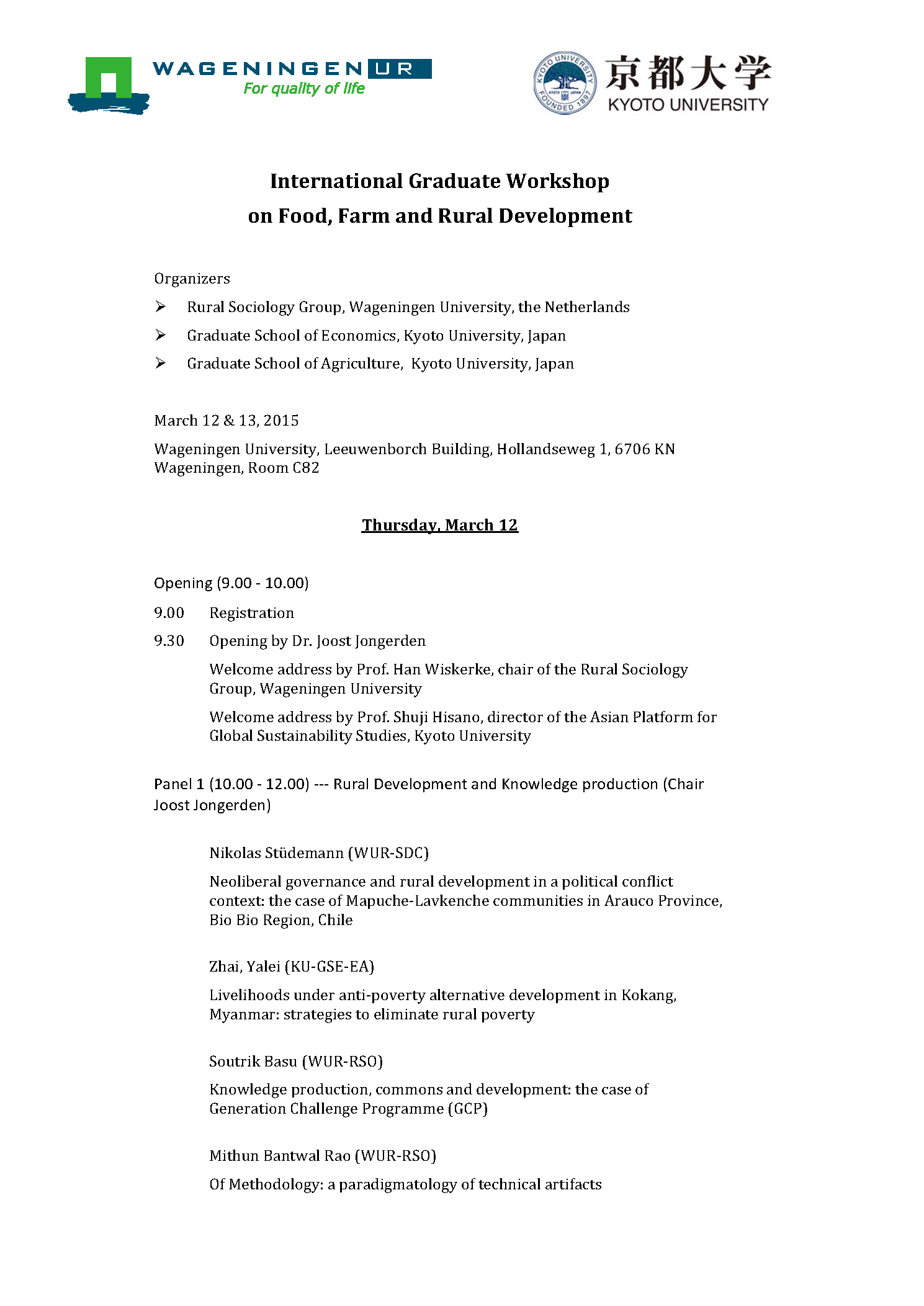

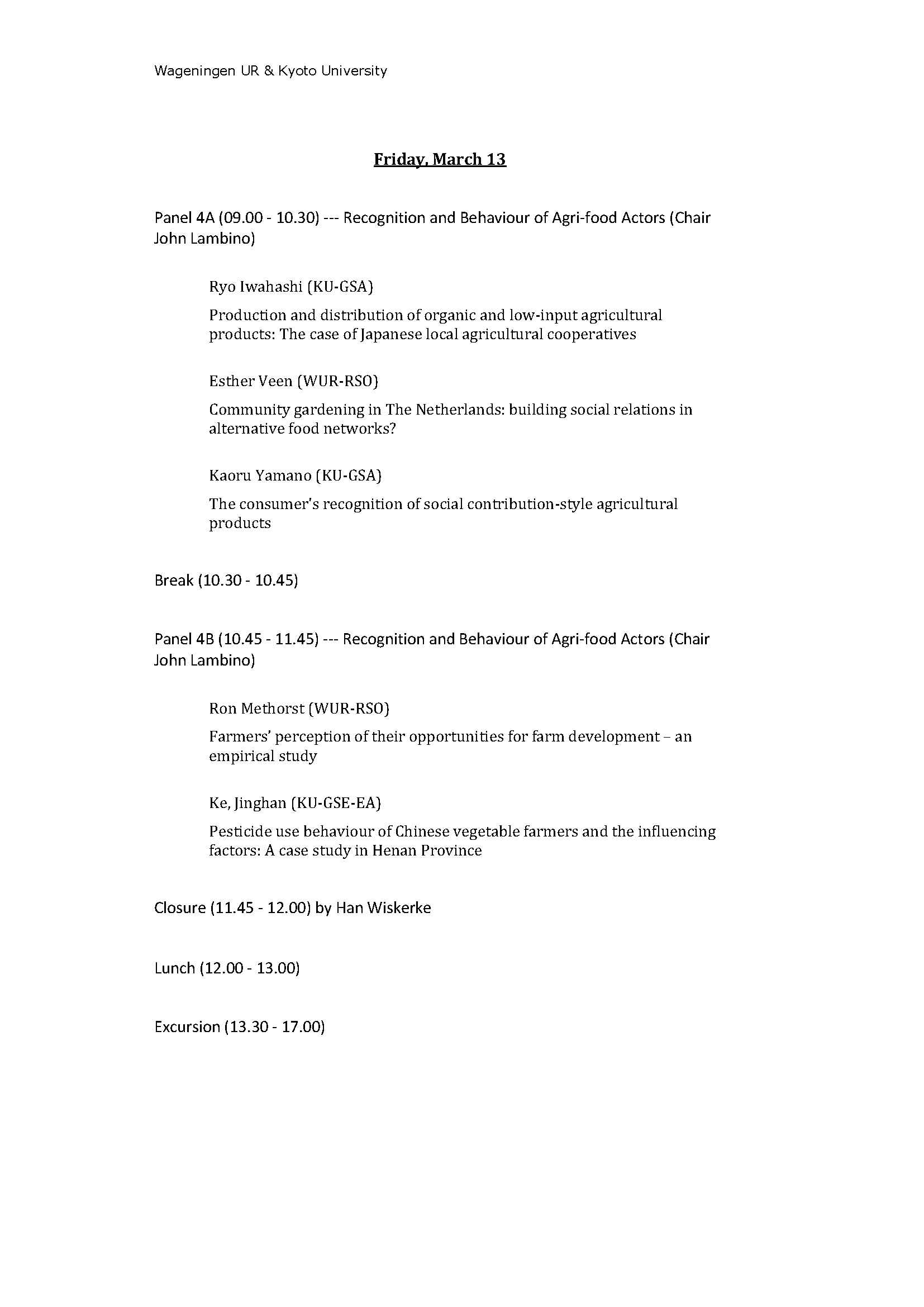
Program of the International Graduate Workshop on Food, Farm and Rural Development is available now. At the workshop PhD students of Wageningen University in the Netherlands and Kyoto University in Japan will present their research. Issues discussed are the political economy of agriculture, food-sovereignty and food security, alternative food networks and behaviour of agri-food actors in Europe, Latin America and Asia. The workshop will take place in Wageningen on March 12 and 13.Participation is free of charge but pre-registration required. For a PDF of the program, other information or registration contact Joost Jongerden at joost.jongerden@wur.nlThe workshop is organized by the Rural Sociology Group of Wageningen University, the Netherlands and the Graduate School of Economics and the Graduate School of Agriculture of Kyoto University, Japan.
International Workshop on Food, Farm and Rural Development
The Rural Sociology Group of Wageningen University, the Netherlands and the Graduate School of Economics and the Graduate School of Agriculture of Kyoto University, Japan organize a two-day workshop. At the workshop PhD students present their research. Issues discussed are the political economy of agriculture in Southeast Asia and Latin America, food-sovereignty and food security in Asia and Africa, alternative food networks in Asia and Europe and behaviour of agri-food actors in Europe and Asia. The workshop will take place in Wageningen on March 12 and 13. A program will be available in the second week of February. Participation is free of charge but registration necessary. For more information or registration contact Joost Jongerden at joost.jongerden@wur.nl
 Rural Sociology Wageningen University