
Seda Altuğ*
The scholarly debates in Ottoman /Kurdish studies regarding the Armenian and Kurdish issues from late 19th century onwards, reveals that the national question is usually viewed as a product of competing nationalisms— that is, political ideologies built around conceptions of communal belonging and statehood. The scholarship on sectarianism in the Arab Middle East, too, despite critical work in the last decade, has been dominated by rather ahistorical and primordial assumptions concerning the relationship between religion, modernity and politics in the Ottoman imperial and (post-Ottoman) colonial contexts.
However, neither ethnic nor religious identifications are fixed and unchanging social categories; their significance is bound up with political, economic, social and even epistemological projects of difference-making. Accordingly, transformation in the idioms of community- ethnic or religious- has changed over the course of the 19th century in a context of Ottoman reform (Tanzimat) and increasing European encroachment in the Ottoman Empire. Meanings attached to religion have been transformed. Religion started to get decontextualized from its secular allegiances, such as family, tribe, locality and class of which it had been an organic part.
While the existing scholarship points out (Ottoman) Mount-Lebanon for the emergence of sectarianism in the immediate aftermath of the promulgation of the Tanzimat, an analogous transformation has been taking place in Ottoman Eastern provinces in the same decade despite major differences in terms of local social, economic and political relations between Mount Lebanon and the eastern provinces. In the former case, religion had become a site of colonial encounter between a self-defined Christian West and Muslim East while the secular elites (Maronites and Druze) aimed to consolidate their respective religious communities. Whereas in the case of the Eastern provinces, the Ottoman centralization and dismemberment of the earlier contracts between the “Kurdish nobility” and the imperial centre, the Land Code (1858), the transformation of the labour relations and the property regime in the Kurdo-Armenian rural landscape instigated the sectarian question, which would soon be designated as the Armenian reform issue and would eventually be transformed into the Kurdish question.
This blog post reflects on the relationship between the politics of difference and the land question starting from the late Ottoman Empire through the post-Ottoman Syria under the French mandate. The political regimes (empire/ nation-state), the scale (Qubînê, the Beshiri plain in the province of Diyarbekir which later became a district of Siirt in modern Turkey/northeastern Syria under the French mandate) as well as the time frame that the analyses refer to vary greatly. Well aware of its problems, this blog poses questions about the relationship between transformations in the idioms of community, sovereignty and rural materiality in imperial and nation state contexts.
The rivalry over the control of land and natural resources in between the local Kurdish elites and the Ottoman state as the newcomer economic actor intensified during the reign of Abdulhamid II (1878-1914). It became a key vector in the changing conceptions of ethno-religious belonging that were transmitted back and forth from locality to state. Underlying the collapse of an economic question with the sectarian question is the concomitant transformations in the notion of religion and land in the context of increasing imperial rivalry in the Ottoman East following the Berlin treaty (1878), hence the internationalization of the Armenian issue) and Hamid II’s military measures, namely the establishment of Kurdish Hamidiye cavalry (1891) against the Russian threat and the Armenian nationalist revolutionaries. The state- sponsored violence of powerful Hamidiye regiments against mainly the Christian and Kurdish peasants resulted in the massacre and dispossession of thousands of Armenian and Kurdish peasants, fueling local identity formation primarily among Armenians and Kurds in the region and the empire at large.
With the advent of the 1908 revolution, demands for land reform, reclamation of the usurped land during the reign of Hamid II (1876–1909), and elimination of extra- legal taxes paid by the Armenian peasants to the Kurdish lords formed the main demands of the Armenian MPs in the Ottoman parliament. The land issue has apparently lost its weight in the debates on the Armenian conflict in the aftermath of the Armenian Genocide (1915), mainly because the cultivators of the land and their representatives were killed or displaced. The newly founded Turkish nation state inherited and exacerbated the nationalist property regime where one’s current (as well as former) sect defined one’s entitlement to land and natural resources. The Sheikh Said Revolt (1925), its violent repression and the Plan for Reform in the East (1926, Şark Islahat Planı) was yet another blow to the rural topography of Kurdistan which at the time had become home to a majority Kurdish population together with Islamicized Armenians, some small Christian enclaves along its southern border and a large group of recently settled Balkan/Caucasian refugees.
Following the Sheikh Said Revolt, the Syrian side of the border (binxêt, Jazira) which came under the French mandate (1921-1946) became the new refuge for the undesirables of the Turkish state, namely the Christians who survived the genocide, Kurds and political opponents of the Kemalist regime. The French sectarian politics of settlement, land distribution and urban and rural administration transformed the region to a large extent. The French envisioned the Kurdish and Christian refugees would turn into agriculturalists, the nomadic population would become shepherds, and the Christian refugees from Mardin would become shopkeepers and traders. The other Christian communities, in particular the Catholics, “with their less ardent and more civilized attitudes” would form the urban population.
The French aspiration for Jazira was to transform it into a separate space specialized in agriculture for the, by-definition, loyal Christian urban and rural populations, Kurdish peasants and Arab semi-nomads. They undertook the task of strengthening the power of pro-French rural elites, fostered the empowerment of Christian urban elites and simultaneously promoted small-peasantry through building religiously-secluded villages, distributing land or providing agricultural material to the new villagers. New villages were founded for refugees around the military posts along the riverbeds. The foundation of new villages, the settlement of newcomer multireligious Kurdo-Christian tribes and the granting of plots of land followed sectarian lines. If the infrastructural measures— such as building roads, extending the railroad from Nusaybin and pluralizing economic centres in the region—addressed the general agricultural public, religion emerged as a key feature in the distribution of land or the organization of villages.
The French attempt at founding small towns and villages on a sectarian basis (in order to attract refugees from Turkey and to counter the adverse effects of delimitation of the Turkish-Syrian border) and the increasing Christian visibility in the tiny urban space in Jazira arguably formed the spatio-economic background to the emergence of an elite-dominated sectarianism in the French Jazira in 1930s. As soon as the terms of the French colonial rule in Syria and Lebanon started to be negotiated between Paris and Damascus in mid 1930s, the political implications of the sectarian colonial development in Jazira has started to evoke opposing views between the Syrian Arab nationalists and the Jazirans as well as between the Jazirans themselves. While the majority of Jazirans opted for political and economic autonomy under the rubric of “protection des minorités”, the Arab nationalists aspired for a centralized and unitary Syria. The Jaziran issue (al-mas’ala al-jazira) evoked fear and anxiety for the Arab nationalists. They objected to the French sectarian politics of difference and viewed it as a question of national sovereignty. Throughout the violent and peaceful public debates about the Jaziran question, entitlement to land reappeared again and again both as a symbolic signifier of nationalist sovereignty as well as a material resource to be exploited by the national sovereigns.
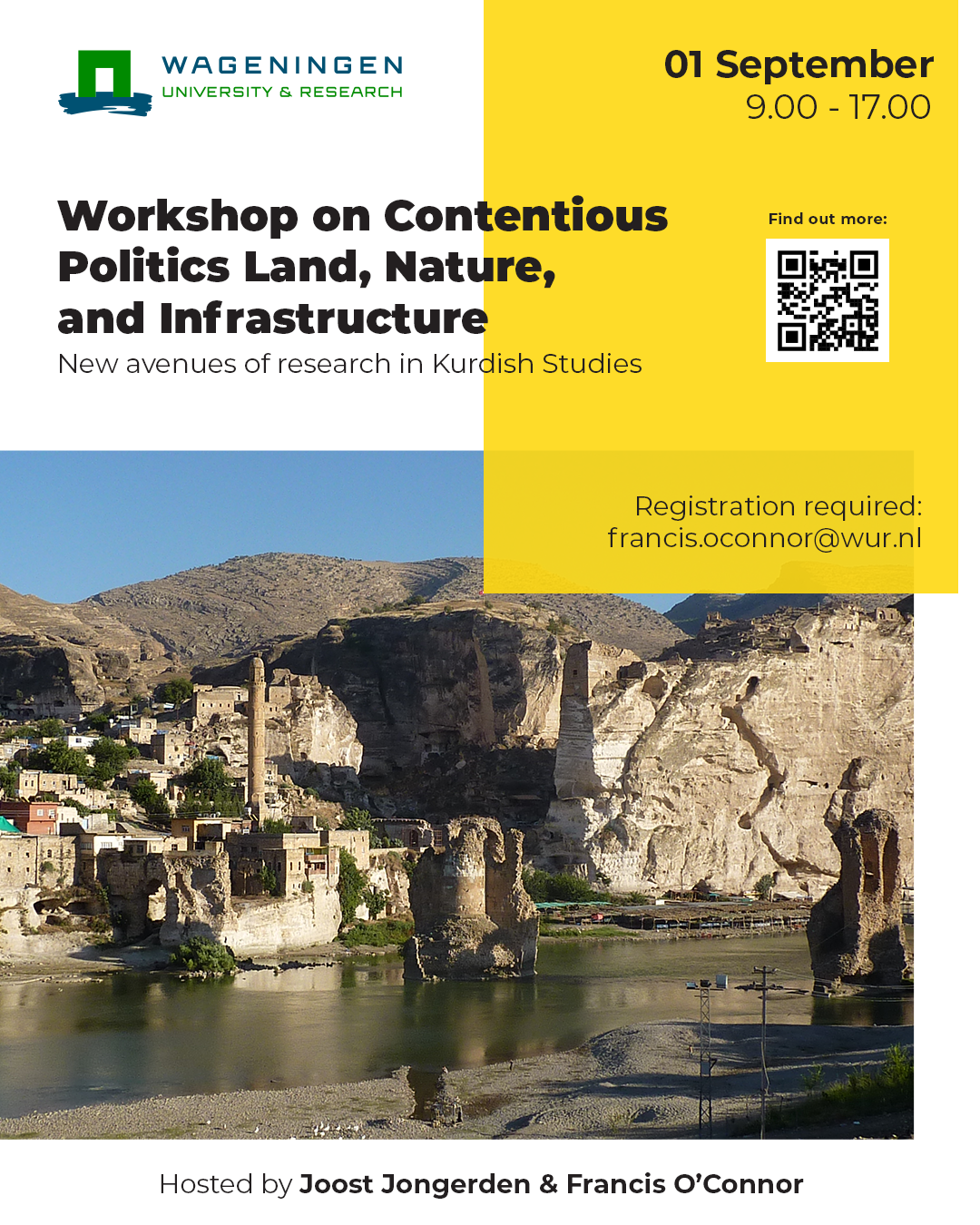
*Seda Altuğ is a lecturer at the Atatürk Institute for Modern Turkish History at Boğaziçi University, Istanbul. She will speak at the RSO workshop Contentious Politics in Kurdish Studies: Land, Nature, and Infrastructure
 Rural Sociology Wageningen University