

A year ago, my colleague Dirk Roep reached retirement age. He had organized a wonderful farewell party, where I was also supposed to give a speech to honour him, his work and his contribution to the Rural Sociology Group. Unfortunately, I had to cancel due to illness and was unable to give my speech. So now, a year later, on Dirk’s 68th birthday, I am writing down what I wanted to say a year ago at Dirk’s farewell party:
After 35 years of working for the Rural Sociology Group (and its predecessor, the Sociology Department) in various positions (and even more different employment contracts), the time has now come to enjoy a well-deserved retirement. Of those 35 years, we have known each other for 32 years, we have been colleagues for roughly 28 years, and I have been the chair of the Rural Sociology Group (and thus formally your ‘manager/supervisor’) for 20 years.
Our collaboration began in October 1992 when I started as a PhD student. You had also been appointed as a PhD student shortly before that, together with René de Bruin on a single PhD position and probably also with the expectation that you would complete your thesis in two years (and a bit), building on research you had done in previous years on farming styles in the peatland areas and on regional quality production. Those two years turned out to be a little longer, but in 2000, after many part-time appointments, you successfully defended a wonderful PhD thesis entitled ‘Vernieuwend Werken: Sporen van Vermogen en Onvermogen’ (‘Innovative Working: Traces of Ability and Inability’).
During that period of our PhD research, we found common ground in our shared interest in the emerging field of what is now called STS studies: the sociology and philosophy of science and technology. We read the works of John Law, Bruno Latour, Michel Callon, Wiebe Bijker and kindred spirits and tried to translate the insights from actor-network theory and the social construction of technology to the domain of rural sociology and apply them to our own field of research: you to a new farmers’ cheese from the peatland area (Veenweidekaas), and I to a new regional bread made from wheat grown in Zeeland (Zeeuwse Vlegel). I sometimes look back on that period with nostalgia: a voyage of discovery into both new scientific literature and new (or renewed) agricultural practices, in which we not only observed and analysed, but also, as researchers, tried to help shape change and innovation. Combining scientific progress with social impact has undoubtedly remained one of the hallmarks of your way of working.
At the end of 1996, my PhD contract came to an end and, after some freelance work, I started working at the Centre for Agriculture and the Environment after completing my PhD. You remained affiliated with the Rural Sociology Group on and off. From the late 1990s onwards, you worked as a researcher in the European IMPACT project, where you were one of the creators and founders of the well-known Rural Development triangle, formed by the processes of broadening, deepening and re-grounding.
In 2001, I returned to Rural Sociology on a part-time basis and combined this with a postdoctoral position at the Centre for Studies in Science, Technology and Society at the University of Twente in a project led by Jan Douwe van der Ploeg and Arie Rip. This project, under the acronym AGRINOVIM, built conceptually on our PhD theses on socio-technical or socio-material innovation processes in agriculture. When I was able to start working full-time at the Rural Sociology Group a year later, you took over my postdoctoral position in Twente and we were able to continue our collaboration as colleagues.
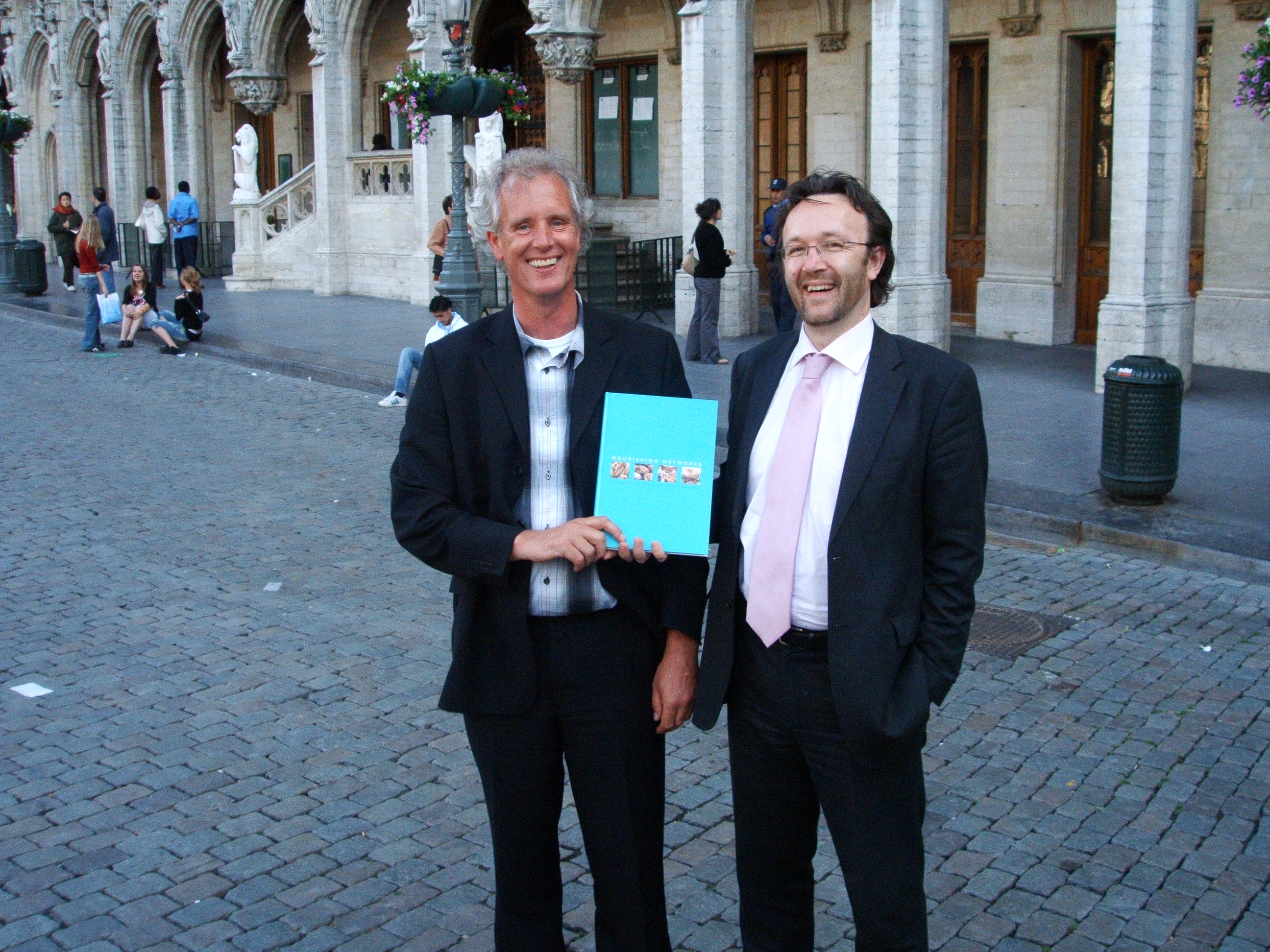
After AGRINOVIM we also collaborated in my first EU project as coordinator, the SUS-CHAIN project on new food chains/networks and their impact on rural development. In that project, too, your analytical skills came to the fore as you summarized all the empirical material from 14 European case studies in another triangle, formed by governance, embedding and marketing, and distinguished three different trajectories: chain innovation, chain differentiation and territorial anchoring. We published the results of this project in the book ‘Nourishing Networks’ and in various joint scientific articles, which are still cited to this day.
I don’t think we collaborated in other projects after that, because we each developed our own substantive focus. I focused more on food networks, including in the urban context, and you focused more on place-based development and sustainable place shaping, culminating in the successful acquisition of the Marie Curie Training Network SUSPLACE. In my opinion, this was the crowning glory of your later work. And again, you provided an innovative analytical framework and once more something triangular in nature; sustainable place shaping as the interaction of three processes: socio-cultural re-appreciation; ecological re-grounding; and political-economic re-positioning.
Despite not collaborating in EU-funded research projects, we did work together a lot in education and PhD supervision. We taught, developed and innovated courses together, and took over courses from each other. I joined you in the supervision of three of your PhD students: Wiebke Wellbrock, Ron Methorst and Syed Omer Husain. But over the past 10-15 years, we have above all collaborated a lot in the management of the chair group. You were the group’s research and education coordinator for a long time (and for a period you also fulfilled both coordinating roles) and you were my most important sparring partner: to test ideas, to think together about the strategy of the chair group, to let off steam. You gave me solicited and unsolicited advice and alerted me early on when things threatened to go off the rails or when staff members needed extra attention because they were stuck or not feeling well. Without you, I would not have made it as chair holder. And so it was only logical for me to ask you to temporarily lead the group when I was absent for almost six months in the second half of 2019 due to holidays and sabbatical.
You are an all-round rural sociologist, and this is proven by both the diversity of research topics you have worked on and the diversity of courses you have taught. Apart from a few introductory courses (Sociology and Health Sociology), I believe you have taught just about all of our courses at some point and have also coordinated, renewed and/or developed many of them. In a broader sense, at the level of the group’s education portfolio, you have also played an important role in educational innovation. About 15 years ago, we came to the conclusion that the share of education in our income was too low and that we were too dependent on International Development Studies. You then played an important role in broadening our educational offering and in anchoring it much better and more broadly in various Masters programs, which has led to a huge increase in the number of thesis and internship students and, with that, our educational income.
Dear Dirk, I will miss you enormously as a colleague and sparring partner. Above all, I would like to thank you for everything you have done for and meant to the group, but also to me personally, over the past decades. I wish you all the best in this new phase of your life and hope you and Tineke have many more wonderful years together.

