
Christhe Vreugdenhil, a student in the Master’s programme International Development Studies (MID) at Wageningen University, conducted her thesis research in Kenya. In the text below, she discusses her research, experiences, and findings. A link to her thesis is provided below.
Colonial British administration in Kenya, though fought off in the 1960s, has had a lasting impact on Kenyan education and society. During colonialism, policies enforced the banishment or suppression of indigenous languages and the imposition of English as language of instruction (LOI). Despite formal independence, this is still a reality in many Kenyan classrooms today.
While language is a mode of communication and individual expression, it is also a carrier of culture, values and social connections (Osimen et al., 2025). Many young people in Kenya are thus in danger of losing more than just their mother tongue: identity, existential frameworks (Wa Thiongo’o, 1986), intellectual traditions and indigenous knowledge that is passed on generationally (Prah, 2017), family ties and traditional values (Obiero, 2008) are also in danger. Interestingly, by recent policy changes, indigenous languages should be a subject taught in school (KICD, 2017), but it is not clear whether and how this is being implemented.
That is why the research question of my thesis was: How does English as the language of instruction impact cultural identity formation and the integration of indigenous languages in Kenyan urban and rural classrooms? In my subquestions, I focussed on pedagogical strategies concerning the use of English vs. indigenous languages, the perceived relationship between English and cultural identity, and the different challenges that rural and urban schools face.
Methodology
For this research, I interviewed sixteen teachers in Kenyan primary and secondary education. They were recruited mostly through snowball sampling. Participants had various ethnic backgrounds and taught at schools in both rural and urban areas. Questions focussed on the teaching practices of the educators, personal experiences of teachers and their perception of students’ language use and identity, and their views on rural and urban schooling. I recorded all the interviews, then transcribed, coded, and analysed them using both a decolonization and afrocentric lens.
Results
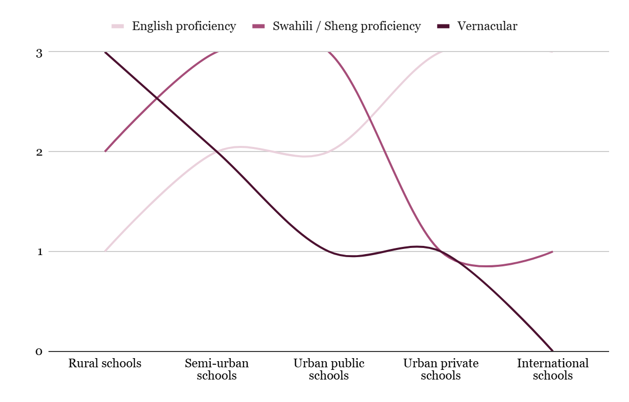
First I assessed the current state of policy implementation in Kenyan schools. The Competency-Based Curriculum (CBC), introduced in 2017, still operates predominantly using English, although many teachers admit to code-switching to other languages to increase students’ comprehension. This is especially the case in classrooms with many different ethnicities: in rural schools a local indigenous language might be mixed in, while Swahili is more common in semi-urban schools. While teachers are positive about the CBC because it is less rigid and exam-focussed than the previous system, indigenous languages have not been introduced as a subject at a single one of the participating schools. At some schools, it is even still prohibited to speak any language other than English on school grounds. This reveals the prevailing status hierarchy in languages: indigenous languages and Swahili are officially not deemed suitable for academic contexts (though used off the record), while English remains the language of the educated and professional.
I found large differences between urban and rural schools. Rural schools struggle with lack of materials, facilities, and infrastructure (like textbooks, computers, or a good internet connection). This has a large impact on rural students’ ability to practice English, academic performance and future career chances. However, since their lives are much more embedded in their mother tongues, they reportedly identify strongly with their roots and cultural background.
On the other hand, urban students tend to speak exclusively English, even at home. While they do mostly still identify with their ethnic background, the language barrier causes them to lose touch with their cultural heritage and even with family members, like their grandparents, who might not speak English (fluently).
Figure 1
Language proficiency of students compared to degree of urbanization (0 = none, 1 = low, 2 = medium, 3 = high).
Discussion
The failure of the Kenyan education system to integrate indigenous languages in the classroom has various effects. Rural students’ academic performance is impaired, hampering the development of their careers and of the Kenyan economy and society as a whole. Additionally, urban students’ connection to their cultural roots is compromised, leading to loss of culture in the long term. Different approaches to language teaching are needed in each context to ensure a nurturing academic career for each individual, as well as the ability to develop a rooted cultural identity. In order to achieve this, various changes are necessary:
- The government, schools, institutions and organisations should promote the attribution of equal status to indigenous languages, Swahili (and even Sheng, the “street” version of Swahili) and English, enabling the use of these languages in academic and professional spaces;
- Schools should act on policy and introduce Indigenous Language as a subject;
- Parents should realize their essential role in the transmission of their culture by teaching their children the language that belongs to their ethnic group and speaking it at home;
- The government should provide rural schools with the same (financial) resources as urban schools, leveling the playing field for students.
Click here to access her thesis

