Unknown's avatar

About FoodGovernance

Jessica Duncan is Associate Professor in Rural Sociology at Wageningen University (the Netherlands). She holds a PhD in Food Policy from City University London (2014). Jessica’s main research focus concerns the practices and politics of participation in food policy processes, particularly the relationships (formal and non-formal) between governance organizations, systems of food provisioning, the environment, and the actors engaged in and across these spaces. More specifically, she maps the diverse ways that actors participate in policy-making processes, analysing how the resulting policies are shaped, implemented, challenged, and resisted, and she theorizes about what this means for socio-ecological transformation. Participation and engagement is at the core of her approach. In turn, she is active in a broad range of local, national and international initiatives with the aim of better understanding participation processes with a view towards transitioning to just and sustainable food systems. She is involved in several research projects including ROBUST, HortEco & SHEALTHY. Jessica is published regularly in academic journals. She recently co-edited the Handbook on Sustainable and Regenerative Food Systems (2020). Her other books include Food Security Governance: Civil society participation in the Committee on World Food Security (2015) and an edited volume called Sustainable food futures: Multidisciplinary solutions (2017). Jessica has received several awards for her teaching and in 2017 she was awarded Teacher of the Year for Wageningen University (shortlisted again in 2018 and 2019, longlisted in 2020). With the funds she has received for these awards she launched a story-telling workshop for students and faculty, with storytelling trainer, Emma Holmes. Jessica is on the Editorial Board of the journal Sociologia Ruralis and is an advisor to the Traditional Cultures Project (USA). She is a member of the Wageningen Young Academy and sits on the Sustainability Board of Experts at Wageningen University.

‘Change agents facilitating ecologically intensive production and value chains’

Exciting PhD opportunity with Rural Sociology Group and Knowledge, Technology and Innovation Group.

FoodGovernance's avatarFood Governance

We are looking for two PhD candidates with knowledge and experience working in Chile to contribute to the project ‘Horticultural food systems based on ecologically intensive production and socio-economically sustainable value chains in the transition economies Chile and Uruguay’ (HortEco).  These are  4-year research positions at Wageningen University, with scholarships.

1) PhD position in sociology of innovation and transitions ‘Change agents facilitating ecologically intensive production and value chains’

Transitioning towards ecologically and socio-economically sustainable production and marketing require combined ecological, technological, social and institutional change. Current innovation systems in Latin American countries, including Chile and Uruguay, are oriented towards high external input agriculture, and see innovation as science-driven technological change.

Co-innovation, while successful at a small scale, requires work beyond the farm level. Public and private actors throughout the food system need to fulfil key change agency roles in the transition to ecologically intensive production and value chains providing knowledge and mobilizing…

View original post 183 more words

PhD course: Gender & Diversity in Sustainable Development

An exciting new PhD course, co-taught by two RSO faculty members: Bettina Bock and Jessica Duncan.

FoodGovernance's avatarFood Governance


Come join us in The Netherlands for this exciting course! Space is limited so apply soon! More information: http://www.wageningenur.nl/en/activity/Gender-Diversity-in-Sustainable-Development.htm 

Gender and Diversity Poster

View original post

PhD course Gender & Diversity in Sustainable Development

September 19 – October 14, 2016

 Lecturers:
Chizu Sato (SCH)
Bettina Bock (RSO)
Margreet van der Burg (SSG)
Jessica Duncan (RSO)
Elise van Nederveen Meerkerk (RHI)
Janneke Pieters (DEC)
Elisabet Rasch (SDC)


Inequality lies at the center of current debates about sustainable development, from which a number of policy issues, including Sustainable Development Goals, emanate. Yet, how social (in)equality contributes to creating sustainable development often remains invisible in research. This course enables participants to recognize linkages between gender and diversity and sustainable development in a contemporary globalising world.

The topics covered in this course are:

  • Introduction: key concepts in gender studies
  • Trends form a historical perspective
  • Economics: macro and micro perspectives
  • Work and care
  • Population and migration
  • Food security and governance
  • Environment and natural resource management
  • Global politics

The last topic will be covered in a public lecture by Prof. dr. Melissa Leach (the Director of the International Development Studies at the University of Sussex, UK) who will connect global policy and local practice in support of sustainable development from a gender and diversity perspective.

Topics will be surveyed from perspectives that attend to the intersecting diverse dimensions of inequality, such as gender, race, ethnicity, social class, and nation, to mention just a few. Intersectional perspectives will be put in context in time and place to explain changing constructions, perceptions and interpretations of inequality. This course examines sustainability historically, as well as both in the global South and the global North, illuminating differences across time and geographical locations and their dynamic interactions.

Course outline  Registration


Open access to special issue: Soy production in South America

FoodGovernance's avatarFood Governance

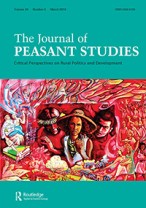
FJPS 42_5-6 Cover.indd
The Journal of Peasant Studies has just published a new Special Issues: Soy production in South America: Globalization and New Agroindustrial Landscapes. The Guest editors are Gustavo de L. T. Oliveira and Susanna B. Hecht.

The entire collection (15 articles) is freely available for a limited time!

Summary of the Issue:

Soy in South America constitutes one of the most spectacular booms of agroindustrial commodity production in the world. It is the pinnacle of modernist agroindustrial practices, serving as a key nexus in food-feed-fuel production that underpins the agribusiness-conservationist discourse of “land sparing” through intensification. Yet soy production is implicated in multiple problems beyond deforestation, ranging from pesticide drift and contamination, social exclusion and conflicts in frontier zones, concentration of wealth and income among the largest landowners and corporations. This volume explores in depth the complex dynamics of soy production from its diverse social settings to its transnational connections, examining…

View original post 52 more words

Feeding the City Summer School in Brescia, Italy

FoodGovernance's avatarFood Governance

Last year I taught in this Summer School and I am excited to be a part of it again this year as we explore how to feed cities.

For more information contact: segreteria_dmmt@med.unibs.itFeeding the city Summer School

View original post