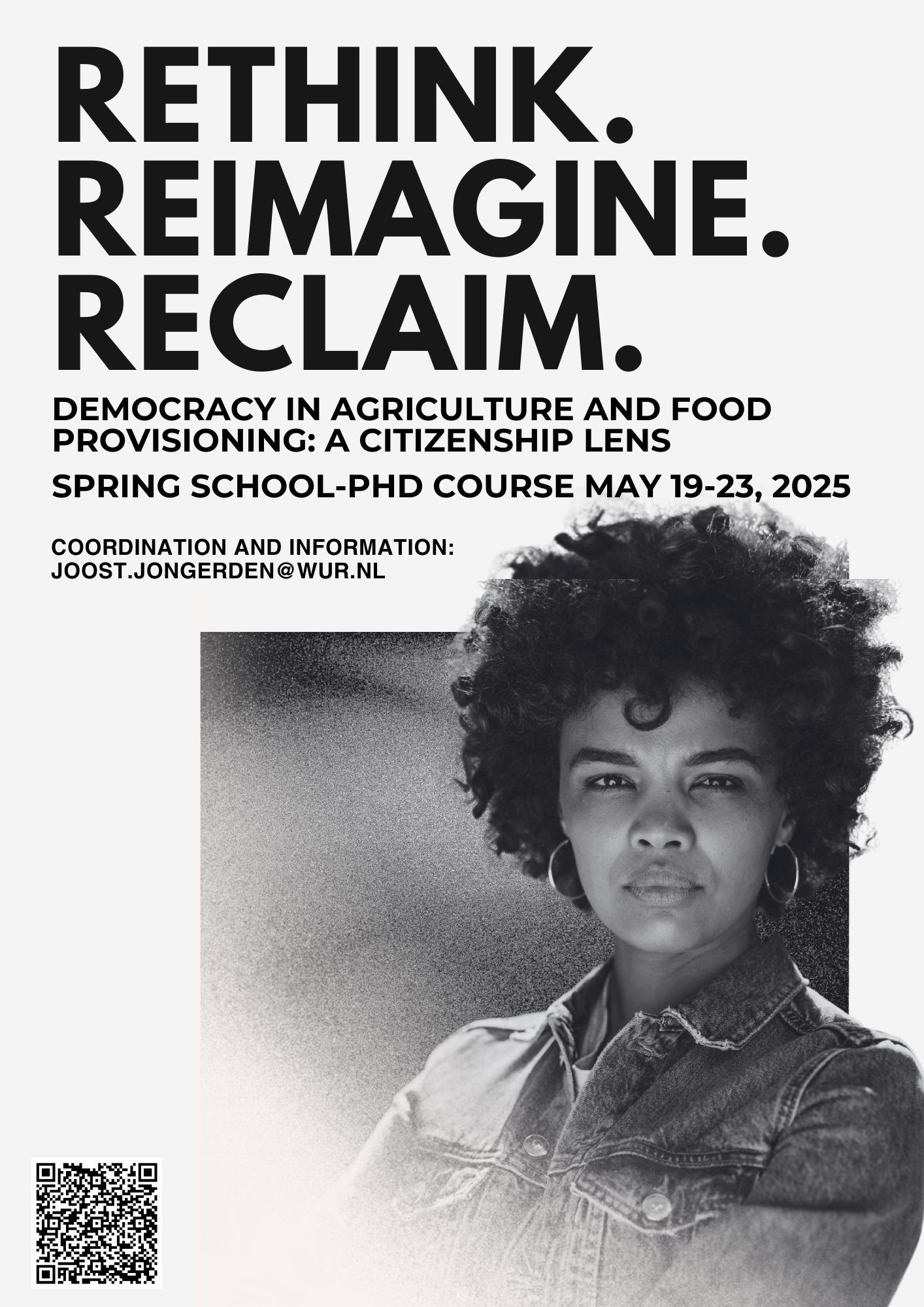
Spring School | Rethink. Reimagine. Reclaim.

𝗥𝗲𝘁𝗵𝗶𝗻𝗸 the way citizenship shapes our agricultural and food systems. Engage with critical debates on justice, fairness, and the democratization of food provisioning.

𝗥𝗲𝗶𝗺𝗮𝗴𝗶𝗻𝗲 agriculture through the lens of agrarian and food citizenship. Explore how individuals and movements challenge existing systems and build equitable alternatives.

𝗥𝗲𝗰𝗹𝗮𝗶𝗺 agency in shaping the future of food and agriculture. Learn how acts of citizenship drive meaningful change toward fairer and more inclusive systems.

Join us in this graduate course, 𝗗𝗲𝗺𝗼𝗰𝗿𝗮𝗰𝘆 𝗶𝗻 𝗔𝗴𝗿𝗶𝗰𝘂𝗹𝘁𝘂𝗿𝗲 𝗮𝗻𝗱 𝗙𝗼𝗼𝗱 𝗣𝗿𝗼𝘃𝗶𝘀𝗶𝗼𝗻𝗶𝗻𝗴: 𝗔 𝗖𝗶𝘁𝗶𝘇𝗲𝗻𝘀𝗵𝗶𝗽 𝗟𝗲𝗻𝘀 (May 19–23, 2025). Participate in seminars, workshops, and excursions led by leading scholars like Engin Isin and Cristina Grasseni, and contribute to envisioning just and sustainable futures.

More information and registration.

Publication | “Being in Relation: Art as Ecology”

Publication | Proud to share the publication of our colleague YiLing Hung in the online journal APRIA – a journal for artistic research. For this edition the theme was “Being in Relation: Art as Ecology”. 

YiLing’s article is written from the perspective of a performance maker in responding to the theme: Art as Ecology. Performance creates a new ‘in-between’ space—the imagined place between the real and the fictional world, which is situated inside the heads of the spectators. We can say performance ‘makes space,’ opening up the possibility for everyday space to become ‘strange, wondrous, and provocative.’ As a performance maker, she has been attempting to find answer(s) to the question: Where is the line that separates a daily life event and a (theatrical) performance? This article is a self-reflection and further articulation on her performance work Moving On/ Vanishing, which was created in 2018 and was invited for performance again during the Prague Quadrennial of Performance Design and Space (PQ) in 2023.

Read the article here.

Video series | Georgia Diamanti: Contributing to inclusive agricultural policies through collaborative research.

Georgia Diamanti, PhD candidate at the Rural Sociology Group, shares her experience working on the SWIFT project, focusing on the impact of European agricultural policies on women farmers and the importance of collaborative, bottom-up approaches.

“As a PhD candidate at the Rural Sociology Group, I’m proud to be part of the SWIFT project, working with diverse stakeholders to create more inclusive agricultural policies in Europe. This collaborative approach inspires me, knowing that even small contributions can be part of a larger transformation.”

Find out more about the SWIFT project here.

Sociale rechtvaardigheid begrijpen vanuit ‘verbranding’: jonge mannen op het platteland

Jolien Klok, onderzoeker bij de vakgroep Rurale Sociologie, Wageningen Universiteit

Het publieke debat rondom ‘de kloof tussen stad en platteland’ lijkt even bedaard, terwijl we – de één rijkhalzender dan de ander – wachten tot het nieuwe kabinet zijn plannen uitwerkt en daarin kleur zal geven aan het Nederlandse platteland. Hoewel er vanuit de wetenschap geluiden klinken dat het al teveel herhalen van een veronderstelde ‘kloof’ haar reproductie alleen maar zal doen toenemen (Huijsmans & Miltenburg, 2023; Van den Berg, 2023), als een self-fulfillingprophecy, is het onmiskenbaar dat sociale ongelijkheid zich ruimtelijk manifesteert en met name op het platteland gevoeld wordt (Huijsmans, 2023; Van Vulpen, 2023).

Continue reading

Are Forests Still Relevant for the Nutrition Security of Traditional Forest Dwellers? Insights from One Year of Fieldwork in Kalahandi, Odisha

By Amrutha Jose Pampackal – Forests have garnered a lot of attention in international policy discussions in recent years because of their role in addressing the rising challenges of biodiversity loss and climate change. Less discussed is the importance of forests for the sustainability of many local food systems. Across the globe, billions of people live in proximity to forests and are directly or indirectly dependent on them for their food security. While some view traditional forest dwellers as protectors, others view local people’s dependence on forests as a threat to forests’ health. As part of my PhD research, I study how the nutritional security of forest-proximate communities can be strengthened without increasing the socioeconomic and ecological pressures on forests.

Continue reading