The Rural Sociology Group of Wageningen University will celebrate its 75th Anniversary on the 13th of May 2022. Join our event entitled “Rural Sociology: past, present and future” and reflect upon the past and present of rural sociology and discuss its future challenges.
As part of its counter-insurgency strategy to reclaim the countryside in southeast Anatolia from the Kurdistan Workers’ Party (Partiya Karkerên Kurdistanê, PKK), the Turkish Armed Forces evacuated and destroyed rural settlements on a massive scale in the 1990s. According to official figures, 833 villages and 2,382 small rural settlements, totalling 3,215 settlements, were evacuated and destroyed in fourteen provinces in the east and southeast of Turkey. Several plans for resettlement or the controlled rural return of Kurdish villagers had already been made and discussed when the evacuations took place. It took until 2001, however, for a comprehensive plan to be released, one that, as it turned out, was more concerned about the settlement structure in Turkey than with the forced migrants, and this must be seen against the background of the Kemalist elite in Turkey, which has been preoccupied with the production of places and people as bearers of Turkish identity since the establishment of the Republic.
This Capita Selecta course is organized by Stichting ReGeneratie in collaboration the Rural Sociology chair group. The course is not funded by the university and contains many excursions. We therefore need to ask a course fee of €100 person for traveling, meals and tours. You will be visiting the oldest food forests and meet the key players in food forestry in the Netherlands. You can register yourself by completing this form.
August 30, 2023, 13.30-15.00 Claudia Oviedo Rodriguez will defend her PhD-thesis titled The Promised Transformation: Mexican Coffee Policies During the Administration of President López Obrador during a ceremony in the Auditorium of the Omnia building of Wageningen University. The ceremony will be live broadcasted: a link will appear five minutes before the start in the events box (upper left of the screen). See the Abstract below. The full thesis can be downloaded once the embargo has been lifted: clicking its DOI. The paper Incorporation of different types of farmers into different coffee marketsis published open access in the Canadian Journal of Development Studies. Contact: claudia.oviedo.rodriguez@outlook.com.
Abstract This thesis analyses Mexican coffee policies during the administration of President Andrés Manuel López Obrador (AMLO). It builds on approaches of state theories, agrarian political economy, and global value chain studies, and contributes to debates regarding the role of the state in small farmers’ livelihoods. The thesis is based on a case study analysing implementation of rural policies in the Soconusco region of Chiapas, and contains four empirical and analytical chapters. Chapter 1, “Evolution of Coffee Policies in Mexico”, addresses how the interests of the state and its mechanism of support to coffee farmers evolved from the time this crop was introduced to Mexico until the start of the AMLO administration. Chapter 2, “Incorporation of Different Types of Farmers into Different Coffee Markets”, discusses social differences among beneficiaries of rural programmes and the conditions under which different types farmers are incorporated into the market. Chapter 3, “Arabica, Robusta, and the Narrative of Quality Coffee”, analyses collaboration and conflicts among the state, small-scale farmers, farmer organizations, and the coffee processing industry with respect to formulation and implementation of coffee policies. It also explores the role of quality in the politics of coffee. Chapter 4, “AMLO’s Rural Programmes and Elimination of Intermediaries” discusses achievements and weaknesses of rural programmes, paying particular attention to the AMLO administration’s strategy of bypassing farmer organizations upon providing agricultural subsides. The aim of this thesis is to understand how a radical transformation that has been promised by the Mexican state influences social relationships among the state, small farmers, farmer organizations, and the coffee processing industry.
In March 2023, three Rural Sociology Group researchers (and one RSO intern) attended the kick-off meeting for the EU-funded SWIFT project. RSO leads the part of the project on Gender-Responsive Rural Policies across the EU, with Oxfam Belgium.
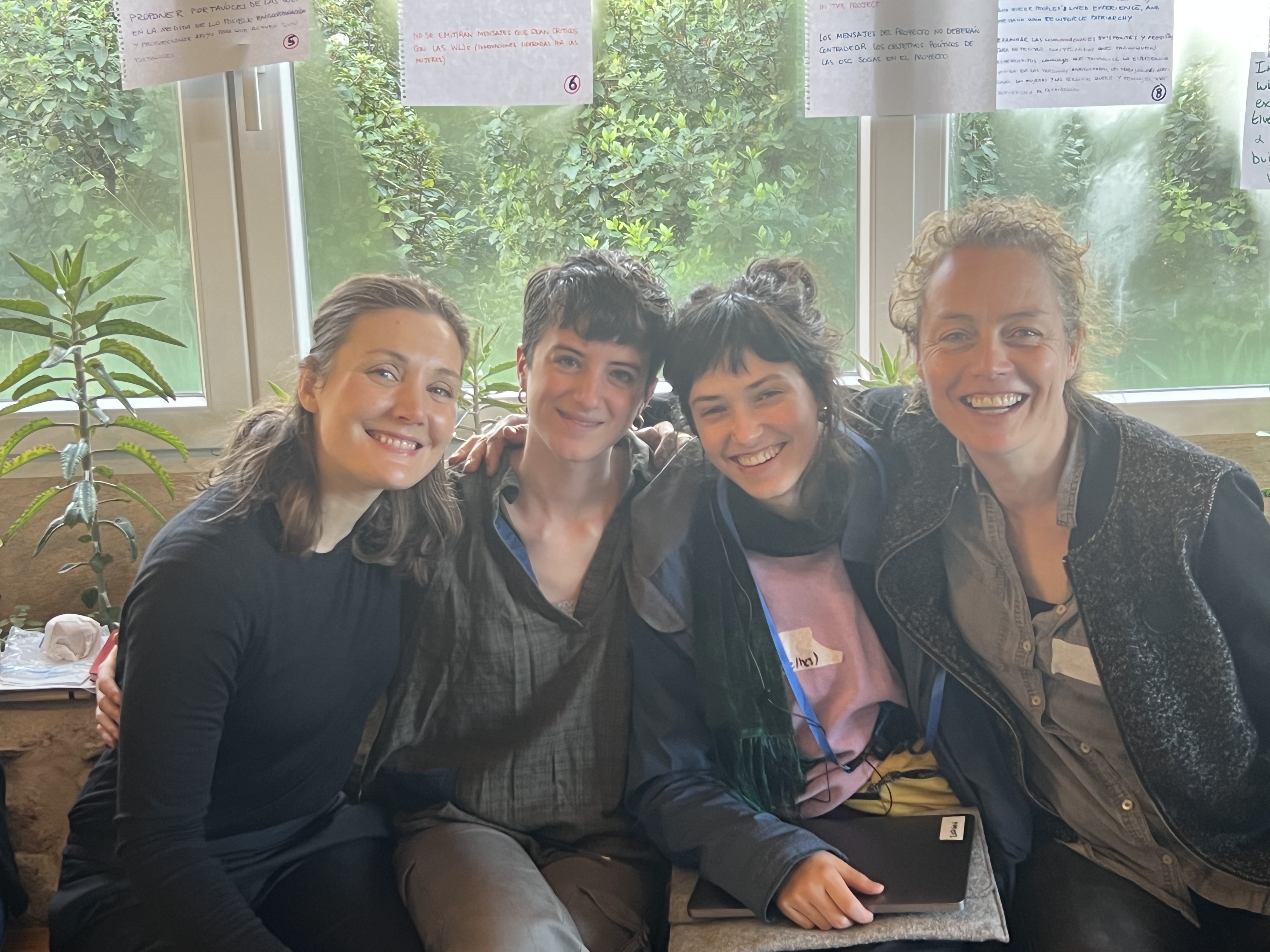
Jessica Duncan, Georgia Diamanti, Greta Capaite, Els Hegger from RSO participate in the SWIFT meeting in Agres, Spain
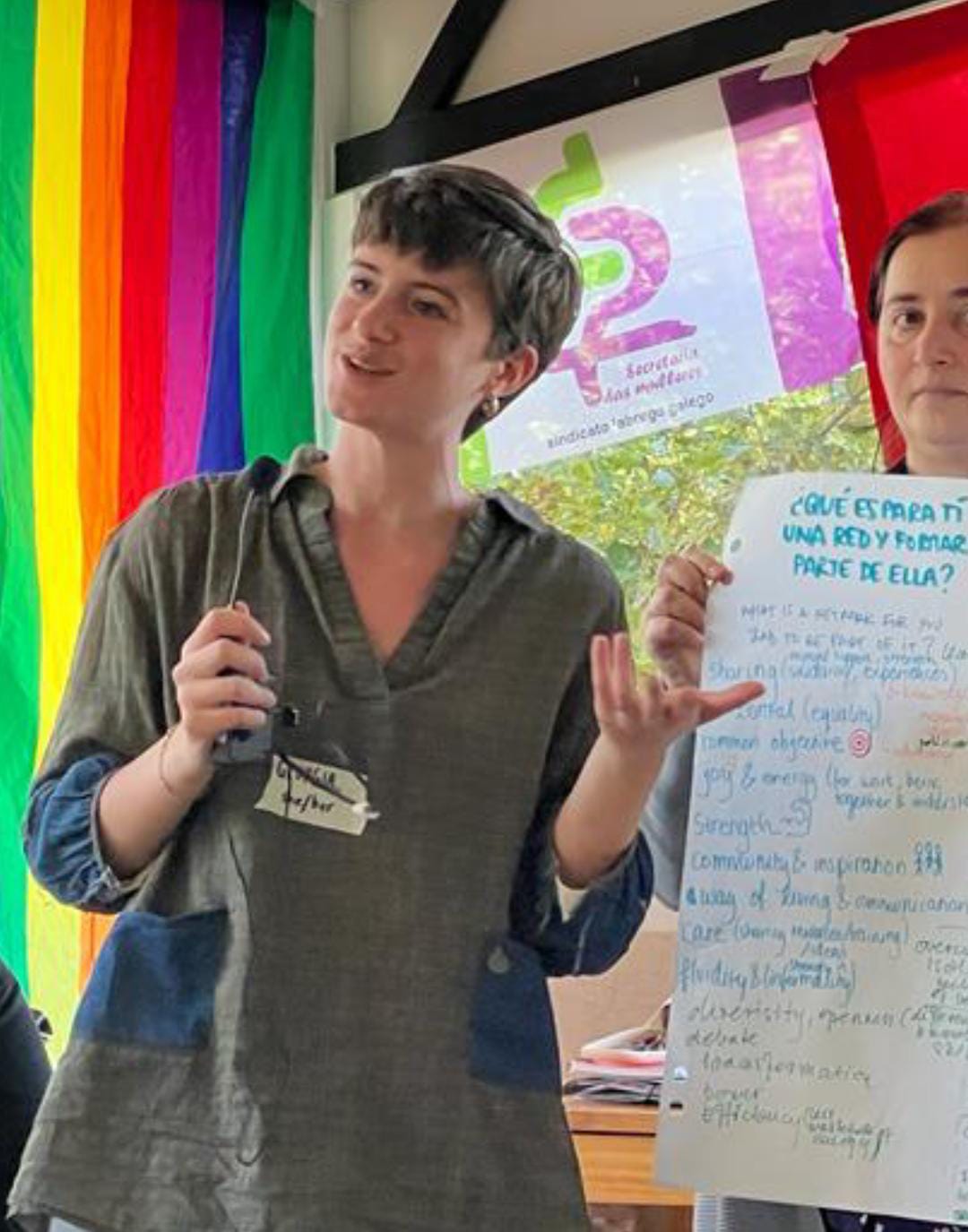
In what follows, SWIFT researcher Georgia Diamanti shares some of her experiences and reflections.
What is the SWIFT project?
SWIFT, which stands for Supporting Women-Led Innovations in Farming and Rural Territories, is a Horizon Europe project set up with the purpose to advance the position of women and LGBTQI+ persons in farming, and to moreover investigate how agroecological processes can promote gender equality. Agriculture is masculine: only 30% of all agriculture in Europe is practiced by women and, when you go higher up, at the relevant policy decision-making boards, women are almost absent. It is against this context that SWIFT is operating.
At the time of the project meeting, I had just been working at Wageningen University and on this project for a little over a month but was quite excited at the prospect of getting to join the rest of the project members in Spain for our kickoff meeting. The organizations and institutions that were part of SWIFT were spread across Europe and as such we mostly only knew each other over Zoom meetings.
We arrived on Sunday evening, following a scenic drive through the Spanish mountainside – just as the sunset’s final colors filtered through the trees. The house we were to spend the coming week, “Riera d’Agres”, was a beautifully restored property that used to function, as we later found out, as a children’s farm camp. Here, children were taught agroecological principles and a consciousness of the work that goes into getting food on a plate. It felt like a very fitting venue for the occasion. Slowly, we gathered in the dining hall.
SWIFT participants rest and connecyt outside Riera d’Agres
As we sat for our first dinner, persons who we had thus far known only as faces on our screens began one by one to materialize. After handshakes and warm hugs were exchanged, people seemed to enter into lively conversations. It was clear how we were all connected by common interests and values. It made coexistence feel comfortable and natural, almost from the very start. Amidst the excitement to have made it and to find ourselves in such a beautiful place after a long journey (that had preceded for the majority of us) there was also a detectable feeling of uncertainty, about what was to come in these 5 days we were set to spend in Agres. Not much later, satiated by the flavourful food that was served to us by our hosts, we retired to our rooms for the night, excited for the week to begin.
To give some context to the week, it was to be split into two parts overall; Monday and Tuesday were for the SWIFT group to get introduced, and to brainstorm about project expectations, concerns, etc., while Wednesday to Friday was to be focused on bringing in the experiences of the WLIs. For this part, women (and one non-binary) farmers were invited to join in our activities, while also being given the space to share their experiences and desires for the project.
The very logic behind SWIFT was for it to grow in a more organic, bottom-up approach – one that incorporated the experiences of those affected by the policies within the process itself. To make the producers from research object to research subject. Here, we were even joined by three women who had come all the way from Brazil who worked with various feminist and agroecological organizations, and Maggie who operated an LGBTQI+ farm in New York. While not directly under the scope of SWIFT (which focuses on the EU) their purpose was to share and inspire – something which they most definitely did.
The latter part of the week was the more emotional one. Seeing the women speak about their experiences and the emotion with which they articulated their troubles, concerns, and hopes resonated visibly with the rest of the group. I recall briefly scanning the room while one of the producers was speaking, only to find tears gleaming in many of the attentive faces as we listened together. It was nice to see that not only had the space we’d created allowed so many of us to be open and vulnerable but also that this process was growing as intended, in collaboration with those whose lives the research concerns.
During the final days, we spoke also of concrete ways in which to help achieve the goals of SWIFT – here I refer not only to our strict deliverables to the EU but also further ways through which the project could truly be of assistance to the Women Led initiatives (WLIs) and their daily struggles. We talked a lot about the possibility (and responsibility) of research as a form of activism. And so, although it’s true that SWIFT had a lot of policy-related deliverables, we also spoke of how we could, in parallel work to change the general narrative; speaking even of facilitating a feminist school or a documentary (ideas that seemed to receive high support from the majority).
If anything, even the academic literature itself continuously points out cultural norms and normative expectations as barriers to women being able to realize their full potential, particularly in the developed world where strict legal barriers to land ownership are not present as they are in developing countries but where barriers nevertheless persist. As such, while collaborating with EU institutions is important, other soft-power strategies may be worth investing in.
—
Georgia Diamanti is a Researcher with the SWIFT project. She has been working on this since February 2023. She holds an MSc in Political Science from the University of Amsterdam and will soon start a PhD in the Rural Sociology Group on gender and rural policies, with a focus on social and environmental sustainability.




 Rural Sociology Wageningen University