Unknown's avatar

About FoodGovernance

Jessica Duncan is Associate Professor in Rural Sociology at Wageningen University (the Netherlands). She holds a PhD in Food Policy from City University London (2014). Jessica’s main research focus concerns the practices and politics of participation in food policy processes, particularly the relationships (formal and non-formal) between governance organizations, systems of food provisioning, the environment, and the actors engaged in and across these spaces. More specifically, she maps the diverse ways that actors participate in policy-making processes, analysing how the resulting policies are shaped, implemented, challenged, and resisted, and she theorizes about what this means for socio-ecological transformation. Participation and engagement is at the core of her approach. In turn, she is active in a broad range of local, national and international initiatives with the aim of better understanding participation processes with a view towards transitioning to just and sustainable food systems. She is involved in several research projects including ROBUST, HortEco & SHEALTHY. Jessica is published regularly in academic journals. She recently co-edited the Handbook on Sustainable and Regenerative Food Systems (2020). Her other books include Food Security Governance: Civil society participation in the Committee on World Food Security (2015) and an edited volume called Sustainable food futures: Multidisciplinary solutions (2017). Jessica has received several awards for her teaching and in 2017 she was awarded Teacher of the Year for Wageningen University (shortlisted again in 2018 and 2019, longlisted in 2020). With the funds she has received for these awards she launched a story-telling workshop for students and faculty, with storytelling trainer, Emma Holmes. Jessica is on the Editorial Board of the journal Sociologia Ruralis and is an advisor to the Traditional Cultures Project (USA). She is a member of the Wageningen Young Academy and sits on the Sustainability Board of Experts at Wageningen University.

Call for Paper Abstracts – Sustainable and Just Rural Transitions: Connections and Complexities

FoodGovernance's avatarFood Governance

XIV World Congress of Rural Sociology
August 10-14, 2016,  Toronto, Canada
Call for Paper Abstracts: Open May 19 – November 1, 2015
Sustainable and Just Rural Transitions: Connections and Complexities
Global environmental changes, shifting resource scarcities, deepening social inequalities, both innovation and crisis in urban centers, and new patterns of voluntary and involuntary migrations are among the conditions and dynamics now shaping the futures of rural places and people. Intensifying and intertwining forces of commodification, industrialization,  neoliberalization and globalization over the last several decades have produced uneven and arguably illusory gains, given evidence of the increasingly precarious position of labour and livelihoods throughout the rural world and the widespread distribution of environmental harm and ecological degradation. Within these general patterns and trends, circumstances can vary greatly across rural contexts within and between continents.
Rigorous analysis of the interconnected challenges now experienced by rural people and places, as well as…

View original post 275 more words
Professor Bettina Bock asks “what future do we want for the country side?”

Dr. Bettina Bock from the Rural Sociology Group, also Professor of Population Decline and Quality of Life for the Northern Netherlands at Groningen University,  is in the news asking questions about the future of the Dutch country side. Check out here interview here: Bock Interview

Apologies but it is only available in Dutch.

International Masters in Rural Development: Field Visit to Soc Trang Province, Vietnam

FoodGovernance's avatarFood Governance

As I explained last week, I am representing the Rural Sociology Group in a case study summer programme organized by Can Tho University’s Mekong Delta Development Research Institute.

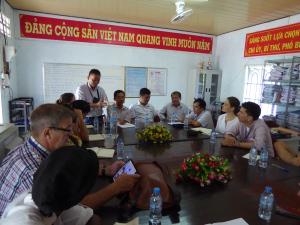
Meeting with district representatives of the Ministry of Agriculture and Rural Development Meeting with district representatives of the Ministry of Agriculture and Rural Development

On Friday, August 7th, the Case Study group visited two areas in the Soc Trang province of Vietnam. The first stop was a visit to a district office of the Ministry of Agriculture and Rural Development. Here, students and staff were able to ask officials questions related to their selected research topics and interests. One policy initiative we learnt about was a plan to increase the number of dairy cows in rural areas as a poverty reduction strategy. This programme stems from the national Agricultural Restructuring Plan where key crops and animals were identified, dairy cows being one of them.

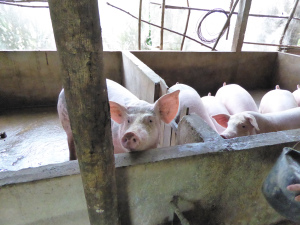
Pigs for bio gas and food Pigs for bio gas and food

From…

View original post 308 more words

Mekon Delta Case Study: Agricultural transformation in developing countries under contexts of urbanization and climate change

Welcome to Can Tho University

Welcome to Can Tho University

For the month of August the Mekong Delta Development Research Institute (MDI) is hosting a summer school case study on Agricultural transformation in developing countries under contexts of urbanization and climate change- the case of the Vietnamese Mekong Delta, for the International Master of Science in Rural Development (IMRD) programme from Ghent University.  Wageningen’s Rural Sociology Group is involved in the IMRD programme and as a result, I was able to come and participate in a supportive capacity for the first two weeks.

Case Study Participants at Can Tho University

Case Study Participants at Can Tho University

About the Mekong Delta Development Research Institute (MDI)

MDI is an interdisciplinary organization of Can Tho University (Can Tho, Vietnam). It was established in 2005 from the Mekong Delta Farming Systems Research and Development Institute. MDI has the mission to “improve life quality of rural people and ensure socio-economic and environmental sustainability of the Mekong Delta through collaborative education, research and development activities”. It also has four research programmes:

  • Food security
  • Agriculture resources management
  • Rural development
  • Climate change, adaptation and mitigation.
Visiting a collection of  farming and aquaculture tools

Visiting a collection of farming and aquaculture tools

Boating on the Mekong River

Boating on the Mekong River

Continue reading

Health and climate change: policy responses to protect public health

FoodGovernance's avatarFood Governance

A long awaited report from the Lancet / UCL Commission on Climate Change and Health has just been published called “Health and climate change: policy responses to protect public health”

You need to register to The Lancet to access the report but registration is currently free.

There are quite a few references to food security, including this statement challenging assumptions around sustainable intensification:

Panel 4: Food security, climate change, and human health

The provision for global food demand by 2050 cannot assume improved crop yields through sustainable agricultural intensification because of the negative effects on crop growth from an increased frequency of weather extremes. Multifunctional food production systems will prove important in a warmer world. These systems are managed for benefi ts beyond yield, and provide multiple ecosystem services, support biodiversity, improve nutrition, and can enhance resilience to shocks such as crop failure or pest outbreaks (p 16).

There is also a supplementary video 

View original post 41 more words