Het verhaal van Josette

Marleen Buizer*

Met plezier stel ik Josette aan u voor. Josette heeft het bedrijf van haar ouders kunnen overnemen. Niet te groot, niet te klein, met 70 hectare voldoende om van te leven. Josette is trots, op de flinke koppel Blaarkoppen en MRIJ-dubbeldoel koeien die ze op haar land houdt. De sterke dieren kunnen het ruwvoer afkomstig van het ruige grasland goed verteren, en hoewel haar koeien niet véél vlees produceren, worden ze alom gewaardeerd voor de heerlijke smaak van hun vlees. Dat geldt trouwens ook voor de melk en de kaas, de belangrijkste producten van Josettes bedrijf. Ze probeert met haar gezin het bedrijf draaiende te houden op een manier waarvan ze denkt dat die toekomstbestendig is.

“Pleeg geen roofbouw”, was altijd het pleidooi van haar ouders, en “geef je ogen altijd goed de kost”. Dat soort uitspraken blijven hangen. Dat “geef je ogen altijd goed de kost” heeft Josette héél letterlijk genomen. Ze kijkt trouwens niet alleen met haar ogen, maar ruikt ook aan de grond en voelt hoe kruimelig van structuur en droog of vochtig die is. Geregeld gaat ze op haar knieën in het gras, schraapt de grond een beetje om, onderzoekt wat voor beestjes ze tegenkomt, graaft een beetje verder en laat de grond door haar handen gaan. Ze bewondert dan de kruiden, en ziet dat ze gezond zijn. Eén van de blaarkoppen komt vandaag lekker tegen haar aan staan, dat kriebelt en ze duwt een beetje terug. Ze kan zich niet herinneren dat dit specifieke dier dit eerder heeft gedaan – ze is zeker in een aanhankelijke bui. Maar toch maar even voelen aan de horens, zou er iets zijn? Maar alles voelt goed, en even later ziet Josette het dier vreedzaam wat gras herkauwen. Ze gaat weer op haar knieën, en constateert tevreden dat er heel wat kruiden in haar gras staan. Géén strakke lappendeken van Engels raaigras hier. En geen Heermoes of Jacobs Kruiskruid te bespeuren! Ze heeft wat geëxperimenteerd, vorig jaar, door nieuwe kruiden te zaaien. Dat had te maken met het grondwaterpeil dat in overleg met het waterschap omhoog is gebracht. Ze was door de vernatting toch wat huiverig voor leverbot en maagdarmwormen. Vanwege de kosten en het risico op resistentie weigert ze chemische middelen te gebruiken tegen de parasieten. Vandaar de experimenten met kruiden. En verdorie, het werkt!

Continue reading

Call for working groups

Navigating Rural Transitions: Exploring liveable futures

European Society for Rural Sociology
July 7-10, 2025
Riga, Latvia

Submit a proposal to convene a Working Group for the next ESRS conference.

Our focus

The 2025 ESRS conference will take up the theme of ‘Navigating rural transitions:  Exploring liveable futures’.

As we navigate ongoing transitions, an exploration of  liveable rural futures calls on us to consider the diverse range of challenges and possibilities that lie ahead: from a just, sustainable, and ‘worth living’ futures for all, to survivable or even catastrophic futures, and everything in between. 

Understood this way,  the pursuit of a liveable rural future requires engagement with critical social-political and social-ecological questions related to, among others, farming, agriculture, and food systems, justice and discriminations, the politics of knowledge, social mobilisations and agency, migration and mobility, technologies, connections and solidarity, care and hope. Additionally, the importance of (local) democracy, collective action, and the development of (relatively) autonomous forms of organisation in rural areas, such as the rural commons, may also be considered.

Addressing these topics means engaging with the lived experiences and practices of people today, while also taking into account what they aspire and hope for. This requires working with, questioning and developing new theories and methods. It also requires discussions about the roles of  researchers and what type of actions are needed.

With this in mind, we welcome proposals for Working Groups (WG) that seek to explore and advance understandings of what is happening and what needs to happen to ensure liveable rural futures in the face of continuing uncertainty and multiple, intersecting, and ongoing ‘crises’. In particular, we are interested in proposals for WGs that interrogate and engage with the different dynamics, practices,  tensions, contradictions, and entanglements involved in realising liveable rural futures.

We invite contributions in a variety of formats: academic presentations and round-tables, audio/video materials, live performances (music, drama, poetry), photo or art exhibitions, and others.

Continue reading

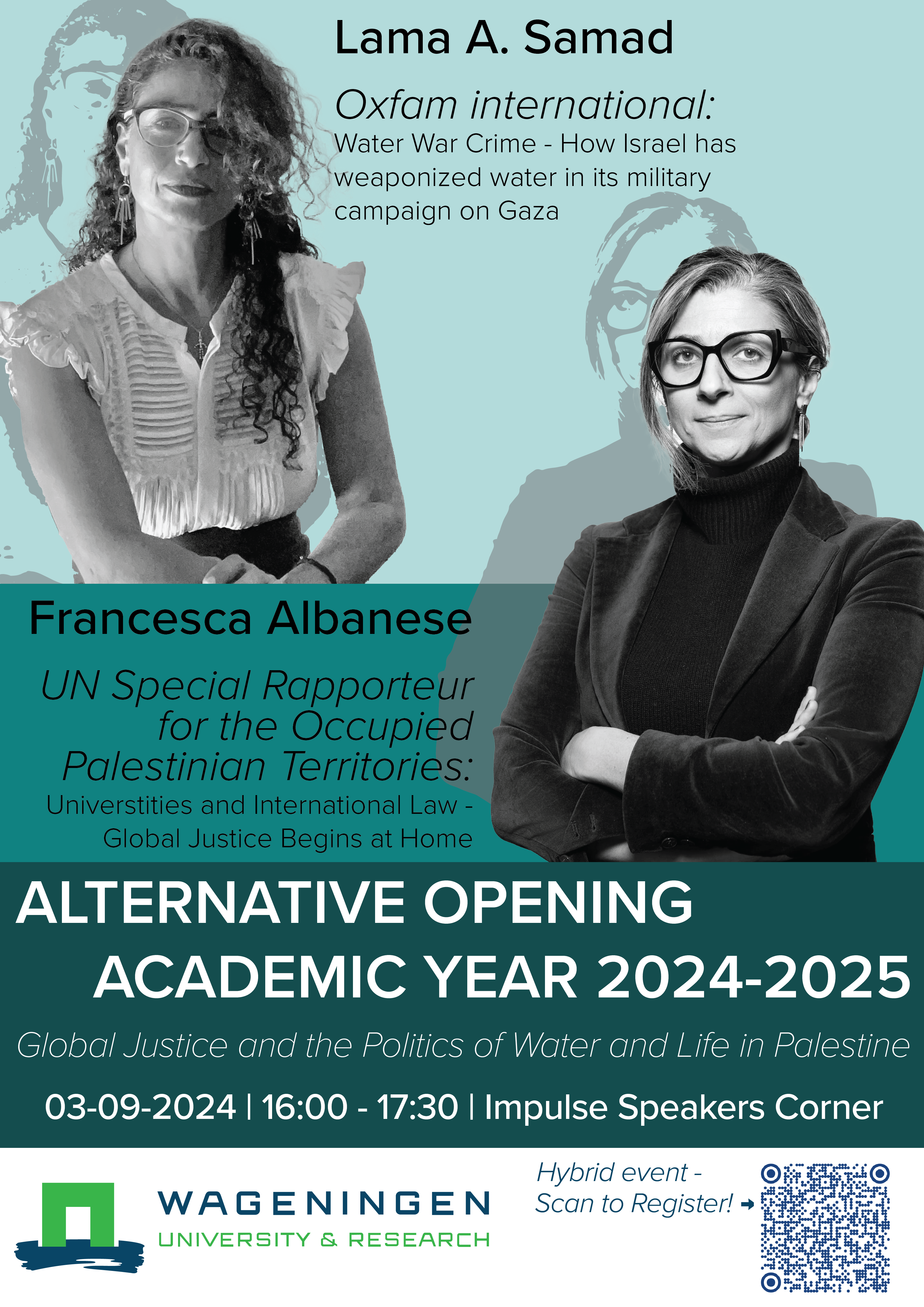
Global Justice and the Politics of Water and Life in Palestine

Seminar “Global Justice and the Politics of Water and Life in Palestine”.

September 3, 16.00-17.30

16.00 Opening and Welcome. Joost Jongerden, Associate Professor at Rural Sociology, WUR

16.10 Presentation by Francesca Albanese, UN Special Rapporteur for the Occupied Palestinian Territories: “Universities and International Law: Global Justice Begins at Home”

16.35 Presentation by Lama Abdul Samad, Oxfam International: “Water War Crime: How Israel has weaponised water in its military campaign on Gaza” 

17.00 Q&A. Moderation by Lucie Sovova (on location), Assistant Professor at Rural Sociology, WUR, and Jessica Duncan (on-line), Associate Professor at Rural Sociology, WUR

17.20 Closing words by Amal Ahmad, Assistant Professor at Development Economics, WUR

17.30 Closure

Presentation by Francesca Albanese (UN Special Rapporteur OPT)
Presentation by Lama Abdul Samad (Oxfam International)

Democracy in Agriculture and Food Provisioning: A Citizenship Lens

Spring School-PhD course May 19-23, 2025

With daily seminars by Engin Isin and contributions by Cristina Grasseni, Robin Smith, Joost Jongerden, and Han Wiskerke

Fair and just agriculture and food systems have been central issues in policy and practice for much of the 20th and 21st centuries. Peasants, consumers, and social movements have been fighting for rights such as land ownership, access to healthy food, and the right to determine our agricultural and food futures for many decades, if not centuries. Few have conceptualized this in terms of citizenship. Yet by questioning what is fair, just, and right, challenging the working of our agrarian and food systems, and practising alternatives people establish themselves as citizens, and more specifically as agrarian and food citizens.

Continue reading

Shaping Sustainable Futures: Insights from the 15th IFSA Conference

Mark your calendars for a wonderful event set to take place from 30th June to 4th July 2024 in Trapani, Sicily, Italy – the 15th International Farming Systems Association (IFSA) conference. This conference promises to be a gathering of minds dedicated to exploring systemic change for sustainable futures, with a focus on crucial topics such as postgrowth farming systems.

Continue reading