Call for working groups

Navigating Rural Transitions: Exploring liveable futures

European Society for Rural Sociology
July 7-10, 2025
Riga, Latvia

Submit a proposal to convene a Working Group for the next ESRS conference.

Our focus

The 2025 ESRS conference will take up the theme of ‘Navigating rural transitions:  Exploring liveable futures’.

As we navigate ongoing transitions, an exploration of  liveable rural futures calls on us to consider the diverse range of challenges and possibilities that lie ahead: from a just, sustainable, and ‘worth living’ futures for all, to survivable or even catastrophic futures, and everything in between. 

Understood this way,  the pursuit of a liveable rural future requires engagement with critical social-political and social-ecological questions related to, among others, farming, agriculture, and food systems, justice and discriminations, the politics of knowledge, social mobilisations and agency, migration and mobility, technologies, connections and solidarity, care and hope. Additionally, the importance of (local) democracy, collective action, and the development of (relatively) autonomous forms of organisation in rural areas, such as the rural commons, may also be considered.

Addressing these topics means engaging with the lived experiences and practices of people today, while also taking into account what they aspire and hope for. This requires working with, questioning and developing new theories and methods. It also requires discussions about the roles of  researchers and what type of actions are needed.

With this in mind, we welcome proposals for Working Groups (WG) that seek to explore and advance understandings of what is happening and what needs to happen to ensure liveable rural futures in the face of continuing uncertainty and multiple, intersecting, and ongoing ‘crises’. In particular, we are interested in proposals for WGs that interrogate and engage with the different dynamics, practices,  tensions, contradictions, and entanglements involved in realising liveable rural futures.

We invite contributions in a variety of formats: academic presentations and round-tables, audio/video materials, live performances (music, drama, poetry), photo or art exhibitions, and others.

Continue reading →

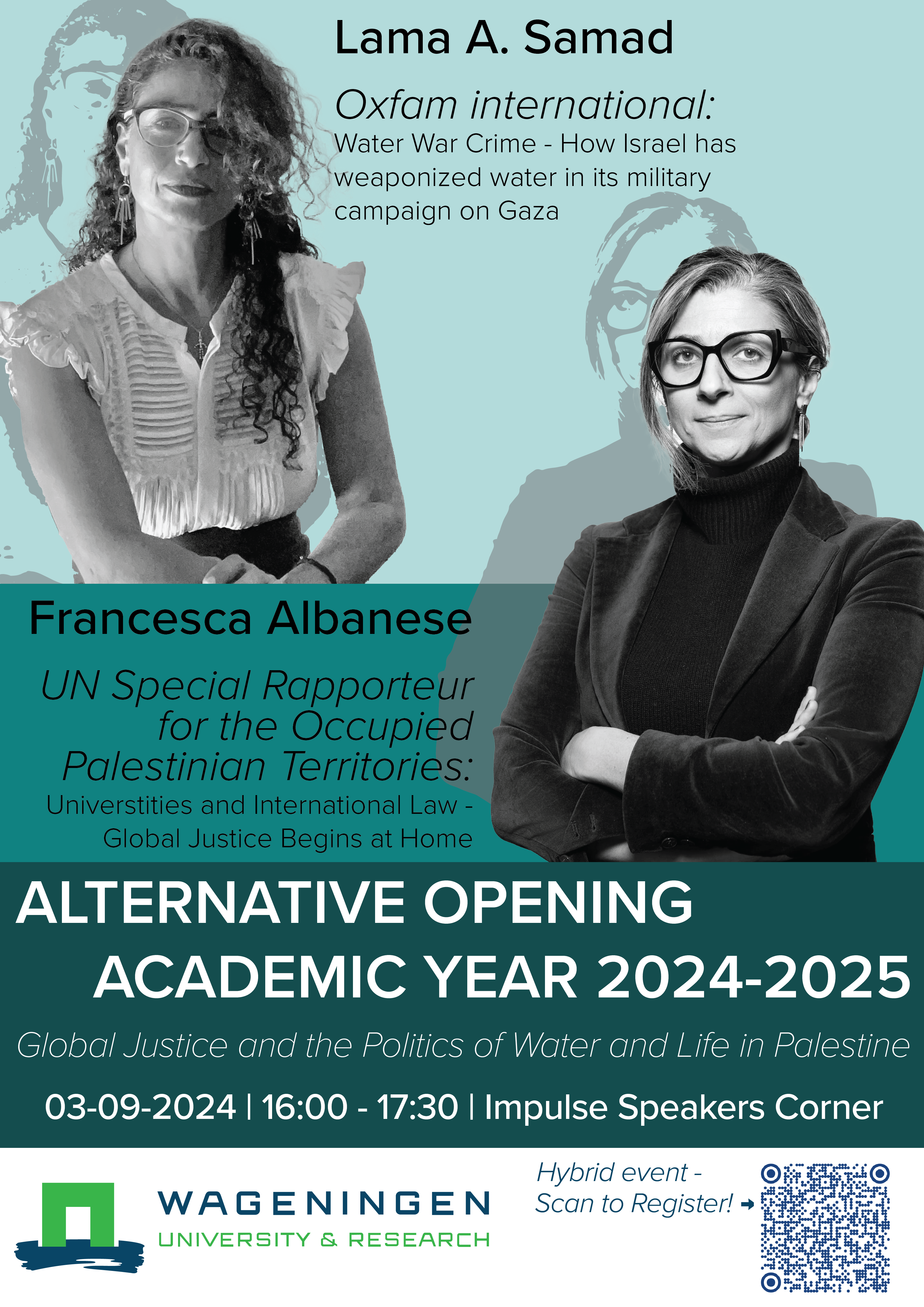
Global Justice and the Politics of Water and Life in Palestine

Seminar “Global Justice and the Politics of Water and Life in Palestine”.

September 3, 16.00-17.30

16.00 Opening and Welcome. Joost Jongerden, Associate Professor at Rural Sociology, WUR

16.10 Presentation by Francesca Albanese, UN Special Rapporteur for the Occupied Palestinian Territories: “Universities and International Law: Global Justice Begins at Home”

16.35 Presentation by Lama Abdul Samad, Oxfam International: “Water War Crime: How Israel has weaponised water in its military campaign on Gaza” 

17.00 Q&A. Moderation by Lucie Sovova (on location), Assistant Professor at Rural Sociology, WUR, and Jessica Duncan (on-line), Associate Professor at Rural Sociology, WUR

17.20 Closing words by Amal Ahmad, Assistant Professor at Development Economics, WUR

17.30 Closure

Presentation by Francesca Albanese (UN Special Rapporteur OPT)
Presentation by Lama Abdul Samad (Oxfam International)

Democracy in Agriculture and Food Provisioning: A Citizenship Lens

Spring School-PhD course May 19-23, 2025

With daily seminars by Engin Isin and contributions by Cristina Grasseni, Robin Smith, Joost Jongerden, and Han Wiskerke

Fair and just agriculture and food systems have been central issues in policy and practice for much of the 20th and 21st centuries. Peasants, consumers, and social movements have been fighting for rights such as land ownership, access to healthy food, and the right to determine our agricultural and food futures for many decades, if not centuries. Few have conceptualized this in terms of citizenship. Yet by questioning what is fair, just, and right, challenging the working of our agrarian and food systems, and practising alternatives people establish themselves as citizens, and more specifically as agrarian and food citizens.

Continue reading →

Shaping Sustainable Futures: Insights from the 15th IFSA Conference

Mark your calendars for a wonderful event set to take place from 30th June to 4th July 2024 in Trapani, Sicily, Italy – the 15th International Farming Systems Association (IFSA) conference. This conference promises to be a gathering of minds dedicated to exploring systemic change for sustainable futures, with a focus on crucial topics such as postgrowth farming systems.

Continue reading →

Interactive Workshop for International Women’s Day

By Marije van Santen

To mark International Women’s Day, an engaging workshop took place in Impulse, fostering dynamic and thought-provoking conversations about the future of feminism. Hosted by Jessica Duncan, the workshop began with an insightful introduction, celebrating women’s achievements while acknowledging the ongoing journey towards gender equality.

Following the introduction, a panel of researchers, all specializing in gender, equality, and power, presented propositions concerning women’s issues. Georgia Diamanti and Marije van Santen discussed the impact of the Common Agricultural Policy on women, followed by Tabitha Muriuki’s exploration of oppressive ideologies within family law. Margriet Goris concluded with a proposition addressing the gender pay gap and options available to men.

After the propositions, attendees formed smaller groups to deliberate and identify key feminist principles. Engaging discussions ensued, culminating in the sharing of various principles raised by the audience:

1. Principles for Wageningen University & Research (WUR) and other universities:
> Promote genuine participation of diverse individuals within the university.
> Ensure active inclusion of women in research endeavors.
> Provide students with access to female scientists.
> Implement mandatory courses on positionality in science, gender studies, ethics, and philosophy across bachelor’s and master’s programs.
> Increase representation of women as chair group holders.

    2. Principles for the workplace:
    > Close the gender pay gap through collective efforts, including active involvement of men.
    > Foster transparency in company salaries to address gender disparities.

    3. Principles for society:
    > Create safe public spaces for individuals of all genders.
    > Enforce zero tolerance for sexual harassment and sexism.
    > Consider women’s perspectives in the development of products and services.

    This workshop is connected to the SWIFT project and serves as the starting point for ongoing discussions about feminism at WUR. Let’s reconvene next year on International Women’s Day to further advance the dialogue!