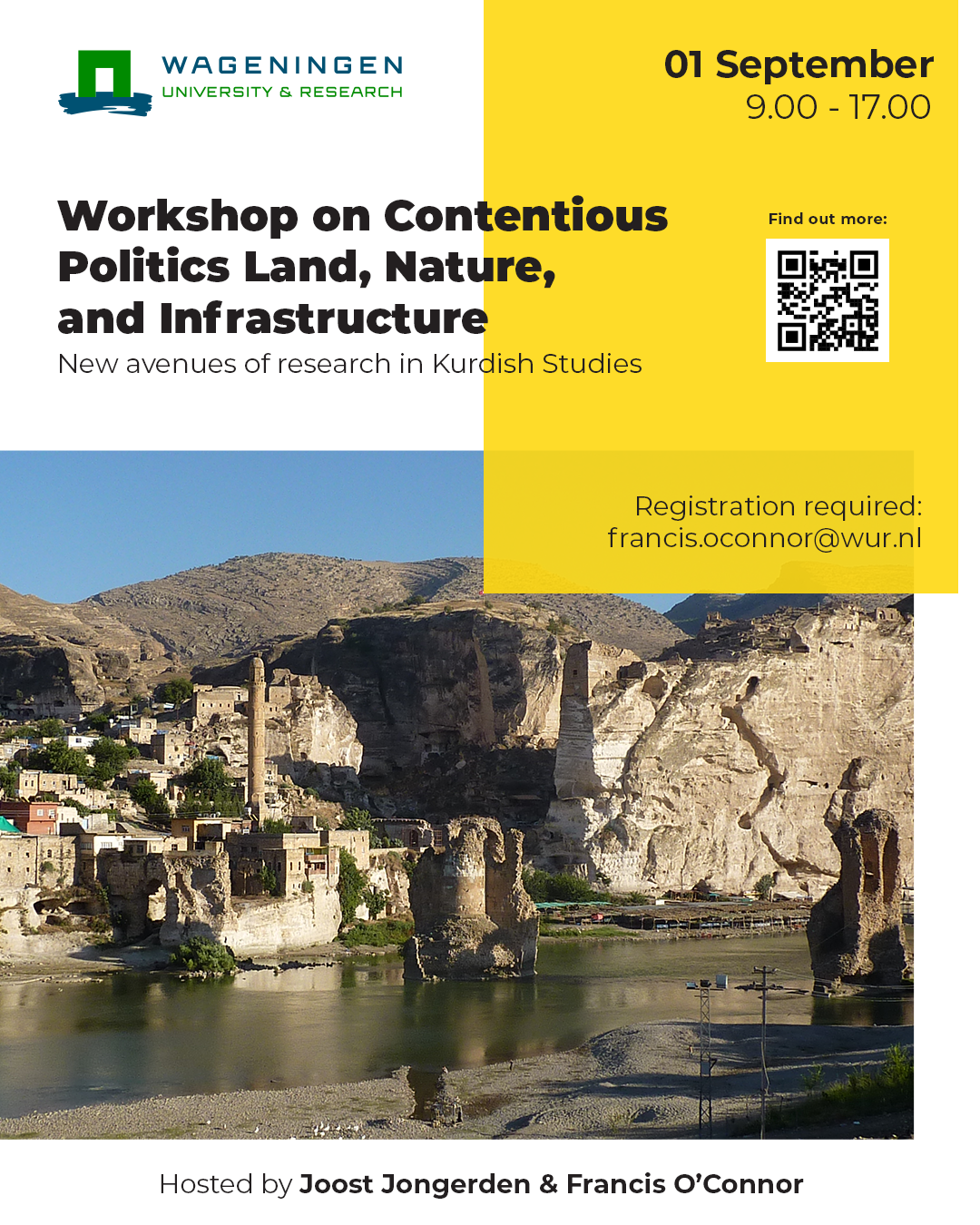
Workshop on Contentious Politics in Kurdish Studies: Land, Nature, and Infrastructure

Hosted by the Rural Sociology Group, Wageningen University and Research, September 1, 2023

In Kurdistan occupations and demonstrations by landless workers and peasants demanding land reform have taken place on a large scale since the middle of the 20th century. In more recent years, this contestation over land has overlapped with the rise of environmental activism. The workshop Contentious Politics in Kurdish Studies: Land, Nature, and Infrastructure addresses a number of theoretical debates and questions related to land.

Affiliations of the participants

Kamuran Akin is an independent researcher who recently defended his PhD at the Institut für Europäische Ethnology, Humboldt Universität zu Berlin.

Seda Altuğ is a lecturer at the Atatürk Institute for Modern Turkish History at Boğaziçi University, Istanbul.

Aysegul Aslan is a Ph.D. candidate in geography at Fırat University, Turkey, and a visiting fellow at the Environmental Policy Group at Wageningen University, the Netherlands

Eray Çaylı is a professor of Human Geography with a Focus on Violence and Security in the Anthropocene, Hamburg University, Germany

Pinar Dinc  is a researcher at the Centre for Advanced Middle Eastern Studies at Lund University.

Ayhan Işık is a Postdoctoral Researcher at Centre de Recherche Mondes Modernes et Contemporains, Université libre de Bruxelles.

Adnan Mirhanoğlu is a researcher in the Department of Earth and Environmental Sciences at KU Leuven, Belgium.

Zeynep Oguz is a lecturer in Social Anthropology at the University of Edinburgh.

Murat Öztürk is associate professor at the  Department of Economics at Kırklareli University in Turkey. 

Marcin Skupiński is a Ph.D. candidate at Warsaw University, Poland.

Necmettin Türk is a PhD Candidate in the Working Group “Critical Geographies of Global Inequalities” at the Institute of Geography, Hamburg University, Germany.

Filyra Vlastou-Dimopoulou is a Ph.D. candidate in Human Geography (NTUA & Paris 1 Panthéon-Sorbonne University.

Dobrosława Wiktor-Mach is professor of Economics, Cracow University, Poland.

Organizers

Joost Jongerden – Associate professor at the Rural Sociology Group, Wageningen University, the Netherlands joost.jongerden@wur.nl

Francis O’Connor – is a Marie Curie Skłodowska Post-Doctoral Fellow in Rural Sociology at Wageningen University in the Netherlands. Francis.oconnor@wur.nl

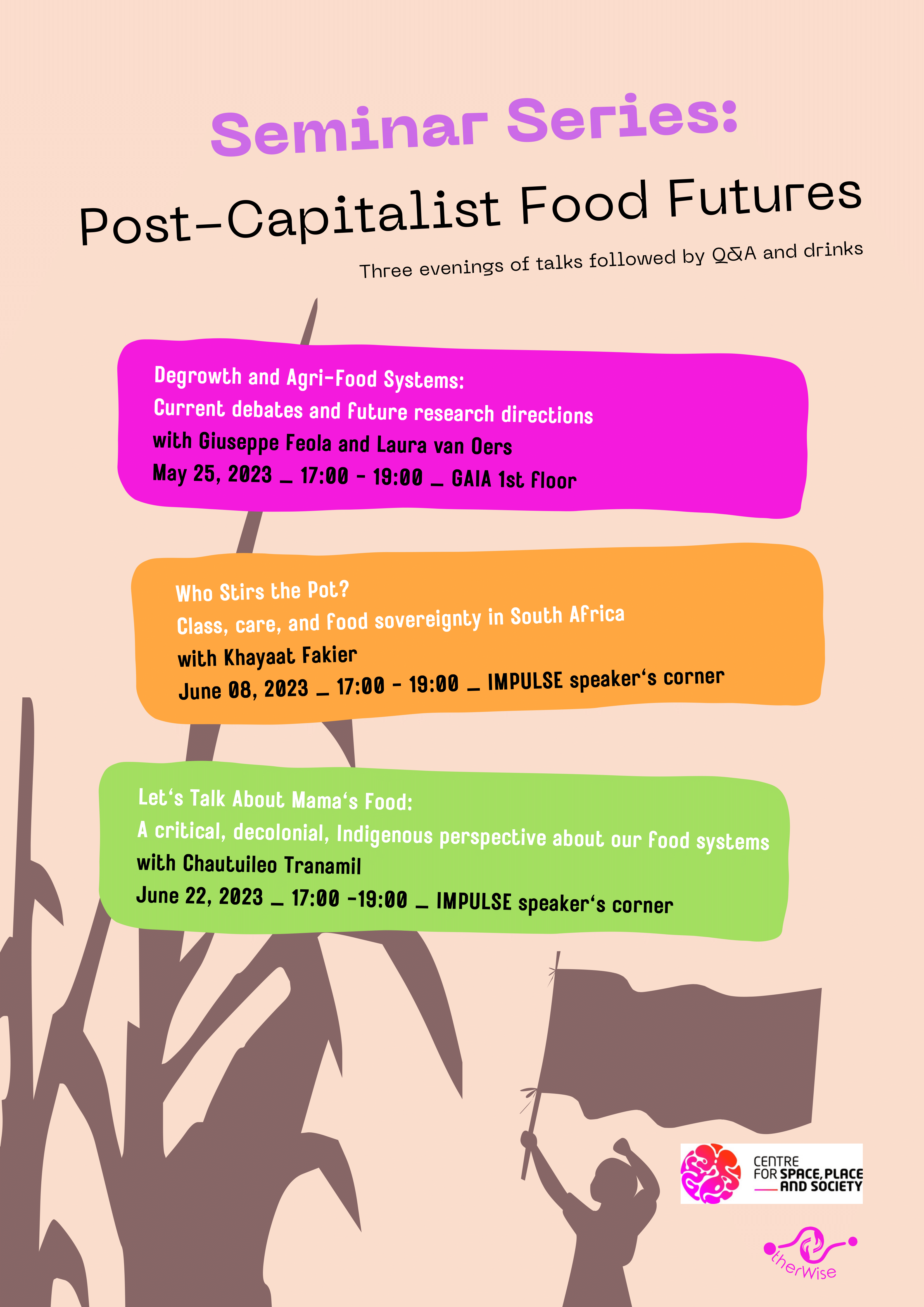
Postcapitalism seminar series

As part of our new course ‘Beyond Sustainability: Theorizing post- and anti-capitalist food futures’ (RSO58806), we are curating an evening seminar series where we will welcome scholars and activists engaged in reimagining food and society more generally. You are cordially invited to join us for the seminars!

(Re)building historical commons: exploring forest commoning as a transformative practice in the Northwestern Iberian Peninsula. PhD-defence by Marta Nieto Romero

Friday December 16, 2022, during a ceremony from 13.30-15.00, Marta Nieto Romero will defend her PhD thesis ‘(Re)building historical commons. Exploring forest commoning as a transformative practice in the Northwestern Iberian Peninsula‘ in the auditorium of the Omnia building of Wageningen University and Research. See here for more information and a link to the live broadcast or recording of the ceremony. The PhD-thesis will be available at WUR Library after a successful defence. Below a Summary of the PhD-thesis.

Summary

commons is a social organizational system where all interested parties participate in the collective use and care for common resources with an emphasis on open access, fair usage and long-term sustainability. While commons have received substantial scientific attention, we know little on how commons’ systems emerge and are sustained over time; in other words, the common-ing practices. The thesis investigated how forest are commoned and become the basis for building thriving communities both in rural and urban areas. It followed a case-study approach with two cases in Galicia (Spain), and one in North region of Portugal (North-western Iberian Peninsula). Methods included interviews, participant observation and a Participatory Action Research (PAR) project where people’s meaningful experiences in forests were collected and shared with the broader community to understand the role of affects in driving participation. The thesis offer understanding on why/how humans engage in caring for their places, and why is this relevant for sustainability transformations.

Workshop The Margins of Insurgent Control: Spaces of Governance

On September 1st and 2nd, the CSPS will host an international workshop featuring anthropologists, ethnographers, rural sociologists, social geographers, social movement scholars to discuss the field of rebel governance, which has been most authoritatively defined as the “the set of actions insurgents engage in to regulate the social, political, and economic life of non-combatants during war.” The workshop is hosted by Francis O’Connor and Joost Jongerden.

Research on rebel governance has dramatically reinvigorated the study of armed conflicts through its increasing methodological diversity and broad range of case studies. Yet, it is arguably characterised by an over focus on the state-like qualities of these movements, seeking out institutionalised patterns of governance that overlook some of the subtleties of how rebel governance emerges and develops in the shadow of existing states and in cohort with other societal actors. This workshop will focus on the margins of the phenomenon, emphasising the social complexity inherent in practises of rebel governance shaped by pre-existing political and cultural ties, reciprocal social norms confronted by structures of state and insurgent violence in contexts of often dramatic social upheaval.

The workshop’s participants will focus on four issues: firstly, they will address the spatial margins, where insurgent presence is more fluid or inconsistent and there is no territorial control but where forms of governance are nevertheless implemented. Secondly, they will consider early phases of insurgent mobilisation where incipient forms of governance are tested and refined but marginal in salience. Thirdly, they will analyse governance provision by actors on the margins of insurgent movements themselves, looking at the role of affiliated but somewhat autonomous groupings like militias or associated social movements. Finally, they will also reflect on the complexity of overlapping realms of sovereignty between rebel movements and state institutions and forces.

In order to conceptually incorporate these issues into rebel governance research, there is a need to bridge the existing literature with other related approaches such as social geography, social anthropology, social movement studies and contentious politics. The participants will take the workshop an opportunity to reflect on how best (or indeed, if it is necessary) to incorporate these approaches into the study of rebel movements’ governance efforts.

The workshop will be structured around the following (non-exhaustive) number of ethical and methodological issues and key questions that could play a role in the further development of the field.

Continue reading

Masterclass: Methodological and Ethical Dimensions of Fieldwork

The Masterclass for PhD researchers, hosted by renowned Visiting Fellow Prof. Zachariah Mampilly focuses on the ethical and methodological challenges of fieldwork. Professor Mampilly has extensive experience in the field, in authoritarian contexts and conflict zones in locations as varied as Sri Lanka, South Sudan and the Democratic Republic of Congo.

Objective
The Masterclass is designed for PhD students, Post-Docs and staff members as an opportunity to collectively reflect on both the pragmatic dimensions of fieldwork, as well as the ethical dilemmas that arise before, during and after periods in the field. It will also be an occasion to discuss the epistemological consequences of the choices made in the field and how that affects the research we produce and the potential ‘real world’ consequences they might entail.

Structure
Professor Mampilly will guide a structured discussion, reflecting on his own experiences in the field. The session will then open into an informal exchange where participants are encouraged to reflect on the issues they encountered in past or ongoing fieldwork, as well as anticipated difficulties in upcoming periods in the field.
A number of the participants already present in Wageningen for the The Margins of Insurgent Control: Spaces of Governance (September 1-2nd) workshop will also be in attendance and will serve as valuable sources of interchange and information.

Outcomes
An enhanced understanding of the potential challenges and solutions that all researchers are confronted with in the field. It is also the chance to ask focused questions to experienced scholars about fieldwork in specific places, for e.g. on conflict in Sudan or environmental related research in the Amazon.

Questions and registration
Please address any questions to Francis O’Connor francis.oconnor@wur.nl
Registration is mandatory: please register at the following link as in-person places are limited due to ongoing COVID restrictions. It is also possible to participate online.

When and where
Date: Wed 31 August 2022 14:00 to 17:00
Venue: Leeuwenborch, building number 201

Recommended readings