
The joy of interdisciplinary collaboration! Yes, there are barriers and challenges, but in setting up the Centre for Unusual Collaborations (CUCo) the main surprising outcomes were joy, a sense of meaning and creativity. We coined this ‘collateral happiness’.
With due pride we share: new paper out now! Recounting the journey of the first two years of the Centre for Unusual Collaborations; its origins, lessons learned and recommendations for universities and funders to better support unusual collaborations.
The paper elaborates on three roadblocks to funding inter- and transdisciplinary research, as well as how these were overcome – or not! The three roadblocks are:
1) Rewards and recognition – and this remains a major hurdle to this day!
2) Funding trust-building and interdisciplinary collaboration
3) Competencies, tools and approaches
Congratulations to all the authors! And great thanks to Springer Nature Group Humanities and Social Sciences Communications for the smooth reviewing and editorial process.
View the publication here
Category Archives: publication
Decolonization Agriculture – New Article in Third World Quarterly
This article, authored by Necmettin Türk from Critical Geographies of Global Inequalities at the University of Hamburg and Joost Jongerden from the Rural Sociology Group at Wageningen University, discusses agriculture in the context of colonization and the debates it has sparked. The authors examine the colonial homogenizing policies of the Syrian Ba’ath regime and the subsequent decolonization processes that led to the emergence of Rojava as a pluriverse.
The Ba’ath regime, in power since 1963, implemented nation-state colonialism in the predominantly Kurdish region, using agricultural modernization as a tool for its colonization efforts. This modernization bolstered the central state, perpetuated the underdevelopment of the region as a periphery, and asserted control through the settlement and land distribution to Arab families loyal to the regime. Following the regime’s collapse in Rojava in 2012, the communities that comprise the Autonomous Administration of North and East Syria (AANES) dismantled the colonial agricultural system. They developed a decentralized governance and agrarian development approach, referred to here as the decolonization of agriculture.
Based on interviews and fieldwork in the region, the article explores the interplay between agricultural development and colonial politics, as well as the critical role of agriculture in the broader struggle for decolonization. The authors conclude that in the anti-colonial struggle, people and the rhizomatic governance structures they develop challenge colonial submission to the central state, exploring life beyond the nation-state, which is crucial for a decolonial shift.
The article is published open access under this link: https://www.tandfonline.com/doi/full/10.1080/01436597.2024.2374521?src=exp-la
Publication | Degrowth from the East – between quietness and contention
Collaborative learnings from the Zagreb Degrowth Conference. By Lilian Pungas, Ondřej Kolínský, Thomas SJ Smith, Ottavia Cima, Eva Fraňková, Agnes Gagyi, Markus Sattler, Lucie Sovová.
While degrowth as a plural and decolonial movement actively invites the Global South to be part of its transformative project, the current North-South dichotomy threatens to miss the variety of semi-peripheral contexts. Against this backdrop, we aim to contribute to dialogues on degrowth from the often-overlooked ‘East’ – specifically post-socialist Central and Eastern Europe (CEE). Instead of being viewed as a site for transformative examples and inspiration for degrowth-oriented socio-ecological transformation, CEE is often portrayed as ‘lagging behind’. Problematising such reductionist narratives, this essay explores CEE as a lively and rich site of postcapitalist alternatives. Based on two special sessions organised at the 2023 International Degrowth Conference in Zagreb, we reflect upon insights gathered on various degrowth-aligned traditions and practices in CEE with a goal to 1) advance an equitable dialogue between the global degrowth scholarship and the East, and 2) strengthen a context-sensitive degrowth agenda in CEE.
Publication | Understanding the emerging phenomenon of food forestry in the Netherlands: An assemblage theory approach
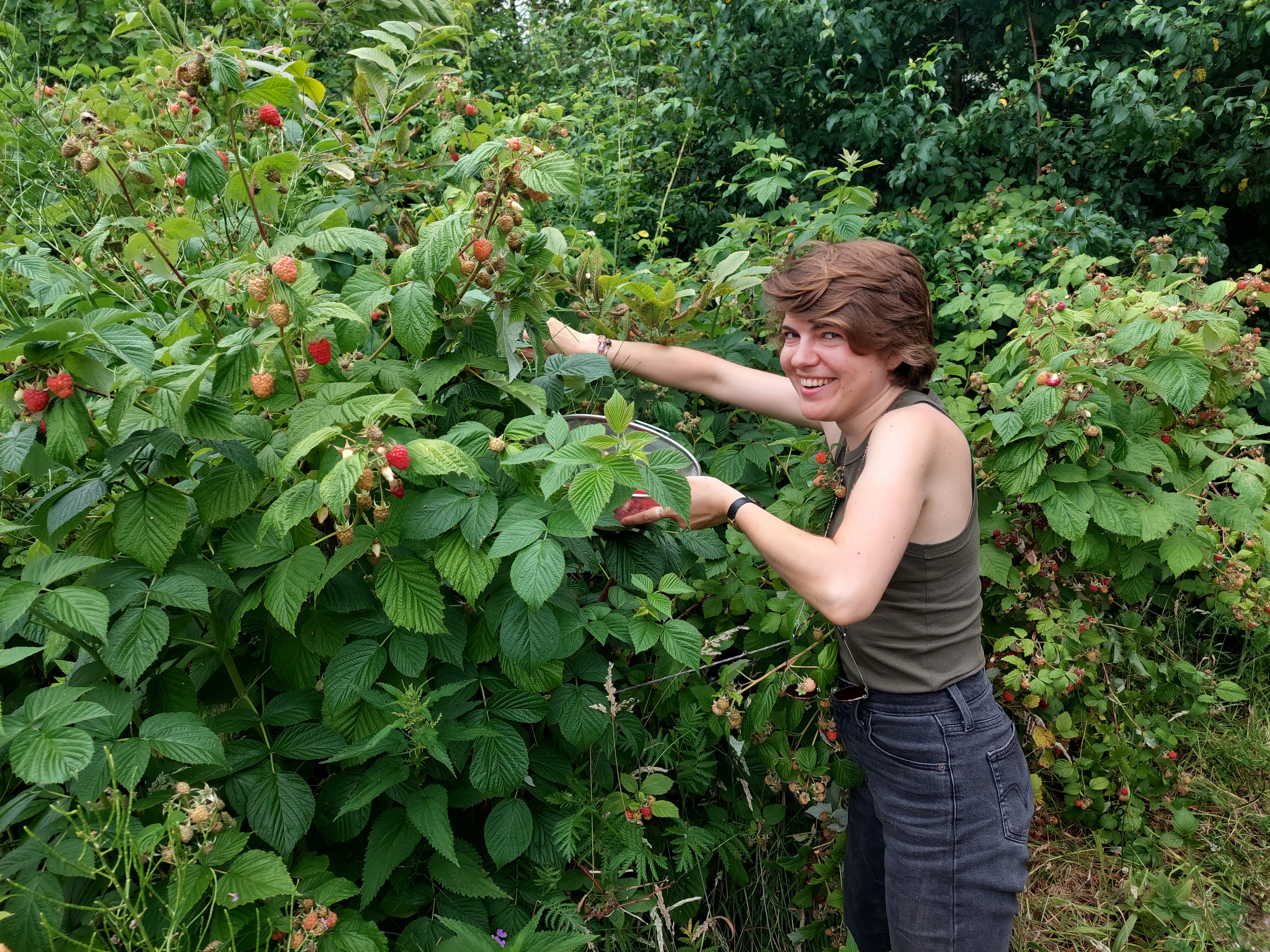
By Anna Roodhof – Food forestry is an advanced type of agroforestry where practitioners design a forest ecosystem that incorporates edible and otherwise serviceable perennial plant species. In the Netherlands, food forests have become an increasingly popular land-use form, inspired by Martin Crawford’s forest garden. The first occurrence of the term ‘food forest’ dates back to 2009, when Wouter van Eck and Pieter Jansen started a forest garden sized 3 hectares, which they aptly renamed ‘food forest’. Since then, and especially from 2017 onwards, this innovative approach to agroforestry has flourished across the country. As a PhD candidate at the Rural Sociology Group at Wageningen University and Research, I study this emerging phenomenon.
Continue reading Rural Sociology Wageningen University