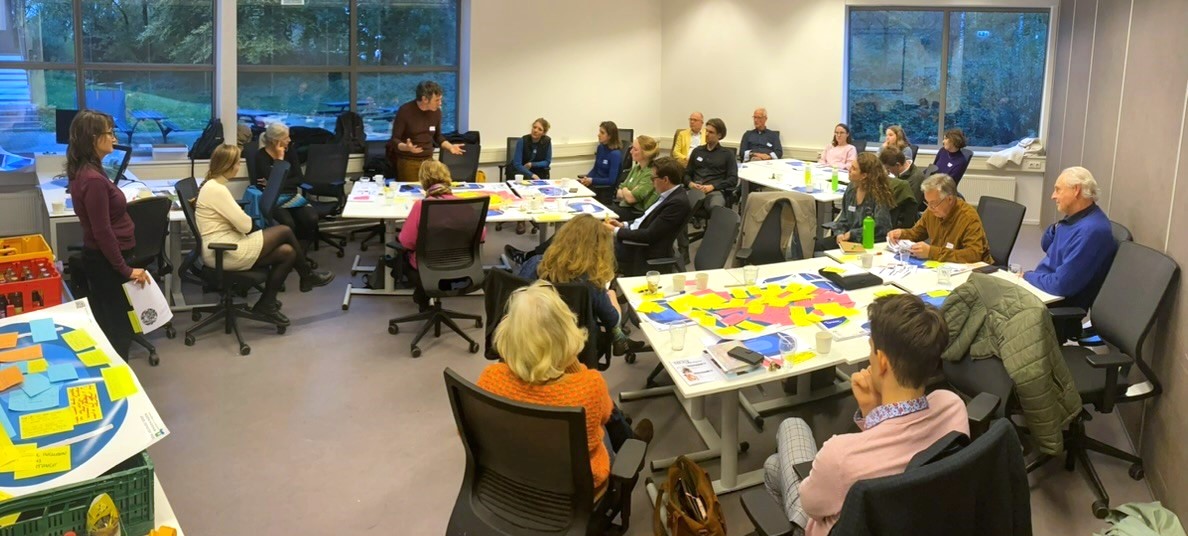
Op woensdag 13 november mochten we het Ministerie van Landbouw, Visserij, Voedselzekerheid en Natuur verwelkomen. Een waardevol bezoek waarin we elkaar beter leerden kennen en zochten naar gemeenschappelijke gronden om elkaar te versterken.
Tijdens een inspirerend gesprek deelden we wat ons drijft in het werken aan een maatschappelijk verantwoorde transitie. Het is essentieel om elkaar te vinden op gedeelde waarden en zo een vruchtbare voedingsbodem voor samenwerking te creëren.
Samen kunnen we stappen zetten richting een duurzame en inclusieve toekomst.
The CULTIVATE team at Wageningen University & Research is thrilled to announce the pre-launch of the Citizen Engagement Library! This resource is a growing collection of strategies, materials, and tools designed to foster greater participation among citizens, policymakers, and organizations in food-sharing activities.
From participatory budgeting and citizen assemblies to mobile kitchens and European-wide campaigns, there are countless ways to engage communities in shaping food systems, addressing challenges, and driving meaningful change. However, reliable, detailed information about these engagement mechanisms can be hard to find. That’s where we need your help!
We are seeking input to improve and expand the Citizen Engagement Library, and there are two ways you can contribute:
1. Fill Out the Citizen Engagement Library Survey
We’ve created a survey to introduce you to the Library and gather your feedback on its current format and content. Your input will help us make the Library as useful and accessible as possible!
Together, we can create a robust resource that empowers communities and fosters collaboration in food-sharing initiatives worldwide. Thank you for being part of this exciting journey!
Happy to share the publication of a recent article in Sociologia Ruralis, “Agroecology for migrant ‘emplacement’ in the left-behind European countryside” by Simone Cappati and Alberto Alonso-Fradejas. In this work, they explore the intersection of the green and demographic transitions in the European Union, focusing on the role of agroecology in the settlement and socioeconomic integration of diverse newcomers in Italy’s ageing and marginalised rural areas.
The article analyzes the challenges and opportunities faced by both Italian city-dwellers-turned-agroecological farmers and non-EU agroecological farmworkers in these communities. Through the lens of agroecological initiatives supported by municipalities and NGOs, they investigate how these efforts contribute to the EU Green Deal while offering newcomers a chance to participate in sustainable rural (re)development. Their findings suggest that agroecology has the potential to foster ’emplacement’ by facilitating everyday interactions between long-time residents and newcomers, though they also highlight potential issues of injustice that may arise from exploitative labor practices.
Publication | Proud to share the publication of our colleague YiLing Hung in the online journal APRIA – a journal for artistic research. For this edition the theme was “Being in Relation: Art as Ecology”.
YiLing’s article is written from the perspective of a performance maker in responding to the theme: Art as Ecology. Performance creates a new ‘in-between’ space—the imagined place between the real and the fictional world, which is situated inside the heads of the spectators. We can say performance ‘makes space,’ opening up the possibility for everyday space to become ‘strange, wondrous, and provocative.’ As a performance maker, she has been attempting to find answer(s) to the question: Where is the line that separates a daily life event and a (theatrical) performance? This article is a self-reflection and further articulation on her performance work Moving On/ Vanishing, which was created in 2018 and was invited for performance again during the Prague Quadrennial of Performance Design and Space (PQ) in 2023.
Biologische boeren kampen met grote onzekerheid door korte pachtcontracten en stijgende grondprijzen. Ruraal socioloog Margriet Goris, werkzaam bij de Rural Sociology Group, belichtte in EenVandaag de moeilijke situatie waarin biologische boeren zich bevinden.
“Biologische landbouw vraagt om een lange termijnvisie, waarbij bodemherstel en biodiversiteit centraal staan,” legt Margriet uit. Echter, door kortlopende contracten, soms zelfs van slechts één of twee jaar, wordt duurzame bedrijfsvoering haast onmogelijk. Deze onzekerheid bedreigt het voortbestaan van vele biologische bedrijven die jarenlang hebben gewerkt aan gezonde bodems en ecologische productie.
Volgens Margriet zou de overheid hier verandering in kunnen brengen door de pachtregelgeving aan te passen en langlopende contracten te stimuleren. Dit biedt niet alleen stabiliteit aan boeren, maar ondersteunt ook de ambitie van het ministerie van Landbouw om tegen 2030 minstens 15 procent van de landbouw biologisch te maken.



 Rural Sociology Wageningen University