Professor Gianluca Brunori: Friends of RSO video series

In this second interview in the Friends of RSO video Series, we speak with Gianluca Brunori, Professor of Food Policy at the Department of Agriculture, Food and Environment, at Pisa University. In our interview, he reflects on the central role the RSO group has had on his career. He notes the impact of the group, based in part on the methodological approaches and a strong, critical view: the attempt to go beyond the common discourse to challenge situations, while also looking the alternatives.

He reflects on the blurring of disciplines and the challenges and opportunities this poses for Rural Sociology. He makes a plea for enhanced engagement with economies to enhance our understandings of alternatives, without losing the “hard core” of the discipline.

Professor Brunori shares an experience of a rainy group camping trip that led to the consolidation of professional relations that have spanned more than 30 years.

Many thanks to Gianluca for sharing his reflections and to Yanick Bakker for her editorial work.
Prof Myriam Paredes: Friends of RSO video series

Over the last 75 years, we have made a lot of friends from around the world. In this short series, we interview a few of these friends with strong roots in RSO and who have gone on to have internationally recognized scientific careers.

In this interview series, we ask them to reflect on their connection to the group, the legacy of the group, and the future of rural sociology more broadly.

In this first interview, Professor Myriam Paredes, of the Latin American Faculty of Social Sciences, (FLACSO), in Ecuador, reflects on the novel approaches and contributions of the group to sociological debate, notably moving beyond traditional actor /structure dichotomies.

She also recalls fondly the deep conversations and good company she experiences while studying at RSO. She shares that students and staff would come together to debate the ageless question of what different realities mean, as a way to introduce non-sociological students into sociological debates.

She also shares her trajectory from MSc student to PhD candidate and reflects on the quality of the teachers, and ‘friends for life’ that supported her on her journey.

A special thank you to Myriam for sharing her memories and to Yanick Bakker for her editorial support.

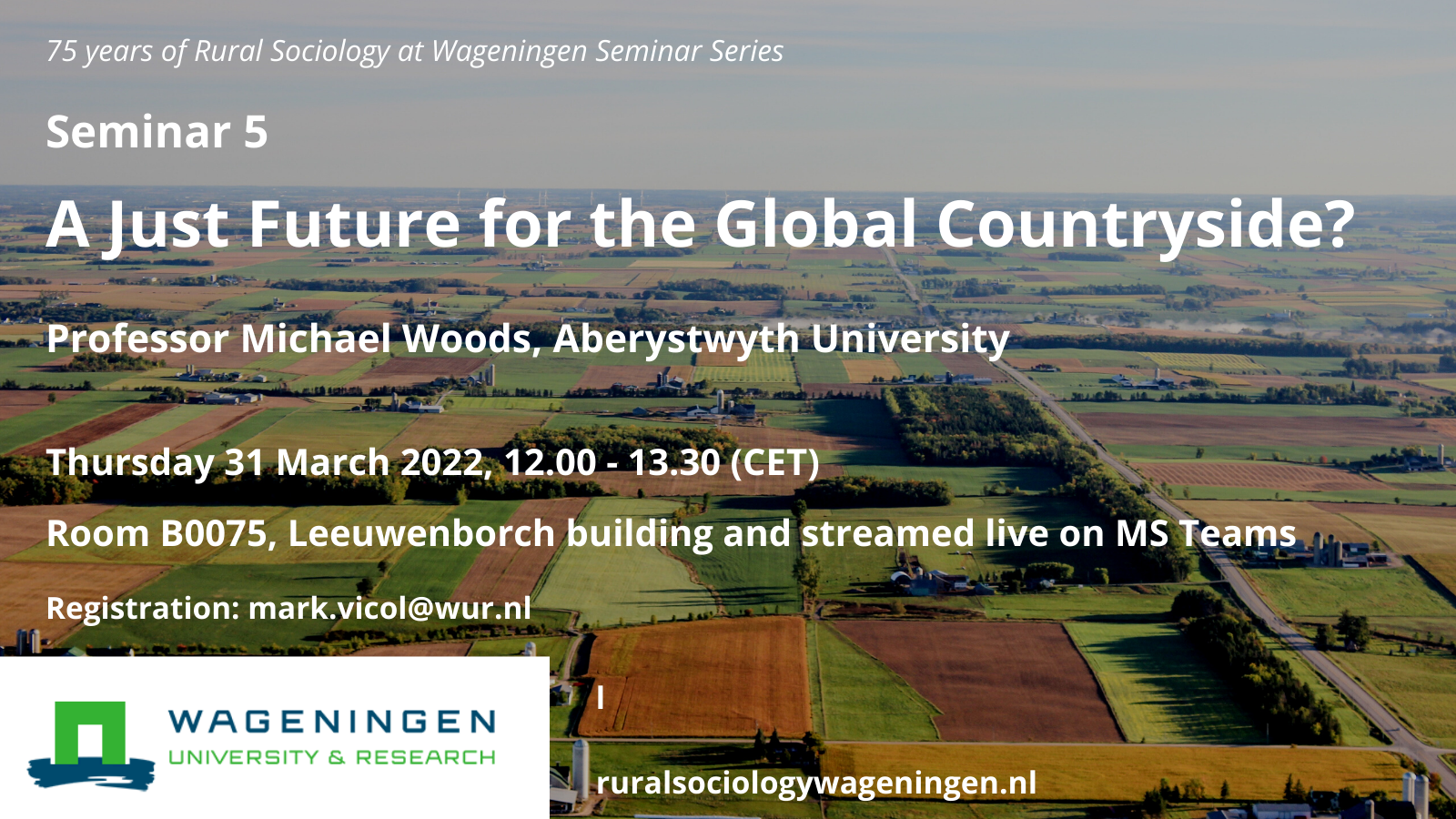
Webinar 5: A Just Future for the Global Countryside? by Michael Woods @WoodsZzp

A Just Future for the Global Countryside? by prof. Michael Woods, Aberystwyth University, Thursday March 31, 2022, 12.00-13.30 (CET).

The talk is part of the Rural Sociology 75th Anniversary webinar series ‘Looking back, Looking Forward: Setting a future agenda for rural sociology’. Watch recordings of the webinars series at Rural Sociology Youtube channel.

The event will be streamed by Teams. Email to mark.vicol@wur.nl to register yourself.

Webinar 4: Mundane normativity and the everyday handling of contested food consumption by prof. Bente Halkier

Mundane normativity and the everyday handling of contested food consumption by prof. Bente Halkier, University of Copenhagen, August 30, 16.00-17.30 (CET):

Food in everyday life is contested from multiple kinds of public debates in present societies such as climate, health, risk, environment and quality, which point to food consumption in everyday life as a site of normative action In the various strands of sociological research on consumption, contested consumption has typically been studied in two strands One strand tends to focus on the mundane routines in consumption that are reproduced, thus to some degree avoiding the normative dimension in the consumption activities themselves Another strand tends to focus directly on political and ethical consumption, thus to some degree ignoring the more mundane dealings with the normative dimension. My contention is that there is some middle ground to cover between each of the two otherwise valuable strands of consumption research if consumption research is to understand the normative dimension of consumption more fully In order to conceptualize such middle ground, an unfolding of the category of mundane normativity and its conditions is useful, and food consumption in everyday life is a clear example with which to think.

The talk is part of the Rural Sociology 75th Anniverary webinar series ‘Looking back, Looking Forward: Setting a future agenda for rural sociology’.

The event will be streamed by Zoom. You can now register for the webinar: https://us02web.zoom.us/webinar/register/WN_VpRUm51-QberdN-QyKWe0w