
 Today I visited the Community Gardens in Marshalltown for the second time. Last Sunday I went there with Jan Flora and Diego Thompson to meet with the group of migrant Hispanic growers to discuss their progress and needs.
The community garden project runs its first year and aims to diversify the availability of locally grown vegetables in this area, while giving new people a chance to start their (part time) business in agriculture through direct selling at farmers markets. The current group of growers, Hispanic and American, followed an eight week course at the Community College (in cooperation with Iowa State University, ISU) this winter called ‘The diversified farm’. After this course they had the opportunity to start growing vegetables on organic certified grounds for a symbolic 50 dollars a year. Each of the growers has a plot of land between 1 and 3 acre. Hispanic migrants, who came to work in the meat processing industry- also in Marshalltown, have agricultural knowledge as they often came from rural areas. One of them told me how he enjoyed being back on the land.
 The neighboring Community College and colleagues from ISU support the project with facilities such as a greenhouse and the use of the tractor, with agricultural and technical knowledge as well as with (helping) to solve practical problems.
Currently, one of the practical issues is the supply of water for irrigation, which now has to come from further down with a small tank behind the tractor which is very labour intensive. However, in a month’s time, water might come from the fire brigade facilities directly neighboring the plots. By that time, pest control will be high on the agenda as crops start to grow now. The first year will be a steep learning curve for all involved, hopefully with promising results.

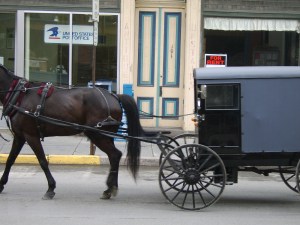 For their dairy farm of 80 cattle they did use some electricity for milking for example with an electric generator. They also had tractors, however, here too the use of it was restricted. This could be noticed by looking at their hey wagons, which had no rubber but metal wheels, to prevent the seduction of using them on the road behind the tractor. Much of the thinking behind this is centred around labour force available and sustaining communities by not out-competing each other. At the other hand, they do use ‘modern’ instruments such as chemical pesticides, chemical fertilizers, and artificial insemination of cows.

 Rural Sociology Wageningen University