
In the master thesis “Navigating Precarity: (Un)documented immigrants in Spain’s agri-food industry” Merissa Gavin discusses the strategies employed by immigrants in navigating precarity from the perspective of the immigrants themselves and new forms of being political are being created. The main question that guided her research was: “How do undocumented immigrant workers in Spain’s agri-food industry engage in claim-making and claim-living to navigate precarity?”
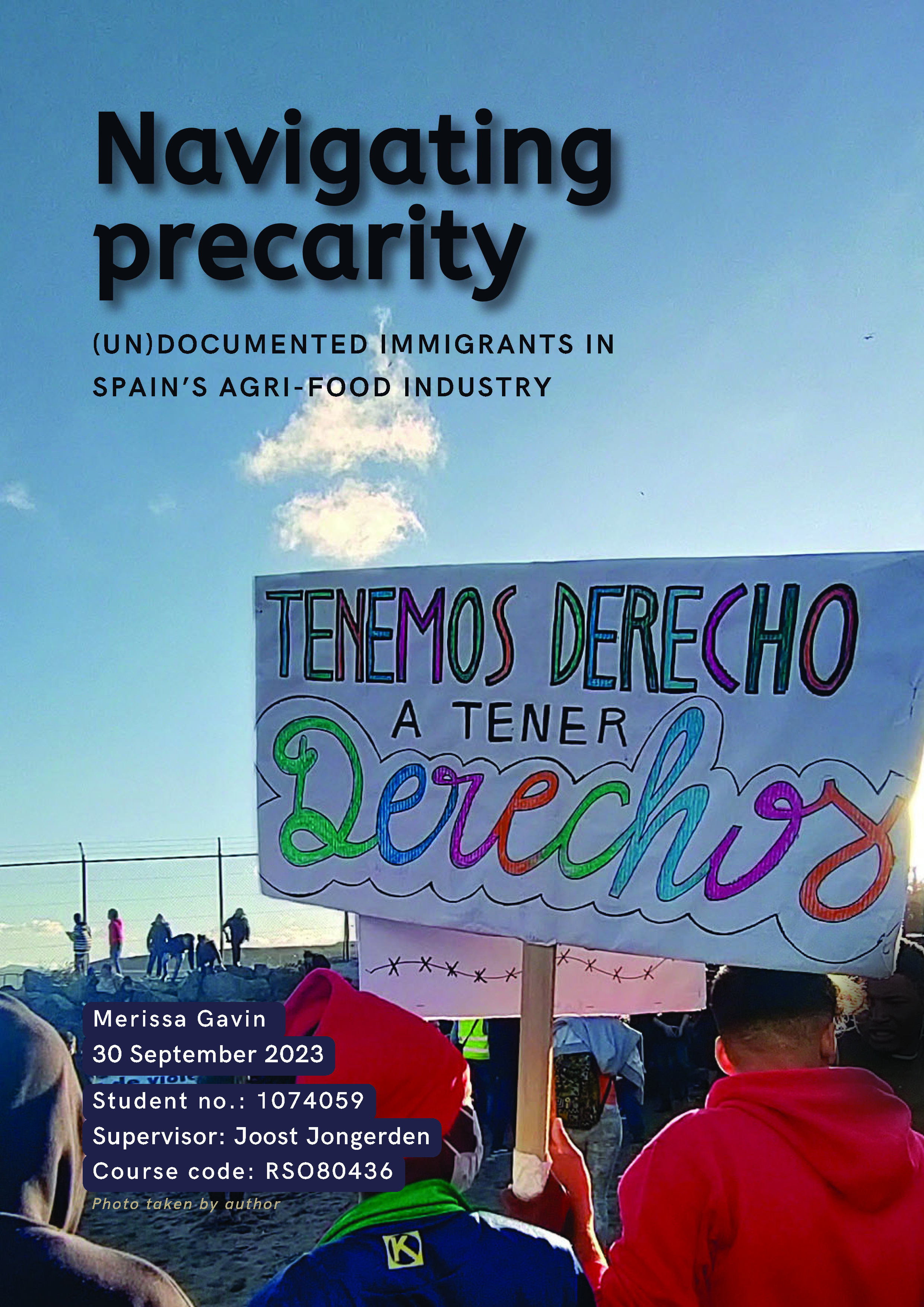
Over the last two decades, immigrant workers have become a structural element of Spain’s agri-food industry. Arriving to Spain undocumented, immigrant workers have few options other than the exploitative working conditions of the agricultural sector. The present research centres on the precarity of these workers, highlighting the multitude of ways they navigate vulnerability and uncertainty. This research is important, firstly, to raise the voice of undocumented immigrant workers and demonstrate how they exercise agency in everyday activities. Secondly, to investigate the socio-spatial conditions that facilitate, or obstruct, the emergence of a collective political being.
Focusing on seasonal harvesting in Andalucía, this research adds to a body of literature on the political creativity of immigrants, where attention to agricultural workers is lacking. The main research question concerns how the legally marginalised, undocumented workers are making and enacting claims for a social and political alternative. This question was addressed through fieldwork research, including participant observation, informal conversations, and semi-structured interviews. Documented or undocumented, immigrants in Lepe face extreme precarity and are in the perpetual struggle of negotiating the tension between being tolerated within the confines of the farm site but unwelcomed and unworthy to participate beyond this space.
In an effort to secure documentation and escape the trap of farmwork, some pledge misguided loyalty to an exploitative boss who feigns benevolence while making empty promises. Others challenge mistreatment at work, threatening to report the boss to the authorities for hiring undocumented workers. Consumed by the micro-politics of everyday life when working the harvest season in the rural right-wing governed town, immigrants in Lepe seldom engage in collective action to claim better conditions. Nonetheless, ostracised from the town centre, they enact a dignified alternative in the informal settlements, where they are freed from the gaze of local residents and authorities and unencumbered by the precarity of their legal status. An intersection of social, spatial and temporal conditions influences the political engagement of immigrants in Lepe. In the absence of an enabling environment, collective action is limited and the prospects for change are bleak.
This is timely research, given the ongoing campaign for blanket regularisation of undocumented immigrants currently living in Spain, as it remains to be seen how the success of the campaign would make material change in immigrants’ lives.
Merissa Gavin (2023) Navigating Precarity: (Un)documented immigrants in Spain’s agri-food industry: https://edepot.wur.nl/640048
 Rural Sociology Wageningen University