
 Last night I saw this new commercial on Dutch television. It’s in Dutch, but you will get the idea just by watching it (otherwise, I can offer translation). I am curious about your opinion in the light of current discussions about our food system. Please leave your opinion on our Facebook page!
Author Archives: Els Hegger
Special Issue on Cooperatives and Alternative Food Systems Initiatives – Free in July
A special issue of the Journal of Agriculture, Food Systems, and Community Development (JAFSCD) on Cooperatives and Alternative Food Systems Initiatives has just been completed and will be freely available — no subscription needed! — through the month of July. http://www.agdevjournal.com/volume-4-issue-3.html We are doing this to make these papers more readily available to researchers and practitioners. It also offers prospective subscribers a chance to explore the contents of JAFSCD. I encourage you to share this notice with your colleagues and networks.
The Special Issue:
Working Together to Build Cooperative Food Systems
Journal of Agriculture, Food Systems and Community Development 4(3)
Edited by: Anderson, C.R., Brushett, L., Renting, H. and T. Gray
A recent emphasis on cooperation and innovative forms of collective action within the food movement invokes a community-centered approach to food provisioning where collective problem solving and democracy take centre place in the development agenda. Cooperative alternative food networks are becoming powerful tools for community development and Continue reading
More local food??
Today I experienced something very personal that I would like to share with you. After an intensive week of project meetings, workshops, presentations, discussions, inspirational sessions and an excursion about urban and local food, I was convinced of the result of the combined effort of the past years. I really thought: Wow! This is really going somewhere! My spirit was up!
However, biking home from our final PUREFOOD project meeting, I was thrown back into reality. As I have been in Spain (see previous posts about life in the Alpujarra) in the past months I went to my favourite bakery for the first time in 4 months. At least, that was my intension. I have been very loyal to this bakery ever since I started living in Utrecht, as it was the only (yes, the only!) true bakery left in the city of Utrecht. All the other places that call themselves ‘bakery’ are actually served by large factory bakeries located out of the city. And you can taste the difference, bread is not bread. You have real bread and you have bread that can sit in your kitchen for a week and still feel fresh (hence: that is not bread). As I am a true Dutchy, I eat a lot of bread and thus was a good customer of the bakery. I had a personal relationship with the owners (the lady was also called Els, which instantly creates a bond) and the people working there, and so I was aware that the son who was actually already owning the bakery had a brain tumor. I always assumed (or maybe hoped…) that a brother, uncle, nephew, or someone would take over temporarily or permanently. It was always packed in the bakery and it was so so nice to be there. The atmosphere was like 25 years ago, nothing fancy, just bread and friendlines.
By now, you probably know where this story is going. I naively biked to ‘my’ bakery to buy something for lunch. I parked my bike and saw they changed the interior. Very fancy ‘rough’ wood, everything neatly in order, no familiar breads and certainly no familiar prices. Hmmm… I was at unease with the situation but had to wait my turn to be helped by a young lady I had never seen before (and I knew all the people working there). Finally, I could ask the burning question: has the bakery a new owner? Very happily she responded positively. All I could say was: “O”. She told me that with the young ill baker it was impossible to keep the bakery running, the parents were getting old and there was no-one that could take it over. But at least they were also a traditional baker, she told me. So, I was relieved. Until she told me that they bake the bread in their traditional bakeries 35 km away! What?? There’s a bakery in this shop, why don’t you use that? “Too expensive and we already bake the bread overthere anyway.” I had to swollow my tears. Yes, really.
On the bike home, I tried to understand why I was so emotionally touched by the situation. For a week I had been discussing all the fantastic initiatives in cities to re-localise food; yet I can’t buy real bread anymore. So, where are we, really?
Life in the Alpujarra (2)
As promised in my first blog about our adventure in the Alpujarra, I will elaborate a bit more about the relationship between foreigners and the locals as it is an intricate one. Small villages like Yegen are doomed to become ghost villages within a generation if the current trend prevails. Young people leave the Alpujarra to study in Granada (or other nearby cities) to escape the old-fashioned rural life. Once they’ve seen life outside the Alpujarra, there’s hardly ever a way back. They grew up with their parents’ struggle in trying to make a living of the land; strenuous physical work in a harsh environment. Much of the land is now owned by the generation that is between 50-65 years old. They migrated (mainly Germany) many years back to earn money as there was little work and the salaries were low in Spain. Upon their return, the “re-migrants” invested their money in agricultural land as a pension for later. However, their children are not interested in working the land, they rather have a job in the city. So, no pension, no children close by to take care of you plus they’re sitting on a large plot of land that is worth close to nothing. The question that has arisen many times in the past months: what will happen to the villages and to the land? Continue reading
Life in the Alpujarra (Spain)
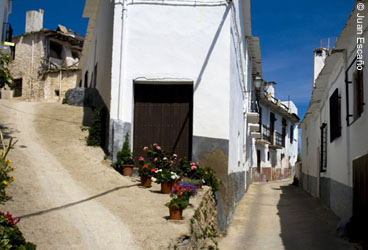 Since the beginning of February my family and I have been in the Alpujarra; south side of the Sierra Nevada in Spain. We are here to experience the rough side of life: being a farmer in a tough arid land. We are trying to get a glimpse of the other side of the food story and feel what it is like to work the land (mainly by hand labour); and give our brain a bit of a rest. But despite the huge amount of physical work we do each day, the mind doesn’t rest. There is just too much going on here: the shrinking and greying villages, the contrast between coastal and hill-side farmers, the young versus the old, the ‘extranjeros’ vs the locals, fighting bush fires vs keeping a varied landscape, organic farmers selling mainstream to the world market, etc etc… I will start by telling you a bit about the village structure here, in Yegen.
Yegen is a small, typical white Moorish village in the centre of the Alpujarra. It seems just another village, but it is bit more special than all the other white towns. A certain Gerald Brenan (a British self-appointed anthropologist) was already fascinated by the life and customs in this village more than 90 years ago. He experienced Yegen as rather backwards (a way of life that he couldn’t imagine still existed) while at the same time the villagers as being extremely open to new comers. He ended up living in Yegen for about 30 years and produced a very popular book. Unfortunately, I haven’t had the chance to get a hold of a copy but I did discover a 45 minute documentary about Gerald Brenan’s return to the village in 1974 (http://www.youtube.com/watch?v=2JAAYPVsQQ4). Interestingly enough, he talks about the huge progress of the village and the change in customs and traditions, whereas to me – born in the late 1970s – it seems to be a pre-War setting. I couldn’t believe it was actually 1974; the streets were huge irregular stones mixed with sand on which only mules were to be seen, the women washed their clothes in a river, no motorised traffic at all. At the same time, Continue reading
 Rural Sociology Wageningen University