Prosumerism in Almere

With colleagues from Wageningen Plant Research and Wageningen Economic Research I have been involved in the research project ‘prosumerism’ (commissioned by AMS and Flevo Campus Almere) in which we studied the extent to which Almere citizens engage in their own food production – for example by growing it in their gardens or picking it in the wild. We used semi-structured interviews with people who can be considered ‘prosumers’ (hence: people who are involved in their food production) and conducted a questionnaire, to which we got 835 respondents.

An important finding is that most prosumers we spoke to are motivated mainly by the enjoyment they get from growing and processing something themselves – making their own wine or fruit juices, for instance. Health and sustainability are less important to most of them. Another important finding is that while a relatively large part of the questionnaire respondents (two thirds) engage in prosumption in some way, for most people these activities are very small-scale.

Jan Eelco Jansma, the project leader, wrote a blog about our work. Our report can be downloaded here. Both are in Dutch.  Klein kader Archetype 3


Thesis opportunity: the gentrifying foodscape part II

The urban foodscape is in constant transition, among others due to gentrification. This has effect on options and choices of both newcomers and people who have been living in the neighborhood for longer.

Sophie Visser, MSc student Health and Nutrition, studied the gentrifying Amsterdam neighborhood ‘Van der Pekbuurt’ (see Sophie’s blog on her results) by mapping its food establishments, interviewing both older and newer inhabitants and making observations. She found that due to gentrification the number of establishments in the neighborhood increased immensely. While this has positive aspects – the increased offer leads to an increased choice – not all inhabitants feel comfortable in all these new establishments.

We are looking for a student to continue Sophie’s work on gentrification and foodscapes. Preferably the student would follow up on the previous thesis by updating the mapping of the foodscape, and executing more interviews with a broader group of people. Alternatively, the student chooses another neighborhood (in Amsterdam or elsewhere) in a further state of gentrification, in order to get a broader view on how gentrification can affect foodscapes.

Pre-requisites: completed at least two social sciences courses (preferably with RSO); keen interest in foodscapes; able to conduct qualitative research, preferably but not necessarily in Dutch

Supervisor: Esther Veen (RSO): esther.veen@wur.nl

Questions? Please get in touch!

Gentrification and the Van der Pek foodscape

Written by Sophie Visser

‘Gentrification’ transforms cities all over the world. Neighbourhoods are upgraded and there is an influx of new, affluent inhabitants. This often has a negative effect on the longstanding inhabitants of that neighbourhood, as they can no longer afford the housing and no longer feel welcome due to the neighbourhood’s changed cultural and social atmosphere. Gentrification influences the foodscape as well. While there may be an increase in food availability, food accessibility for longstanding inhabitants often decreases due to an increase in price and because longstanding inhabitants do no longer feel welcome in the facilities in their neighbourhood.

With this thesis I aimed to investigate the effects of gentrification on the foodscape, the food choice and food accessibility for the inhabitants of the gentrifying Van der Pek neighbourhood, located in the North of Amsterdam. I used semi-structured interviews, observations, informal conversations and food mapping to collect data.

I conclude that the Van der Pek neighbourhood is at an early stage of gentrification. There is an influx of new inhabitants and a slow decrease in the number of longstanding inhabitants, who are aging and passing away. Over the past years, the number of establishments in the Van der Pek neighbourhood increased immensely. This appears to be positive at first sight because the increased offer leads to an increased choice for the inhabitants. However, not all inhabitants feel comfortable at every establishment. The new establishments are often more expensive, which is unsuitable for longstanding inhabitants: they base their food choice on price and often have lower incomes. Additionally, while some new establishments try to target both new and longstanding inhabitants, mostly new inhabitants are attracted to these establishments. Hence, even though the number of establishments has increased, as the gentrification process furthers, access to food might increase for new inhabitants but decrease for longstanding inhabitants.  

voorblad Sophie

As this thesis provides an in-depth analysis of the foodscape and food choices of inhabitants of the gentrifying neighbourhood, it can provide valuable information to the municipality of Amsterdam – who wants to prevent a division between the two groups of inhabitants in gentrifying neighbourhoods. Besides that it can lead to further research on other gentrifying neighbourhoods to provide a better overview of the influence of gentrification on foodscapes and food choice.


Indoor gardens for nursing homes

By Paulien van de Vlasakker

Advanced technology and alternative food-production methods, such as vertical farming and hydroponic cultivation, are part of an upward trend of initiatives for the support of the transition of conventional food-production methods to more decentralized and local production systems. The development of high-tech urban agriculture is one strategy for more sustainable and resilient urban food systems being explored by cities worldwide to feed their increasing populations.

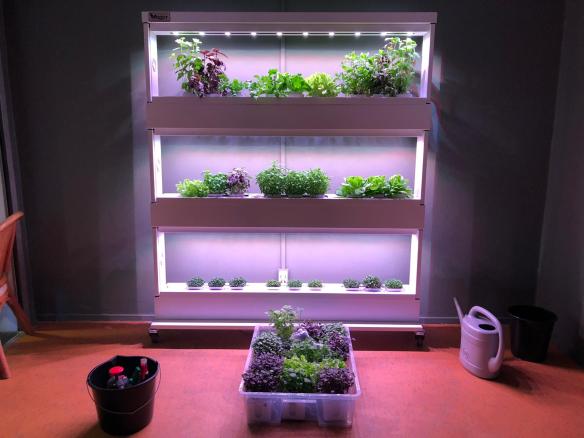
To contribute to the development of urban high-tech agriculture, I established Vegger in October 2016. Vegger is a start-up located on the Wageningen University & Research campus. During the first few years, my colleague and I designed and developed high-tech indoor gardens for the cultivation of vegetables and herbs inside people’s working and living environment. The indoor gardens that we created are cultivation systems equipped with horticultural led lightening, soilless cultivation methods and a controlled environment system. Vegger is part of StartLife, the business facilitator of Wageningen University. We rent our office/working space in StartHub, located in the Atlas Building.
Vegger

For my internship, as part of my MSc Organic Agriculture, I conducted a pilot project with high-tech indoor gardens in two nursing homes of Stichting Innoforte located in Velp, Gelderland. Growing vegetables inside nursing homes can be a response to the need for an increased intake of fresh and local vegetables by elderly people. In addition to increasing vegetable intake among the elderly, this pilot project also focused on contributing to the creation of a healing environment in the nursing homes. A healing environment is a (physical) environment that aims to promote the well-being of patients, their family and the employees, and to reduce their stress. This way people may heal faster (or the (physical) environment does not worsen their situation). The goal of my internship was to explore how high-tech indoor gardens can contribute to: 1. the consumption of fresh vegetables and herbs among the residents, and 2. the healing environment of the location.

I placed the indoor gardens in two locations. One of the locations was specialized for elderly people with far stage dementia. The other location offered housing for elderly people that do not need (intensive) care. It is important to mention that the locations make use of a different food delivery system. In the location for demented elderly, the staff cooks with fresh foods and matching recipes delivered by their food supplier. The meals for the ‘healthy’ elderly from the other location are ready-to-eat frozen meals. These meals do not contain any fresh ingredients.

During my internship I supported the indoor gardens by delivering gardening services. These services consisted of the maintenance of the indoor garden, including the cultivation of plants. The staff was responsible for harvesting the fresh vegetables and herbs. A food expert was appointed by the health care organisation to assist with the contact between me and the end users (staff and residents of both locations). As research methods I used informal conversations with staff, elderly and friends and family of the elderly, observations of the use of the gardens (including harvesting, engaging with the garden, and talking with others over the garden), and measuring the number of plants harvested by staff.

The results of the study were different between both locations. In the nursing home where the demented elderly live, the indoor garden was especially useful to enhance the healing environment. The residents of the home liked to sit next to the indoor garden; the aesthetic aspect of the indoor garden contributed to an improved living and relaxing environment. The vegetables and herbs growing in the indoor garden, however, were not used to their full potential. This was due to the fact that the home for demented elderly was already being supplied with fresh ingredients by their food supplier. In the other home, where ‘healthy’ elderly people live, on the other hand, full usage was made of the vegetables and herbs from the indoor garden. This was because previously no fresh ingredients were used in the meals. Staff used the fresh vegetables and herbs to prepare side dishes such as soup or salad.

The difference between the use of the high-tech indoor gardens did not only relate to the difference in food supplier, but also to the mental health of the elderly. Elderly with dementia experience on average higher stress levels than mentally healthy elderly. Optimizing a healing environment with indoor gardens can therefore have a greater impact on providing a quiet and relaxed environment for the residents. In addition, the elderly who live in the home for ‘healthy’ elderly people were more aware of the meals that were served. The residents of the home indicated that the fresh vegetables and herbs not only made the meal taste better, but also contributed to the experience of the meal because there were ingredients used from their own garden.

Call for contributions

Cultivating hope while getting into trouble with Community Food Initiatives (CFIs)

RGS-IBG Annual International Conference, London, August 28th-30th 2019

Session sponsored by: Food Geographies Working Group

Community food initiatives (CFIs), such as community gardens or food waste initiatives, are often framed as hopeful solutions to our troubled food system. Yet the actual interrelations of hope and trouble are rarely interrogated in locally specific contexts. Hope and trouble are often employed in partial and limiting ways. CFIs are critiqued for being too hopeful, reproducing existing troubles (e.g. racism, power, privilege, and exclusion). Other readings strategically avoid the dominance of trouble, to leave space for hope and possibility. Neither approach is sufficient. Moreover, binary affects of hope and trouble can create methodological tensions that effect our own abilities to engage in action research that is both critical and reparative, hopeful and troubling.

The aim of this session is to develop new methodological, theoretical, and practice-based approaches for interrogating CFIs as sites of hope and trouble. Exploring diverse organizational forms, actors, benefits, and impacts, enables an understanding of their hopes, best intentions, and generative capacities as well as their troubles, failures, and limitations. We are interested in new stories and tools for helping researchers and community food initiatives “get into trouble” in our food system.

We welcome empirically, methodologically, and/or theoretically driven papers and discussions that engage with the hope and trouble of community food initiatives, such as:

  • Food waste initiatives
  • Food banks
  • Community gardens
  • Alternative food networks
  • Solidarity purchasing groups
  • Food Cooperatives
  • Social enterprises
  • Food advocacy organizations

We propose a format of two successive sessions. The first session follows the general structure of paper presentations followed by time for questions and short discussions. We use the second session for more thorough in-depth discussion. The first hour will be used for a world cafe setting to discuss recurrent themes in groups. We will use the last forty minutes for a ‘talk show’: we ask a representative from each table to come forward. We will then discuss the findings of each group by way of a talk show format: one interviewer asks questions to the representatives, potentially leading to discussions or an exchange of ideas. With this set-up we hope to elicit lively discussions on the topic, from various viewpoints and entry points.

Please contact the convenors to indicate whether you would like to present a paper and/or whether you would like to participate in the world cafe. Paper abstracts due by February 1st.

Session Convenors: Esther Veen (esther.veen@wur.nl), Oona Morrow (oona.morrow@wur.nl), Stefan Wahlen (stefan.wahlen@wur.nl), Anke de Vrieze (anke.devrieze@wur.nl)