Global Justice and the Politics of Water and Life in Palestine

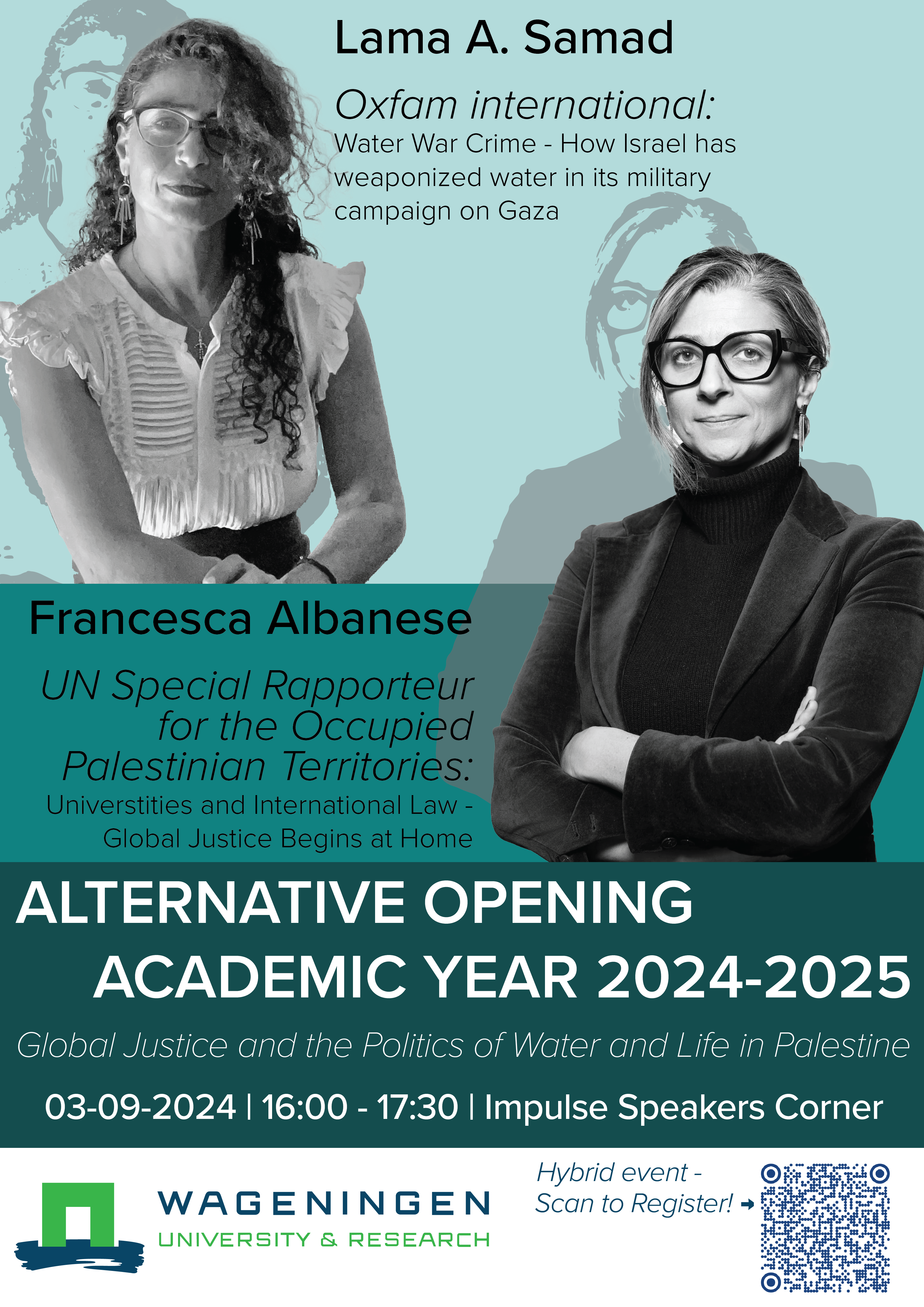
Seminar “Global Justice and the Politics of Water and Life in Palestine”.

September 3, 16.00-17.30

16.00 Opening and Welcome. Joost Jongerden, Associate Professor at Rural Sociology, WUR

16.10 Presentation by Francesca Albanese, UN Special Rapporteur for the Occupied Palestinian Territories: “Universities and International Law: Global Justice Begins at Home”

16.35 Presentation by Lama Abdul Samad, Oxfam International: “Water War Crime: How Israel has weaponised water in its military campaign on Gaza” 

17.00 Q&A. Moderation by Lucie Sovova (on location), Assistant Professor at Rural Sociology, WUR, and Jessica Duncan (on-line), Associate Professor at Rural Sociology, WUR

17.20 Closing words by Amal Ahmad, Assistant Professor at Development Economics, WUR

17.30 Closure

Presentation by Francesca Albanese (UN Special Rapporteur OPT)
Presentation by Lama Abdul Samad (Oxfam International)

Sociale rechtvaardigheid begrijpen vanuit ‘verbranding’: jonge mannen op het platteland

Jolien Klok, onderzoeker bij de vakgroep Rurale Sociologie, Wageningen Universiteit

Het publieke debat rondom ‘de kloof tussen stad en platteland’ lijkt even bedaard, terwijl we – de één rijkhalzender dan de ander – wachten tot het nieuwe kabinet zijn plannen uitwerkt en daarin kleur zal geven aan het Nederlandse platteland. Hoewel er vanuit de wetenschap geluiden klinken dat het al teveel herhalen van een veronderstelde ‘kloof’ haar reproductie alleen maar zal doen toenemen (Huijsmans & Miltenburg, 2023; Van den Berg, 2023), als een self-fulfillingprophecy, is het onmiskenbaar dat sociale ongelijkheid zich ruimtelijk manifesteert en met name op het platteland gevoeld wordt (Huijsmans, 2023; Van Vulpen, 2023).

Continue reading

Decolonization Agriculture – New Article in Third World Quarterly

This article, authored by Necmettin Türk from Critical Geographies of Global Inequalities at the University of Hamburg and Joost Jongerden from the Rural Sociology Group at Wageningen University, discusses agriculture in the context of colonization and the debates it has sparked. The authors examine the colonial homogenizing policies of the Syrian Ba’ath regime and the subsequent decolonization processes that led to the emergence of Rojava as a pluriverse.

The Ba’ath regime, in power since 1963, implemented nation-state colonialism in the predominantly Kurdish region, using agricultural modernization as a tool for its colonization efforts. This modernization bolstered the central state, perpetuated the underdevelopment of the region as a periphery, and asserted control through the settlement and land distribution to Arab families loyal to the regime. Following the regime’s collapse in Rojava in 2012, the communities that comprise the Autonomous Administration of North and East Syria (AANES) dismantled the colonial agricultural system. They developed a decentralized governance and agrarian development approach, referred to here as the decolonization of agriculture.

Based on interviews and fieldwork in the region, the article explores the interplay between agricultural development and colonial politics, as well as the critical role of agriculture in the broader struggle for decolonization. The authors conclude that in the anti-colonial struggle, people and the rhizomatic governance structures they develop challenge colonial submission to the central state, exploring life beyond the nation-state, which is crucial for a decolonial shift.

The article is published open access under this link: https://www.tandfonline.com/doi/full/10.1080/01436597.2024.2374521?src=exp-la

Democracy in Agriculture and Food Provisioning: A Citizenship Lens

Spring School-PhD course May 19-23, 2025

With daily seminars by Engin Isin and contributions by Cristina Grasseni, Robin Smith, Joost Jongerden, and Han Wiskerke

Fair and just agriculture and food systems have been central issues in policy and practice for much of the 20th and 21st centuries. Peasants, consumers, and social movements have been fighting for rights such as land ownership, access to healthy food, and the right to determine our agricultural and food futures for many decades, if not centuries. Few have conceptualized this in terms of citizenship. Yet by questioning what is fair, just, and right, challenging the working of our agrarian and food systems, and practising alternatives people establish themselves as citizens, and more specifically as agrarian and food citizens.

Continue reading

Taxing tradition in Istria, Croatia

Robin Smith

On its face, taxation is not the most alluring subject for those of us studying rural farming communities. However, taxation touches much of what we care about in these spaces. Taxation fundamentally shapes the economic structure of rural areas, influencing the viability of family businesses and the ability of rural entrepreneurs to establish themselves in the formal economy. Taxes can make and unmake markets, sometimes in dramatic fashion.

: Taxing tradition in Istria, Croatia Continue reading