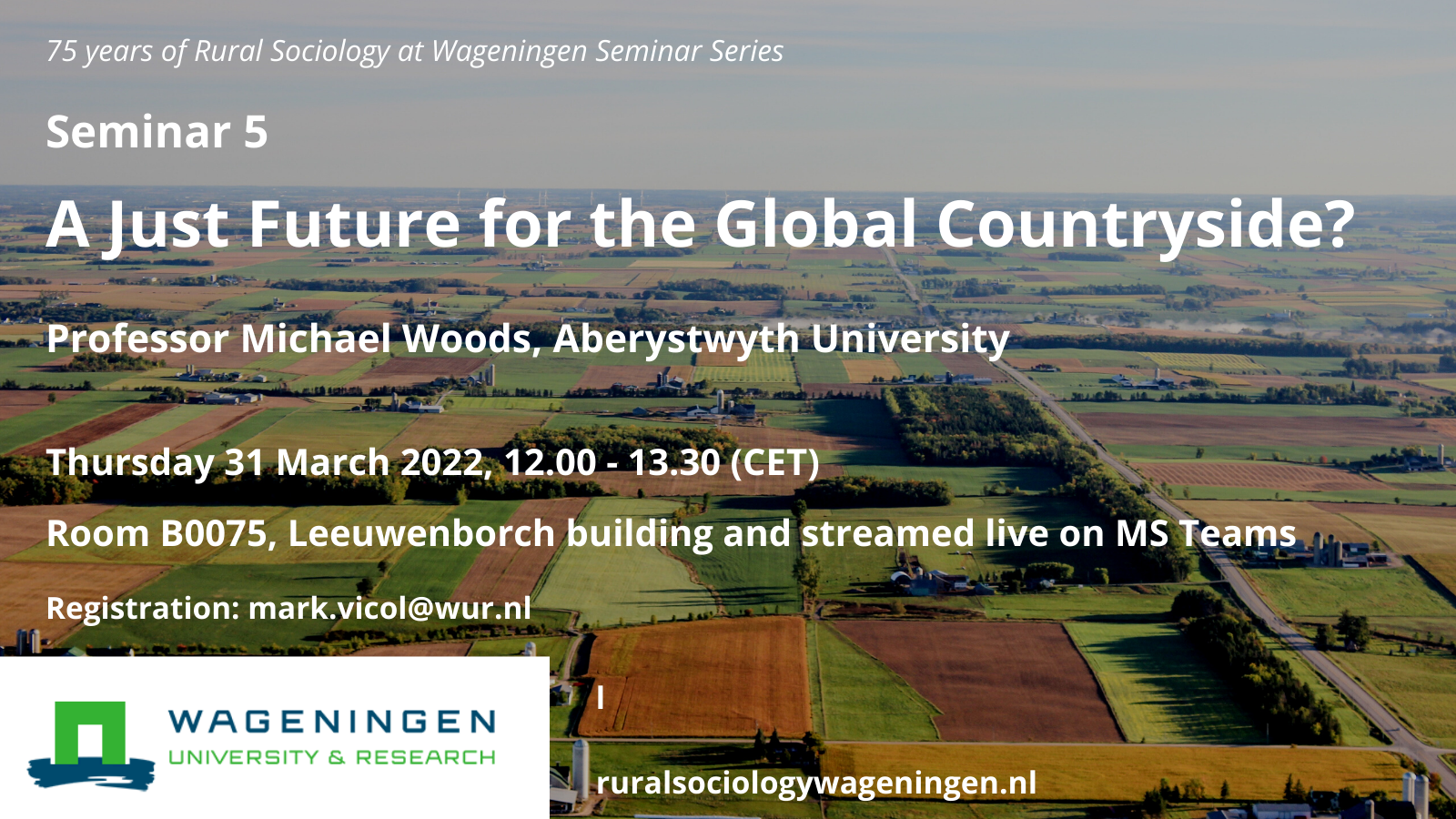
Webinar 5: A Just Future for the Global Countryside? by Michael Woods @WoodsZzp

A Just Future for the Global Countryside? by prof. Michael Woods, Aberystwyth University, Thursday March 31, 2022, 12.00-13.30 (CET).

The talk is part of the Rural Sociology 75th Anniversary webinar series ‘Looking back, Looking Forward: Setting a future agenda for rural sociology’. Watch recordings of the webinars series at Rural Sociology Youtube channel.

The event will be streamed by Teams. Email to mark.vicol@wur.nl to register yourself.

75th Anniversary: 55) Research at the Rural Sociology Group: The Spatial Dimension of Insurgent-Civilian Relations: Routinised Insurgent Space

Francis O’Connor

I was born in the 1980s, in the bucolic countryside of west Limerick where I  enjoyed an idyllic and happy childhood, completely distant from the conflict which wracked the north of Ireland during the so called “Troubles”. Nevertheless, as an admittedly very precocious child, through overheard snippets of adult conversations, impertinent questions, partially understood news headlines, the occasional drama of IRA arms dumps found in the local area and the half-earnest choruses of “Up the Ra”[1] that permeated the Irish social life of my childhood, I recognised the presence of an unspoken something. A something which did not interfere in any way with my childhood priorities of playing hurling and avoiding the hard jobs on our family farm, but as I grew up and read more about Irish politics and what had been happening on the island, it remained a something that engendered a curiosity in me. How was it possible that an armed Republican group, the Irish National Liberation Army carried out Ireland’s biggest ever robbery (21 million euro in today’s terms) in 1978, at the other side of my small parish? Within my childhood cycling radius, where in my experience literally nothing ever happened.  Even now the Mullaghareirk Mountains of my home, are a disorientating maze of narrow roads, high hedgerows, bog, woods and scrubland, in 1978 they would have been completely unknowable to an armed unit of Socialist Republicans from the North. Without local knowledge and assistance, would such an ambitious robbery have ever succeeded? Were the people of my childhood, someway complicit in supporting the violence, incessantly critiqued by the political mainstream in Ireland? Why would people like me and mine, safely ensconced in the rhythms our rural lives get unnecessarily involved in a violent campaign that resulted in hundreds and thousands of deaths? Was it ideology, a sense of obligation or guilt, hatred, fear, ignorance or mere happenstance? This unresolved, half-forgotten line of questioning lay dormant through my formative years.

Half-forgotten that is, until I began university in 2003, at the hysteric heights of the “War on Terror”, where terrorism and support for terrorism saturated all political debate and infiltrated our university discussions and seminars. This reawakened my latent interest on what support for political violence comprises. It led me to take every available course and seminar on civil wars and political violence, to do a Masters on Middle East politics and eventually brought me to Italy to a PhD on the relationship between the PKK and its supporters at the European University Institute in Florence. Under the guidance of Professor Donatella della Porta, one of the world’s leading social movement scholars, I found myself immersed in a vibrant conceptual and theoretical universe. One shaped by the ongoing debate centred on the ground-breaking Dynamics of Contention (2003) by Doug McAdam, Sydney Tarrow and Charles Tilly which argued for a broad approach to the study of a spectrum of contentious politics according to its constituent mechanisms. A spectrum which ranged from episodes such as riots to full blown insurgencies. 

This debate had stimulated a parallel blossoming of social movement research on violence, expanding beyond its foundational pillars of political opportunity structures, resource mobilization and framing to incorporate a relational focus emphasising the dynamic and contingent elements of violent social change. One which argued it was less the inherent characteristics of movements that determined their success or failures, but rather how movements interacted with political institutions, political adversaries and allies that provided a better explanation of political outcomes.  This new wave of research also addressed the criticism that social movement studies had been the empirical preserve of western liberal societies by also incorporating research on global violent and non-violent movements. And since then, I have found myself drawing from this rich theoretical spring of contentious politics and social movements to better understand why civilians support armed movements. An intellectual reservoir which has emboldened me to take a critical stance on much of the rationalist and structuralist approaches which have dominated the study of conflict. After a few twists and post-doctoral turns through Italy, Denmark and Germany, and extremely satisfying diversions to work and publish on lone actor radicalisation, anti-austerity protest, referendums and pro-independence movements, I arrived at the RSO with a new project, that addresses the spatial dynamics of armed groups’ interactions with their supportive constituencies.

The Spatial Dimension of Insurgent-Civilian Relations: Routinised Insurgent Space

In mid-2021, my book Understanding Insurgency: Popular Support for the PKK in Turkey (Cambridge University Press) based on the findings of my PhD research was published. During the many years it took to finally publish the book, and in light of the increasingly hostile research environment in Turkey, I decided to attempt developing a comparative research agenda, to see if the PKK’s determination to maintain the active support and approval of its constituency was an outlier and if other groups were similarly minded. Through a series of chance encounters, I came into contact with the M-19, an armed group which was active in Colombia from the 1970s until 1990.  I set about learning Spanish and in 2018 conducted fieldwork with former supporters and veteran members of the M-19 in Bogota.

 Reflecting upon the interviews I conducted with both the PKK and the M-19, it became clear that the relationship between the insurgents and supporters was not simply a relational dynamic, but one which took place in specific spaces. Encounters between insurgents and civilians were rarely random, they occurred in specific places at specific times. Armed M-19 operatives boarded buses packed with workers to engage in revolutionary propaganda before disembarking and disappearing into early morning rush hour. In the 1990s the PKK organised revolutionary picnics on the outskirts of Istanbul to recruit youngsters. The PKK transformed funerals from instances of private grief and loss, to occasions of revolutionary defiance. The M-19 actually built neighbourhoods for the rural displaced on the margins of Colombia’s rapidly expanding cities. Interviewed insurgents were explicit in how they strategically tailored their encounters to create favourable interactions which reflected positively on the movement. In certain neighbourhoods (or spaces in a conceptual sense) they promoted Kurdish or Colombian nationalism, in others they emphasised traditional socialist objectives. What do revolutionary courts in Kurdistan, the distribution of wellington boots and milk, the ritualised burying of the dead and the organisation of daily life in prison have in common? I argue that they are all forms of Routinised Insurgent Space (RIS).

RIS can be understood as the way insurgent movements deliberately engineer or appropriate existing social spaces to facilitate interactions with supportive constituencies. RIS contains functional and symbolic logics: it embeds armed groups in their immediate spatial environments allowing them access to local resources, but it is also a means of consolidating political legitimacy. From the perspective of the constituency, RIS renders interactions with armed actors safer and more predictable and can potentially lead to a form of joint habitus regarding political identity and behavioural norms. Although the types of RIS implemented are expressions of insurgent movements’ strategy, they are reciprocally constituted and shaped by local civilian agency which can resist or alter them.  My project focuses initially on four distinct forms of RIS: Insurgent Policing & Courts, Insurgent Service Provision, Insurgent Prison Mobilisation and Insurgent Funerals. A rigorous literature analysis and suggested that these four forms are not ideologically specific and recur across almost all types of insurgent mobilisation to greater or lesser extents.

As a comparative project, it of course strives to identify similarities and differences between the cases, but it also focuses on within-case variation. How do forms of RIS vary from urban to rural areas and even across wealthier and poorer neighbourhoods? In contrast to the flourishing rebel governance approach, it also attempts to track how these forms of incipient governance evolve over time rather than focusing on insurgent institutions once they are already established. It tracks efforts to create forms of RIS from their earliest incarnations, analysing why their success varies. In terms of data, the project will make use of interview data with former insurgents and their constituency. A key milestone in the project will be the hosting of a workshop at the RSO in September 2022 titled: The Margins of Insurgent Control: Spaces of Governance.  It is specifically designed to merge the relevant literatures from contentious politics and social movements, social geography anthropology and rebel governance with an explicit focus on the nature of the data used to study armed movements.

O’Connor, Francis. 2021. Understanding Insurgency: Popular Support for the PKK in Turkey. Cambridge: Cambridge University Press.


[1] “Up the Ra” is short for Up the IRA. In Irish, one would express support for somebody or something by shouting for example Gailimh Abú meaning “come on Galway”. In Hiberno-English, abú has been directly translated as up, leading to  the use of ”up something or other” as a common phrase. Up the Ra is a phrase which has to a certain extent escaped its original political connotations and has found its way into sports chants, drunken tomfoolery between non politicised groups of friends and into popular songs. However, its connotations are contextually dependent and can take on a greater or lesser air of menace according to who is in earshot.

75th Anniversary: 54) Research at the Rural Sociology Group:  Making a Difference

Dirk Roep

Overall, my main interest has been on how people come together, and, in collective action, (attempt to) make a difference – how they overcome the constraints they encounter in their everyday life, how in their practice they not only deviate from what is taken for granted or imposed but (try to) make what is considered impossible possible and how they can create meaningful differences and opportunities. Meaningful to themselves, but also as meaningfully novel, promising practices, opportunities in the light of all the challenges that humanity faces in making our earthly life more healthy, sustainable, equitable and inclusive – a better place for all. This points to agency as an intermediary between actors and structures and particularly to transformative agency.

Change is not inherently good – it can also be quite ugly. We are subject to all kinds of dynamically interacting processes that impact on our everyday life, human and non-human initiated and operating on different scales. We need to time and again scrutinise, evaluate and critically reflect on the impact that all these processes have on humans and non-humans, on all that matters. This is core to what rural and rural and agrarian sociology is about for me.

In this respect, the PhD thesis on two diverging styles of farming (Stijlen van Landbouwbeoefening: uiteenlopende ontwikkelingspatronen) by Van der Ploeg and Bolhuis (1985) was an eyeopener to me as a novice in the field. It demonstrated that farmers are indeed subject to all kind of ordering processes in which farming is situated, thus limiting the space for farming and even imposing or enforcing a particular mode of farming – but also that farming and farm development is not fully determined by these hegemonic processes.

Within the Technical Administrative Task Environment (TATE), as Bruno Benvenuti (1982) conceptualised the prescriptive structuring principles, there is space for resistance, deviation and divergence, a certain autonomy, although to what extent is not only an empirical question but also heavily debated. Farmers can indeed make a difference, by structuring their (family) farm labour in meaningful ways following a particular rationale based on more widely shared opinions, values and norms about how to best farm that are internalised and externalised in interaction as evolving patterns of ‘rules in use’ (Ostrom 1992).

Styles of farming can be seen as institutionalised ways of doing, thinking and feeling (Berger & Luckman 1967). This explains how diverging styles of farming, as different modes of ordering (Law 1994), emerge within (apparently) homogeneous settings. Farmers, as individuals but more often in collectives, both resist the structuring (political, economic and bio-physical) forces they are subject to in their everyday life and also build the individual and collective capacity to bypass these forces by creating relatively autonomous protected spaces or niches that provide them with the room for manoeuvre to differ, deviate and differentiate according to their rationale. This is how I became engaged in rural and agrarian sociology. The institutional imperative (Zijderveld 2000) has guided me since in understanding how continuity and change are inherent to action and how heterogeneity is reproduced in interactions between humans and non-humans, between society and living and dead matter with technology as an intermediate (Roep 2000).

In my (1989) MSc-thesis, ‘Stap voor Stap of in een Sprong’ (Step by Step or in one Leap), I explored differential growth patterns and family farm income strategies among farmers producing milk for the famous Parmigiano Reggiano, extending the PhD-research by Van der Ploeg, which was further elaborated in Van der Ploeg, Saccomandi and Roep (1990). This became the launching pad for a series of studies on farming styles – ‘bedrijfsstijlen’ in Dutch, following Hofstee – starting in the Netherlands with Van der Ploeg and Roep (1989). Not only were different farm development and family income strategies based on different rationales revealed by this work but also the differentiated impacts they had, such as on the environment through significant variations in nutrient losses. It was also revealed that farmers, within their institutional embedding, built different capacities when following different farm development paths. Farming styles did make a difference, and this made them politically relevant considering the challenges agriculture was, and it still is, facing and the search for more sustainable and even regenerative farming practices.

The farming styles research also showed that farmers on their own, in supporting networks and in collectives were pioneering alternative farming practices to escape the pressing income squeeze in ways other than by increasing production volume. During the 1990s, the Rural Sociology research team at Wageningen became engaged with various farmer-driven initiatives developing alternative farm development strategies and pathways for agrarian and rural development. These were subsequently mapped, first in the Netherlands and then later across Europe (van der Ploeg & Banks 2002). The broadening, deepening and regrounding of farm practices were identified as alternative income strategies to counter further marginalisation, and an alternative rural development paradigm emerged to the dominant productivist paradigm promoting scale enlargement, intensification and specialisation as the only viable strategy (van der Ploeg & Roep 2003).

Within the framing of this alternative paradigm, local grassroots initiatives developed the necessary but previously lacking capacity to develop and operate in experimental spaces or niches, supported by newly created alliances and networks. I became engaged with a group of pioneering farmers in the western peatland area that, inspired by renowned high added value products with a denomination of origin like the Parmigiano Reggiano and Comte, aimed to upgrade farm-made cheese, Boerenkaas, a speciality product with excellent but underdeveloped potential. Having turned completely towards bulk production, the Netherlands lacked both the capacity to produce and market high-quality speciality food products with a denomination of origin and the proper institutional setting to support this.

Based on this case, I argued in my PhD-thesis, ‘Innovative work: tracks and traces of capacity and incapacity’ (Roep 2000), that the narrowly focused productivist paradigm which had dominated agriculture and rural development since the 1950s and transformed Dutch agriculture and rural areas profoundly through its comprehensive capacity had, at the same time, resulted in an institutionalised incapacity. Diversity was long seen as an aberration, not as a rich source to explore alternative, promising pathways.

Thus, there developed a research agenda on the transformative potential of a wide range of novel practices in farming and food provisioning – or, the Seeds of Transition (Wiskerke & Van der Ploeg 2004). I have been involved in some of the research projects and publications exploring promising sustainability pathways and the new capacities being forged. We have identified and elaborated on various niches supported by alliances in new networks and the accompanying, co-evolving institutional reform (Roep & Wiskerke 2004, 2006, 2012).

The transformative capacity of grassroots initiatives and promising practices, the ability to make a difference and specifically the struggle with allies for and the creation of a favourable institutional embedding to counter unsustainabilities, degeneration, exclusion and inequalities make up the connecting thread throughout my research (Horlings, Roep & Wellbrock 2018; van den Berg et al. 2018). This was complemented by a relational approach, inspired by actor-network theory (ANT) (Law & Hassard 1999) and what Law and Mol (1995) dubbed ‘relational materialism’, and then by Massey (1994) and others with regard to place-shaping practices. This was foundational to the Marie Curie ITN project ‘SUSPLACE: Exploring the Transformative Capacity of Place-Shaping Practices’ (Horlings et al. 2020). Thence, the focus of my work has shifted from sustainable farming practices to sustainable food provisioning practices and sustainable place-shaping practices – and, more recently, from sustainability to regeneration as a future guide.

In line with the above, my current interest is in grassroots or citizens initiatives that aim to

  • Restore and regenerate agro-ecosystems, particularly pioneers in regenerative agriculture and regenerative modes of food provisioning;
  • New commons and commoning, particularly diverse forms of community farming.

And, not least, support and report once again on those initiatives engaged in making a difference.

References:

  • Benvenuti, B. (1982) De Technologisch-Administratieve Taakomgeving (TATE) van landbouwbedrijven. Marquetalia, 5, p.111-136.
  • Berger, P.L., and Luckman, T. (1967). The Social Construction of Reality; A Treatise in the Sociology of Knowledge. London: Penguin Press.
  • Hermans, F., Klerkx L., Roep, D. (2016). Scale Dynamics of Grassroots Innovations Through Parallel Pathways of Transformative Change. Ecological Economics, 130: 285-295.
  • Horlings, L.G., Roep, D. and Wellbrock, W. (2018). The Role of Leadership in Place-Based Development and Building Institutional Arrangements, Local Economy, 33(3): 245-268.
  • Horlings, L.G., Roep, D., Mathijs, E., Marsden T. (2020). Exploring the Transformative Capacity of Place-Shaping Practices, Sustainability Science, 15: 353-362.
  • Law, J. (1994). Organizing Modernity. Oxford: Blackwell.
  • Law, J., and Mol, A. (1995). Notes on Materiality and Sociality, The Sociological Review, 43: 274-294.
  • Law, J., and Hassard, J. (Eds.) (1999). Actor Network Theory and After. Oxford: Blackwell.
  • Methorst, R.G., Roep, D., Verstegen, F.J.H.M., and Wiskerke, J.S.C. (2017). Three-Fold Embedding: Farm development in relation to its socio-material context. Sustainability, 9: 1677.
  • Massey, D. (1994). Space, Place and Gender. Cambridge (UK): Polity Press.
  • Moschitz, H., Roep, D., Brunori, G., and Tisenkopfs, T. (2015). Learning and Innovation Networks for Sustainable Agriculture: Processes of co-evolution, joint reflection and facilitation, The Journal of Agricultural Education and Extension, 21(1): 1-11.
  • Ostrom, E. (1992). Crafting Institutions for Self-governing Irrigation Systems. San Francisco: ICS Press.
  • Roep, D. (1988). Stap voor Stap of met een Sprong: Bedrijfsstrategieën in het landbouwstelsel van de Parmigiano Reggiano. Doctoraalscriptie Agrarische Ontwikkelingssociologie. Wageningen: Wageningen University. (Dutch)
  • Roep,, D. (2000). Innovative Work: Tracks of capacity and incapacity. PhD thesis. Wageningen: Wageningen University. (Dutch)
  • Roep, D., van der Ploeg, J.D., and Wiskerke, J.S.C. (2003). Managing Technical Institutional Design Processes: Some strategic lessons from environmental co-operatives in the Netherlands, NJAS Journal for Life Sciences, 51(1-2): 195-217.
  • Roep, D., and Wiskerke, J.S.C. (2004). Epilogue: Reflecting on novelty production and niche management in agriculture, in J.S.C. Wiskerke and J.D. van der Ploeg (eds.), Seeds of Transition: Essays on Novelty Production, Niches and Regimes in Agriculture, pp. 341-356. Assen: Van Gorcum.
  • Roep, D., and Wiskerke, J.S.C. (Eds.). (2006). Nourishing Networks; Fourteen Lessons About Creating Sustainable Food Supply Chains. Rural Sociology Group. Wageningen/ Doetinchem: Wageningen University and Reed Business Information.
  • Roep, D., and Wiskerke, J.S.C. (2012). On Governance, Embedding and Marketing: Reflections on the construction of alternative sustainable food networks, Journal of Agriculture and Environmental Ethics, 25: 205-221.
  • van den Berg, L., Roep, D., Hecink, P., and Mancini Teixeira, H. (2018). Reassembling Nature and Culture: Resourceful farming in Araponga, Brazil, Journal of Rural Studies, 61: 314-322.
  • van der Ploeg, J.D., and Bolhuis, E.E. (1985). Boerenarbeid en Stijlen van Landbouwbeoefening; En socio-economisch onderzoek naar de effecten van incorporatie en institutionalisering op agrarische ontwikkelingspatronen in Italië en Peru, Leiden Development Studies, 8: 511.
  • van der Ploeg, J.D., Saccomandi, V., and Roep, D. (1990). Differentiële Groeipatronen in de Landbouw: Het verband tussen zingeving en structurering. Tijdschrift voor Sociaal wetenschappelijk onderzoek van de Landbouw, 5: 108-132.
  • van der Ploeg, J.D., and Roep, D. (1990). Bedrijfsstijlen in de Zuidhollandse Veenweidegebieden: Nieuwe perspektieven voor beleid en belangenbehartiging; Koninklijke Land– en Tuinbouwbond en Vakgroep Agrarische Ontwikkelingssociologie Wageningen University.
  • van der Ploeg, J.D., Long, A., and Banks, J. (2002). Living Countrysides. Rurale development processes in Europe: The state of the art. Doetinchem: Elsevier bedrijfsinformatie.
  • van der Ploeg, J.D., and Roep, D. (2003). Multifunctionality and Rural Development: The actual situation in Europe, in G. van Huylenbroeck and G. Durand (Eds), Multifunctional Agriculture: A New Paradigm for European Agriculture and Rural Development, pp. 37-53. Farnham (UK): Ashgate Publishers.
  • Wiskerke, J.S.C., and van der Ploeg, J.D. (Eds.). Seeds of Transition: Essays on Novelty Production, Niches and Regimes in Agriculture. Assen: Van Gorcum.
  • Zijderveld, A.C. (2000) The Institutional Imperative: The value of institutions in contemporary society. Amsterdam University Press, Amsterdam.

75th Anniversary: 53) Research at the Rural Sociology Group: Agriculture, Decolonization and National-Popular Development

Max Ajl

What has been the role of poor rural people in the periphery in changing the world? How can the world change so that poor rural people are no longer poor? How does putting the social inclusion or exclusion of poor rural people front-and-center change how we understand politics, planning, methodology, and epistemology? And what happens to these questions when we place them in the broader framework of ecology and the ecological crisis? These questions have been central to development theories over the last decades or even the last century, and have inflected discussion of the agrarian question, in its political, social, ecological, and national aspects. Yet there has remained a nagging gap between (1) work on decolonization, including contemporary epistemological inquiries; (2) work dealing with macro-economic planning; (3) work on agro-ecology, food sovereignty, pastoralism, and sustainable livelihoods.

Over the last decade, I have tried to address these questions in a variety of ways. Spatially, I have worked outwards from Tunisia to North Africa, the Arab region as a whole, and world ecological crisis. In terms of disciplines, I have worked outwards from rural sociology into historical ecology, the intellectual and social history of planning, and the intellectual history of heterodox post-colonial theories of development.

My dissertation research (Ajl 2019a) started with a puzzle: why and how did Tunisia come to be a poor country, and specifically how did state policies reproduce rural poverty? It tried to understand this through the phenomenon of state price engineering. Yet prices reflected social and political power balances, and the origins of those balances were unclear to me: why and how had poor rural Tunisians been excluded from development? This led to work on the political-historical sociology of anti-colonial revolt, decolonization, and post-colonial political management, especially focused on how the political mobilization of the peasantry/pastoralist population of Tunisia was sheared and blocked from becoming inclusion in Tunisian developmentalism.

In parallel, I worked on other cases in the Arab region, including Syria (Ajl 2019b; Ajl et al. 2020), Yemen (Ajl 2018a), and the Arab region more broadly (Ajl 2021a) tracing how different constellations of social forces, domestically and internationally, led to different agrarian trajectories: partially rural-incorporating as in Syria and Egypt, for example. Or, how the Green Revolution manifested in the Arab region (Ajl 2017; Ajl and Sharma Forthcoming). These studies showed the agrarian question was central to world geopolitics, with more rural-incorporating governments understood as antagonistic to the established order because of their partial endogenization of productive forces. In this way, they showed that national agrarian question were local expressions of a global process (McMichael 1997), wherein political shifts in some Arab nation-states changed the parameters of agrarian/developmental politics in others. In this way I was able to think about how to break from methodological nationalism not only at the level of capitalist accumulation (Wolf 1969) but also resistance to it.

Examining the politics of national liberation and post-colonial planning led me into critiques of those processes from heterodox planners, agronomists, and economists in the Arab region, extending to West Africa and especially Senegal, the home of Samir Amin. In a series of essays (Ajl 2021b, 2019c, 2018b, 2022) I have examined notions of self-reliant or auto-centered development. This idea is based on the diagnosis that countries’ insertion into global capitalism pushes them to pursue policies inimical to the well-being of their poorest sectors. It would follow that more auto-centered policies, focusing on fulfilling the basic needs of the poorest, would lead to superior development outcomes. I examined this idea theoretically through the work of Amin and at the level of intellectual history, as it emerged in planning proposals from Chinese-influenced Egyptian and Tunisian planners.

A third ‘track’ has been my concern with climate change, in particular how to connect the problems of Northern planning and social and ecological crisis with southern aspirations for national popular and ecological development planning. This has resulted in a book (Ajl, 2021c) and a series of articles and chapters (Ajl 2021d, Forthcoming; Ajl and Wallace 2021; Tilley and Ajl 2022) focusing on various aspects of this question: critiques of green modernization, green demographic management, intervention in pastoralist livelihoods, and above all a program for national development planning North and South: bringing what I have learned into Tunisia about popular planning, developmental needs, and appropriate technologies into the northern planning conversation, to think about how to make a world big enough for everyone, North and South.

  • Ajl, M., 2022. Food Sovereignty, the National Question, and Post-colonial Development in Africa, in: Ben Gadha, M., Kaboub, F., Koddenbrock, K., Mahmoud, I., Samba Sylla, N. (Eds.), Economic and Monetary Sovereignty in 21st Century Africa. Pluto, London, pp. 238–258.
  • Ajl, M., 2021a. Does the Arab region have an agrarian question? The Journal of Peasant Studies 48, 955–983. https://doi.org/10.1080/03066150.2020.1753706
  • Ajl, M., 2021b. Delinking’s Ecological Turn: The hidden legacy of Samir Amin. Review of African Political Economy.
  • Ajl, M., 2021c. A People’s Green New Deal. Pluto Press, London.
  • Ajl, M., 2021d. A People’s Green New Deal: Obstacles and prospects. Agrarian South: Journal of Political Economy 10, 371–390. https://doi.org/10.1177/22779760211030864
  • Ajl, M., 2019a. Farmers, Fellaga, and Frenchmen (PhD). Cornell University, Ithaca, N.Y.
  • Ajl, M., 2019b. The Political Economy of Thermidor in Syria: National and international dimensions, in: Syria: From National Independence to Proxy War. Springer, pp. 209–245.
  • Ajl, M., 2019c. Auto-Centered Development and Indigenous Technics: Slaheddine el-Amami and Tunisian delinking. Journal of Peasant Studies 46, 1240–1263.
  • Ajl, M., 2018a. Yemen’s Agricultural World: Crisis and prospects, in: Crisis and Conflict in Agriculture. CABI.
  • Ajl, M., 2018b. Delinking, Food Sovereignty, and Populist Agronomy: Notes on an intellectual history of the peasant path in the global South. Review of African Political Economy 45, 64–84.
  • Ajl, M., 2017. Field Notes on Tunisia’s Green Revolution. Viewpoint Magazine.
  • Ajl, M., Forthcoming. Everything Changes While Everything Stays the Same. Development and Change.
  • Ajl, M., Haddad, B., Abul-Magd, Z., 2020. State, Market, and Class: Egypt, Syria, and Tunisia, in: A Critical Political Economy of the Middle East and North Africa, !!046316523!School for Advanced Research Advanced Seminar Series. Stanford University Press, pp. 46–67.
  • Ajl, M., Sharma, D., Forthcoming. Transversal Countermovements: The afterlives of the Green Revolution in Tunisia and India. Canadian Journal of Development Studies/Revue canadienne d’études du développement.
  • Ajl, M., Wallace, R., 2021. Red Vegans against Green Peasants [WWW Document]. New Socialist. URL http://newsocialist.org.uk/red-vegans-against-green-peasants/ (accessed 11.1.21).
  • McMichael, P., 1997. Rethinking Globalization: the agrarian question revisited. Review of International PoIiticaI Economy 4, 630–662.
  • Tilley, L., Ajl, M., 2022. Eco-socialism Will be Anti-eugenic or it Will Be Nothing: Towards equal exchange and the end of population. Politics 02633957221075323. https://doi.org/10.1177/02633957221075323
  • Wolf, E.R., 1969. Peasant Wars of the Twentieth Century. University of Oklahoma Press.

75th Anniversary: 52) The Politics of Youth Activism in the Kurdish Movement: A research agenda

Sardar Saadi*

In the 1990s, during the peak of the war between the Turkish state and Kurdish guerillas from the Kurdistan Workers Party (PKK), the Turkish army forcefully evacuated thousands of rural settlements in the Kurdish region of Turkey and displaced hundreds of thousands of Kurdish villagers to the cities (Jongerden 2007). The influx of these displaced villagers dramatically increased the population of the Kurdish cities, which were already suffering from poverty, unemployment, and the lack of urban infrastructures, and brought scores of socioeconomic challenges with itself. The newly settled rural migrants found themselves as the “other” in the cities, and they were regarded as undesired subjects and an “inconvenience” for the cities (Jongerden 2022). Children of these families became youth in impoverished neighborhoods where they had resettled, and their subjectivity was shaped by both a history of violence that their displaced families had been through (Neyzi and Darici 2015) as well as their everyday struggle to survive in cities that were increasingly alien to them. Within such an environment they became politicized, but their presence particularly became visible after the 2015-2016 urban armed clashes. Starting in August 2015 and after the violent termination of peace negotiations between the Turkish state and the PKK, many neighborhoods and districts of cities in the Kurdish region of Turkey declared autonomy. The Kurdish youth, mostly from displaced rural migrant families, took up arms and built barricades in their neighborhoods. The Turkish state’s response against this move that was later called the “self-government resistance” was brutal and devastating. A massive wave of state violence caused destruction of cities in the Kurdish region, death of hundreds, and displacement of hundreds of thousands of people (OHCHR 2017).

I have a sustained interest in Kurdistan and the Kurdish self-determination movement. As a SSHRC postdoctoral fellow at the Rural Sociology Group at Wageningen University, I have been excited to develop a postdoctoral project that builds on the insights of my doctoral dissertation. My postdoctoral research investigates the politics of youth in the Kurdish struggle for self-determination in Turkey by looking at dynamics of mobilization that include or may exclude young people in the spheres of civil society and legal political activism. My research explores how the terrain of civil society has been developed in the Kurdish region under the influence of the Kurdish insurgency in Turkey, and what the main actors in shaping this terrain are. In the last two decades, the Kurdish self-determination movement in Turkey has undergone a social and political transformation that shifted the geography of the struggle from rural areas to cities. This shift brought the struggle to urban spheres of civil society, municipal governance, and legal parliamentary politics (Akkaya and Jongerden 2012). I examine dynamics and contradictions in the Kurdish movement in the areas of legal and civic activism under the strong influence of the European Union’s reform politics in Turkey (Olson 2007). I focus on the ways in which the process of ‘NGOization’ (Choudry and Kapoor 2013) in the politics of civic engagement has created a certain culture of activism in Turkey and Kurdistan that is class-based, professionalized, and funded, and which relies on institutional politics against popular mobilization. As Rucht (1999) notes, the shift from radical challenger groups to pragmatically oriented pressure organizations can lead to re-radicalization at the fringes. The Kurdish youth from marginalized neighborhoods in the cities of Kurdistan and Turkey found themselves on the other side of the shift to civil society, municipal, and legal politics that had not prioritized their needs and problems. Similar to other parts of the wider Middle East region, it was in these urban enclaves of marginalization and poverty that collective identities among youth were forged (Bayat 2017).

Building on the anthropological scholarship of youth, politics, and violence, this project will contribute to social studies of youth activism especially in marginalized urban enclaves by showing how specific civil society politics and practices can include or exclude young people from social and political participation. Exploring the dynamics of youth activism, my research will have broader policy implications to better understand youth at-risk and their experiences in environment of war and violence, particularly in the aftermath of forced migration from rural areas to urban centers. This project will make a significant addition to the growing literature on Kurdish studies especially around the Turkish-Kurdish conflict. I intend to broaden the focus of this project in my future research endeavors to explore the dynamics of youth activism in other contexts where indigenous communities and/or ethnic minorities struggle for sovereignty and self-determination.

*Sardar Saadi is a Postdoc at the Rural Sociology Group

Bibliography:

  • Akkaya, Ahmet Hamdi and Joost Jongerden. (2012). Reassembling the Political: The PKK and the Project of Radical Democracy. European Journal of Turkish Studies. 14:1-16.
  • Bayat, Asef. (2017). Revolution without Revolutionaries: Making Sense of the Arab Spring. Stanford: Stanford University Press.
  • Choudry, Aziz and Dip Kapoor, eds. (2013). NGOization: Complicity, Contradictions and Prospects. London: Zed Books Ltd.
  • Jongerden, Joost. (2007). The Settlement Issue in Turkey and the Kurds: An Analysis of Spatial Policies. Boston: Brill.
  • Jongerden, Joost. (2022). Civilizing Space: Addressing Disorder inn Rural and Urban Landscapes. In The Routledge Handbook of Contemporary Turkey. Edited by Joost Jongerden. 373-384. New York: Routledge.
  • Neyzi, Leyla, and Haydar Darıcı. (2015). Generation in Debt: Family, Politics, and Youth Subjectivities in Diyarbakır. New Perspectives on Turkey. 52: 55-75.
  • Office of the United Nations High Commissioner for Human Rights (OHCHR). (2017). Report on the Human Rights Situation in South-East Turkey.
  • Olson, Robert W. (2007). From the EU Project to the Iraq Project and Back Again? Kurds and Turks after the 22 July 2007 Elections. Mediterranean Quarterly.18 (4): 17-35.
  • Rucht, Dieter. (1999). The Transnationalization of Social Movements: Trends, Causes, Problems. In Social Movements in a Globalizing World. Edited by Donatella della Porta, Hanspeter Kriesi, and Dieter Rucht. 206-222. London: Palgrave Macmillan.