
 Making your own vermiculture or ‘worm farm’ is not very difficult (see the many instructions on internet). Maybe the most difficult bit here is acquiring the right type of worms. The ‘red wiggler’ which you can order by mail in Australia, US or the UK is not available through the mail man in the Netherlands. The manure heap – a left over of last year – in the corner of our allotment garden proved the solution. The red wiggler likes manure. We dug in and ‘harvested’ around a hundred last year september and again a hundred in the spring. By now we have a healthy population which reproduces and soon we might need to expand our farm or donate worms to a new farm…. Continue reading
Category Archives: Food
The household nutrient cycle
 Growing plants on the balcony? I do, and tomatoes need lots of fertile soil. Worms make fertile soil for free. In my bicycle shed (typically Dutch I suppose). While in Iowa last year, I was inspired by the ‘urban ag movement’ and I saw an instruction on the cityfarmer website which led me, on return, to close my household nutrient cycle better by composting my own vegetable food scrapes. It took a while to get the right balance in the three-story box that we build out of plastic storage boxes but it is working well now. The worm castings are extremely fertile as is the liquid (their pee and the muck water from the food scrapes). And it is fun, I think, to compost and close part of the cycle in this way.
Back in the 19th century, Marx was worried about disrupted nutrient cycles since large amounts of nutrients were traveling to city and town while none of that returned to the field. During 1830 – 1870 the depletion of the soil fertility was the overriding environmental concern in Europe and the US. Prior to the discovery of chemical fertilizers, bone and Peruvian guano (accumulated dung of sea birds) were massively imported in Britain to relieve soil exhaustion while other countries had to search for alternatives because of the British monopoly on guano (Foster 1999).
“The second agricultural revolution, associated with the application of scientific chemistry to agriculture, was therefore at the same time a period of intense contradictions” Foster (1999:377) writes. The discoveries in soil sciences also made farmers even more acutely aware of the depletion of the soil and the need for fertilizers. Marx understood that soil fertility is “not so natural a quality as might be thought; it is closely bound up with the social relations of the time” (Marx in Foster 1999; 375) captured in his concept of metabolism. His writings about metabolism can be seen as one of the earliest writings on what is now called ‘sustainability’.
The potato eaters
 The famous painting of van Gogh. Never knew it had to be taken so literal as painted. Yes, we love our crisps, chips, fries, mash and “stamppot” as part of our voluntary preferences. But a 150 years ago the potato was eaten out of necessity. The 19th century was not exactly a century of abundance in food for the great majority of the Dutch (and European) population. Indeed, potatoes and nothing but potatoes was the ‘cuisine’ three times a day, in very poor households with vinegar or mustard, and at the slightly better off with lard.
Different food historians have pointed to the fact that the average man in the middle ages had more access to meat than his 19th century fellow. It shows again that there is no such thing as linear progression to civilisation and welfare. Growing cities, crop failures, animal diseases, rising prices of wheat, in short a century of continuously repeating food crisis. Sounds familiar? Nowadays it is the poor in other parts of the world who pay the price.
Eat your landscape Part II: Lupine
 Fresh back from a break, lets continue where a line was dropped earlier (see Par I). In June the lupine of farmer André Jurrius blossomed for weeks. A beautiful view, a big field of white or pink flowers (see picture 4 in the link). An idyllic site for a picnic… But the weather turned suddenly hot and the flowers neared the end of their blossoming. Just a bit too quick for the scheduled picnic in the middle of the field organised by the Vegetarische Slager (the vegetarian butcher). Guests enjoyed several courses with products made of lupine. They ate the landscape quite literally albeit with a time lag of a year. Last year’s harvest of André is being developed into edible products.
The Vegetarische Slager, an initiative of Jaap Korteweg, develops new meat substitutes from lupine, a plant from the legume family with high amounts of protein. With even higher ratio’s of protein and oil as soja, lupine can become the alternative in our moderate climate for imported (genetically modified) soja, the expansion of which is now destroying rainforest. However, the cultivation has to be improved and developed further before it can be a serious competitor of soja according to the LEI last year. That doesn’t prevent André from growing it. He is one of the two farmers who are currently cultivating lupine organically. Dreaming about next year’s picnic or who knows a Hemmens Land event with mobile cooking unit amidst a sea of flowers……
The ‘Suit’ of Urban Agriculture
Marlinde Koopmans of Van Hall Larenstein presented her thesis results yesterday in a workshop at Stroom, The Hague. Her thesis will be online available in September. For now she presents her main results in the below article.
By VHL student Regional Development Marlinde Koopmans (marlinde.koopmans@gmail.com):
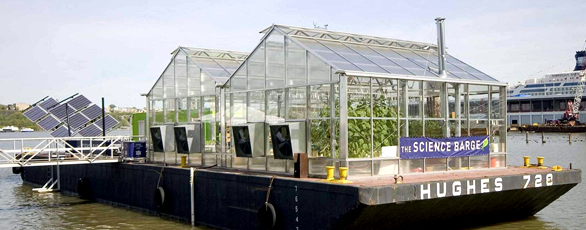
groundworkhv.org/programs/environmental-education/science-barge/faqs/
Lately urban agriculture has gained interests of scholars, policy makers and citizens. Urban agriculture forms a unique integration with the urban system. It uses resources from the city and produces for the city. For the Foodprint program, Stroom has investigated the potentials of urban agriculture for the city of The Hague.In terms of flows of energy and food is a city one giant glutton, consuming tons of high valuable material coming from the countryside and only leaving tons of waste in return. The Hague therefore has, like other cities, to increase its environmental sustainability, for example the reduction and reuse of waste, the improvement of the urban climate.
It requires a systematic change of the metabolic system of the city. Various, often costly, measures are undertaken in order to change this unsustainable metabolic system of the city. Yet these are all very specific solutions to specific problems for example: the assigning of ecological protected areas to certain regions in The Hague and municipality buildings being covered with solar panels to supply energy.Since agriculture can form an ecological circular system, urban agriculture will be able to combine a multitude of environmental facets.
The research investigated the potentials of urban agriculture to contribute to the sustainability of The Hague.Organizations active in The Hague were asked about the possibilities to integrate urban agriculture in the city; how and where could this happen, and how can the respondents participate? Continue reading

