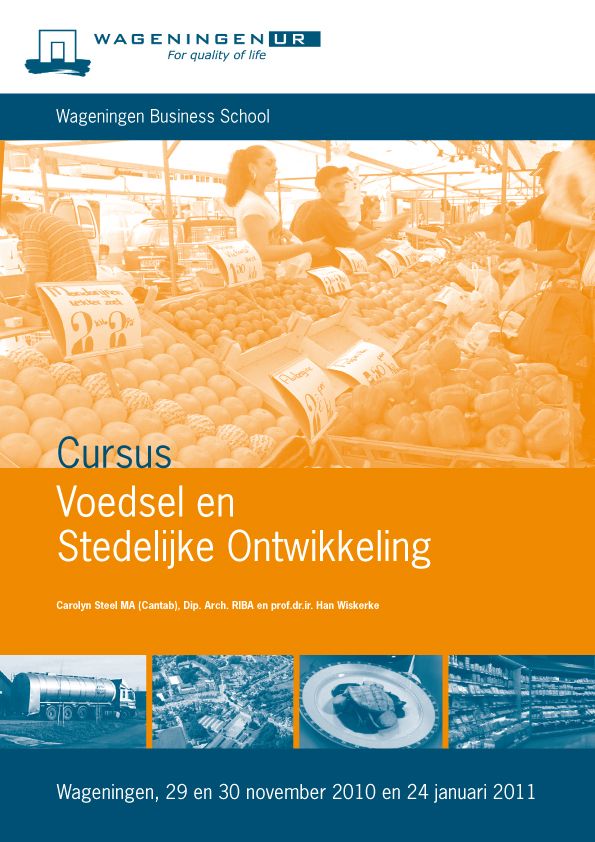
Cursus ‘Voedsel en Stedelijke Ontwikkeling’

Op 29 en 30 november 2010 en 24 januari 2011 verzorgen Carolyn Steel en ik voor Wageningen Business School een cursus over de relatie tussen voedsel en stedelijke ontwikkeling. Deze cursus is toegankelijk voor een breed publiek: beleidsmakers, architecten, landschapsarchitecten, stedelijk ontwerpers, eco-ontwerpers, docenten en mensen die in de landbouw, voedingsmiddelen- of gezondheidsindustrie werken. Daarnaast is iedereen die geïnteresseerd is in duurzame (stedelijke) ontwikkeling van harte welkom.

De aanleiding voor deze cursus is gelegen in de trend van bevolkingsgroei en voortschrijdende verstedelijking en het daarmee samenhangende spectrum aan sociale, economische en ecologische uitdagingen. Klimaatverandering, slinkende olie voorraden en het uitputten van natuurlijke hulpbronnen, gecombineerd met sociale kwesties als armoede, honger en obesitas, vormen de achtergrond voor complexe beleids- en planningsvraagstukken. De verbindende vraag in deze is hoe steden in de toekomst te voeden op een rechtvaardige en duurzame manier.

Als de toekomst inderdaad verstedelijkt is, moeten we dringend (her)definiëren wat dit inhoudt. Huidige aannames over verstedelijking, ontstaan in een tijd die voornamelijk ruraal was, zijn verouderd. We hebben een nieuwe visie nodig op steden en de relatie die zij hebben met het platteland dat hen moet voeden. Als wijzelf en onze toekomstige generaties “goed” willen kunnen leven, moeten we nieuwe inzichten ontwikkelen met betrekking tot wonen, ontwerpen en samenwerkingsverbanden. Hoe we dat moeten doen, is de kern van deze cursus.

Deze cursus is gebaseerd op en geïnspireerd door het boek Hungry City van Carolyn Steel. Hierin analyseert ze stedelijke ontwikkeling vanuit het perspectief van voedsel. Voedsel is de verbindende factor tussen tal van stedelijke uitdagingen, variërend van de ecologische footprint en klimaatverandering tot welzijn en gezondheidsvraagstukken. Door de verbinding met voedsel zichtbaar te maken, krijgen planners en beleidsmakers een middel in handen om hun aanpak te herdefiniëren en deze meer toe te spitsen op een duurzame stedelijke en rurale ontwikkeling. Cursisten leren door dit perspectief de relatie te zien tussen voedsel en verschillende publieke domeinen. Door deze relatie te begrijpen, wordt inzicht verkregen in de kwaliteit van beleid, in de samenhang van beleidsterreinen en in de verbanden tussen lokale en globale kwesties. Cursisten leren werken in multi-disciplinaire teams, waarbij voedsel als gemeenschappelijke taal en verbindende factor gebruikt.

Klik op de volgende links om je in te schrijven of om de cursusfolder te downloaden.

Afstudeerscriptie Alternative Food Geography Amersfoort

Waar komt ons voedsel eigenlijk vandaan? Steeds meer consumenten stellen die vraag en gaan op zoek naar alternatieven wanneer zij niet tevreden zijn met de gangbare antwoorden. Steeds meer steden zijn ook bezig met dit vraagstuk. Het besef dringt door dat veel autokilometers te maken hebben met supermarkt bezoek, dat ons eetpatroon te maken heeft met hoe we ons verhouden tot voedsel, dat eten en koken het wijkwerk ondersteunt, dat stadslandbouw meer dan één publieke functie kan vervullen. Vaak ontbreekt veel kennis over hoe de stad zich tot haar dagelijkse maaltijd verhoudt. Zo ook in Amersfoort. Een succesvolle brainstormbijeenkomst op 17 juni jl (zie eerder blog) door enkele initiatiefnemers (o.a. Transition Town Amersfoort) heeft het stadsbestuur geinteresseerd. Wellicht is de eerste stap gezet naar een Amersfoortse voedselstrategie. Een voedselstrategie

“richt zich op het totale complexe voedselsysteem dat dagelijks voorziet in de behoeften van een regio. Dit voedselsysteem omvat primaire productie, transport, verwerking, opslag en distributie, verkoop en marketing, restverwerking en dienstverlening en maakt deel uit van wereldwijde netwerken.” Cleo van Rijk, Startdocument CoP voedselstrategie voor gemeenten 2010.

DE VRAAG:

De initiatiefnemers in Amersfoort zijn in het kader van de ontwikkeling van een Amersfoortse Voedselstrategie op zoek naar afstudeerstudenten die alle uitingen van alternatieve vormen binnen alle facetten van dit complexe voedselsysteem in kaart willen brengen. Dus ontwikkelt zich in Amersfoort een alternatief voedsel netwerk? En zo ja, wie zijn de spelers, wat zijn de hoeveelheden, waar vindt het plaats en wat zijn de kenmerken?

Historisch Amersfoort

Ben je geinteresseerd? Neem dan contact op met Edgar van Groningen voor meer informatie. Email: edgarvangroningen@gmail.com


Worm farm

Making your own vermiculture or ‘worm farm’ is not very difficult (see the many instructions on internet). Maybe the most difficult bit here is acquiring the right type of worms. The ‘red wiggler’ which you can order by mail in Australia, US or the UK is not available through the mail man in the Netherlands. The manure heap – a left over of last year –  in the corner of our allotment garden proved the solution. The red wiggler likes manure. We dug in and ‘harvested’ around a hundred last year september and again a hundred in the spring. By now we have a healthy population which reproduces and soon we might need to expand our farm or donate worms to a new farm…. Continue reading

The household nutrient cycle

Growing plants on the balcony? I do, and tomatoes need lots of fertile soil. Worms make fertile soil for free. In my bicycle shed (typically Dutch I suppose). While in Iowa last year, I was inspired by the ‘urban ag movement’ and I saw an instruction on the cityfarmer website which led me, on return, to close my household nutrient cycle better by composting my own vegetable food scrapes. It took a while to get the right balance in the three-story box that we build out of plastic storage boxes but it is working well now. The worm castings are extremely fertile as is the liquid (their pee and the muck water from the food scrapes). And it is fun, I think, to compost and close part of the cycle in this way.

Back in the 19th century, Marx was worried about disrupted nutrient cycles since large amounts of nutrients were traveling to city and town while none of that returned to the field. During 1830 – 1870 the depletion of the soil fertility was the overriding environmental concern in Europe and the US. Prior to the discovery of chemical fertilizers, bone and Peruvian guano (accumulated dung of sea birds) were massively imported in Britain to relieve soil exhaustion while other countries had to search for alternatives because of the British monopoly on guano (Foster 1999).

“The second agricultural revolution, associated with the application of scientific chemistry to agriculture, was therefore at the same time a period of intense contradictions” Foster (1999:377) writes. The discoveries in soil sciences also made farmers even more acutely aware of the depletion of the soil and the need for fertilizers. Marx understood that soil fertility is “not so natural a quality as might be thought; it is closely bound up with the social relations of the time” (Marx in Foster 1999; 375) captured in his concept of metabolism. His writings about metabolism can be seen as one of the earliest writings on what is now called ‘sustainability’.

The potato eaters

nationaalarchief.nlThe famous painting of van Gogh. Never knew it had to be taken so literal as painted. Yes, we love our crisps, chips, fries, mash and “stamppot” as part of our voluntary preferences. But a 150 years ago the potato was eaten out of necessity. The 19th century was not exactly a century of abundance in food for the great majority of the Dutch (and European) population. Indeed, potatoes and nothing but potatoes was the ‘cuisine’ three times a day, in very poor households with vinegar or mustard, and at the slightly better off with lard.

Different food historians have pointed to the fact that the average man in the middle ages had more access to meat than his 19th century fellow. It shows again that there is no such thing as linear progression to civilisation and welfare. Growing cities, crop failures, animal diseases, rising prices of wheat, in short a century of continuously repeating food crisis. Sounds familiar? Nowadays it is the poor in other parts of the world who pay the price.