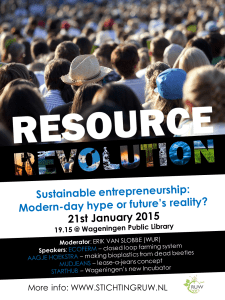
Resource Revolution – Sustainable Entrepreneurship

stichtingruw's avatarBringing Life to Science

141215 - ResourceRevolution v1What: lecture and debate
When: 21 January, 19.15
Where: Public Library // Stationsstraat 2
Entrance: Free

A new wind is blowing in entrepreneurial land and it is called sustainable entrepreneurship. Erik van Slobbe (WUR) will lead the evening and look into the question what sustainable entrepreneurship is and whether it is more than nowadays’ catchphrase. Who better to answer this question than those who are entrepreneurs?

An introduction of the speakers:

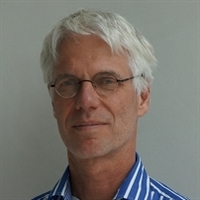
Dr. ir. Erik van Slobbe – WURFoto Erik van Slobbe

Erik van Slobbe completed his PhD at Wageningen University and is currently a senior researcher for the chair group Earth System Science as well as teaching integrated water management and adaptive water management. Before returning to Wageningen University he worked for Arcadis as a senior consultant and has thus acquired experience in moderating meetings with different stakeholders. He was the coordinator of the Climate KIC funded ‘Working with Nature’…

View original post 582 more words

M.Sc. thesis: New opportunities and new constraints for Maasai livelihoods

 Part 3: Dispatch on M.Sc. thesis results    

Florian Neubauer has been working on a M.Sc. thesis with RSO titled `New opportunities and new constraints – Understanding changes in land tenure and livelihoods among the pastoral Maasai in southern Kenya´. In his third and last post, he shares some of the thesis` main findings. Florian’s second post can be found here.

Localized coping strategies increasingly gain in importance: Here, cattle which has accessed a fenced area where grass is preserved for stressful times.

Localized coping strategies increasingly gain in importance: Here, cattle which has accessed a fenced area where grass is preserved for stressful times.

Background

Pastoral livelihoods in Africa are characterized by a high reliance on strategic migration and livestock keeping as a source of social and economic wellbeing. However, over the past decades pastoral livelihoods in Sub-Saharan Africa were increasingly exposed to various pressures like a progressing privatization of land. The experiences of the Maasai in southern Kenya provide an illustrative example for livelihood changes due to land privatization. During the 1970s, a transformation from land held in trust to individual ‘group ranches’, as land communally owned and managed, took place in the Maasailand. During the 1980s, title deeds were privatized and group ranches subdivided into smaller, individually owned ranches. Focusing on Maasai households, this research analysed – with specific regards to impacts and implications on food (in)security – how these changes in land tenure shape the livelihoods of Maasai pastoralists in southern Kenya.

Main results – Summary

The research suggests that changes in land tenure – notably,  the privatization of title deeds and the commodification of land – shape Maasai livelihoods and can contribute to increase a household`s food security. It suggests furthermore that Maasai actively adapt their livelihood strategies as a result of these changes and use(d) the new land tenure system to develop new livelihood strategies. However, these new or changed livelihood strategies impact Maasai pastoralism both as a production system and as a socio-cultural way of life.

Continue reading →

Thesis Opportunity: Stakeholder analysis for sustainability a in Central Mexico

A new and exciting RSO thesis opportunity: Stakeholder analysis for regional sustainability analysis in urbanizing landscapes in Central Mexico

Introduction

Around Mexico-city, rural landscapes have changed significantly – and continue to do so – due to the growth of the city into these rural landscapes. This so-called peri-urbanization occurs in many places in the world and is accompanied by a specific sustainability challenges regarding water management, the role of agriculture in rural communities and the cultural changes that result from this. This MSc thesis will be part of a study of how peri-urbanization has affected the sustainability of three case study regions or watersheds. Regional assessment of the sustainability of natural resource management is complicated by the large range of stakeholder priorities and perspectives. Obtaining an accurate idea of the existing stakeholder’s priorities with regard to the state of the region’s natural resources, the main challenges and their management, is thus an important first step. This gives a basis for the definition of indicators for the sustainability assessment. However, it does not yet enable giving weights to each indicator. A proposed answer to this challenge is to first distil a list of possible sustainability indicators from semi-structured stakeholder interviews, and subsequently ask those same stakeholders to attach a weight or value to these indicators, using pairwise comparisons. The resulting ranking can then be used as an important input to a regional sustainability assessment. Another challenge, still to be resolved, is how to weigh the perspectives of different actors, perhaps according to each actor’s influence and/or importance.

Objective: To define a list of regional sustainability priorities with quantitative weights attached to them, based on the analysis and integration of stakeholder perspectives.

Activities

  • Stakeholder selection
  • Semi-structured interviewing
  • Survey development and execution
  • Combining qualitative and quantitative approaches
  • Writing and defending an MSc thesis

Requirements

  • MSc student in (rural) sociology or related
  • Fluency in Spanish
  • Willingness to do research in Mexico
  • Financial self-sufficiency
  • 5-6 months for the project
  • Start date January 2015 or late July 2015

Contact details

This MSc thesis will be jointly supervised by Dr. Jessica Duncan (Rural Sociology) and Leendert van Wolfswinkel (Farming Systems Ecology).

The project will contribute to the PhD project of Leendert van Wolfswinkel, who will also be the daily supervisor in Mexico. The PhD project is a collaboration between Farming Systems Ecology (WUR), CIMMYT and the Universidad Autónoma Metropolitana.

For more information contact jessica.duncan@wur.nl with a statement of interest and a CV.

Take Back the Economy 3: Who profits? Taking back business

Inspired by the presentation of Katharine Gibson on Wednesday September 4 and her latest book book ‘Take Back the Economy: an ethical guide for transforming our communities’ (http://takebackeconomy.net/) Michelle Steggerda started her weblog on which she will post her reading of the book and her effort to take back the economy.

michellesteggerda's avatarThe social side of capital

Have you heard of Airbnb already? Which started as a small initiative in San Francisco in 2008 developed into one of the biggest shared economy platforms, now compromising 800,000 listings in 34,000 cities. Airbnb is a worldwide network in which people (hosts) rent out (part of) their house to tourists on an irregular basis. Tourist pay less than for the average hotel in the same city and can enjoy a much more personal environment. Hosts who rent out part of their house earn money in return. Trust is gained through a reviewing and verification system. The organization Airbnb gets a commission on every transaction and it so able to get a business model out of it. Everybody is happy, except for the hotel industry. Hotels increasingly experience the Airbnb business as unfair competition as hosts don’t pay taxes and don’t have to comply with the strict legislations. By now the…

View original post 640 more words

Pioniersnetwerk zorglandbouw

Esther Veen's avataronderzoekerstadslandbouw

Eén van de projecten waarbij ik betrokken ben is het project ‘zorglandbouw’. Hierin werken we aan strategieën om in te spelen op veranderingen in de financiering van de zorg, die voor 1 januari gepland staan. Binnen dit project ben ik verantwoordelijk voor het pioniersnetwerk zorglandbouw. Dit pioniersnetwerk bestaat uit ongeveer vijftien pioniers in de zorglandbouw die zich richten op verschillende doelgroepen (ouderen, jongeren, gehandicapten) en diensten (onderwijs, behandeling, kleinschalig wonen).

Pioniers worden vaak gevraagd mee te denken, advies te geven of hun ervaringen te vertellen, omdat ze voorop lopen en visie hebben. De vraag is echter bij wij zij zelf terecht kunnen. Daarom hebben we het netwerk opgericht; tijdens de netwerkbijeenkomsten kunnen pioniers onderling informatie delen en elkaar adviseren. Bovendien nodigen we partijen van buiten uit, die vanuit een andere hoek inspiratie en kennis kunnen brengen. Het netwerk is dit jaar twee keer bijeen geweest en de deelnemers waren enthousiast. De laatste bijeenkomst, vorige week, ging over samenwerking. Er was…

View original post 71 more words