Life in the Alpujarra (Spain)

YEGEN-53Since the beginning of February my family and I have been in the Alpujarra; south side of the Sierra Nevada in Spain. We are here to experience the rough side of life: being a farmer in a tough arid land. We are trying to get a glimpse of the other side of the food story and feel what it is like to work the land (mainly by hand labour); and give our brain a bit of a rest. But despite the huge amount of physical work we do each day, the mind doesn’t rest. There is just too much going on here: the shrinking and greying villages, the contrast between coastal and hill-side farmers, the young versus the old, the ‘extranjeros’  vs the locals, fighting bush fires vs keeping a varied landscape, organic farmers selling mainstream to the world market, etc etc… I will start by telling you a bit about the village structure here, in Yegen.

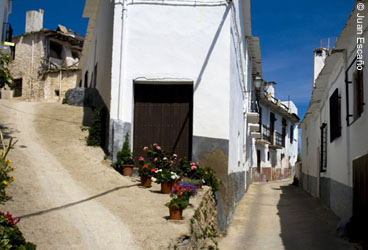
Yegen is a small, typical white Moorish village in the centre of the Alpujarra. It seems just another village, but it is bit more special than all the other white towns. A certain Gerald Brenan (a British self-appointed anthropologist) was already fascinated by the life and customs in this village more than 90 years ago. He experienced Yegen as rather backwards (a way of life that he couldn’t imagine still existed) while at the same time the villagers as being extremely open to new comers. He ended up living in Yegen for about 30 years and produced a very popular book. Unfortunately, I haven’t had the chance to get a hold of a copy but I did discover a 45 minute documentary about Gerald Brenan’s return to the village in 1974 (http://www.youtube.com/watch?v=2JAAYPVsQQ4). Interestingly enough, he talks about the huge progress of the village and the change in customs and traditions, whereas to me – born in the late 1970s – it seems to be a pre-War setting. I couldn’t believe it was actually 1974; the streets were huge irregular stones mixed with sand on which only mules were to be seen, the women washed their clothes in a river, no motorised traffic at all. At the same time, Continue reading

Food Sovereignty conference Yale and ISS – 30 videos, 94 papers and 12 JPS articles available

The conference “Food Sovereignty: A Critical Dialogue” was held twice: on 14-15 September 2013 in Yale University, USA, and on 24 January 2014 at the International Institute of Social Studies (ISS) in the Hague. It brought together the world’s leading scholars and activists, both sympathetic and supportive of the idea of food sovereignty, as well as those highly skeptical of the concept. They fostered a critical dialogue on the issue examining its various meanings, interpretations, and political implications.

The Transnational Institute has published 30 video clips from of the presentations held during the conferences at Yale University in September 2013 and at ISS in January 2014.

The combined processes towards the Yale conference and the ISS colloquium, there are now 94 working papers and 3 Discussion Notes. You can download these papers at : http://www.iss.nl/research/research_programmes/political_economy_of_resources_environment_and_population_per/networks/critical_agrarian_studies_icas/food_sovereignty_a_critical_dialogue/

Journal of Peasant Studies: 12 articles available free of charge 

12 papers by Henry Bernstein, Bina Agarwal, Jack Kloppenburg, Phil McMichael, Marc Edelman, Ryan Isakson, Jennifer Clapp, Jan Douwe van der Ploeg, Madeleine Fairbairn, Annette Desmarais & Hannah Wittman, Kim Burnett & Sophia Murphy, and Peter Rosset & Maria Elena Martinez-Torres are officially published by The Journal of Peasant Studies (JPS), one of the co-organizers of the critical dialogue. As contribution to the critical dialogue, JPS has made all these 12 articles downloadable from its website free of charge in a Special Issue:  http://www.tandfonline.com/toc/fjps20/41/6

Advies voor energiecoöperaties

Esther Veen's avataronderzoekerstadslandbouw

Bijna alle MSc studenten van Wageningen Universiteit volgen het vak Academic Consultancy Training. Hierin vervullen ze als groep een consultancy opdracht voor een ‘echte’ opdrachtgever. Ze worden bijgestaan door een inhoudelijk expert en een coach op het proces. Ongeveer een jaar geleden heb ik voor het eerst zo’n groepje studenten gecoacht. Een leerzame en erg leuke ervaring. Ik heb nu voor een tweede keer een groepje mogen begeleiden. ‘Mijn’ groepje deed een opdracht voor SamenGroen. SamenGroen levert zonnepanelen en ondersteunt energiecoöperaties. De groep beantwoordde de volgende vraag:

Hoe kan SamenGroen haar tijd en middelen efficiënt inzetten voor het adviseren en begeleiden van energiecoöperaties?

Het komen tot een goed adviesrapport is een heel proces. Eerst moeten de studenten de precieze vraag van de opdrachtgever definiëren, wat nog best een opgave was. Wat wil hij precies weten, wat is het doel achter zijn vraag, en wat is mogelijk binnen…

View original post 250 more words

Food Otherwise conference – a video impression

As posted before the Food Otherwise conference has been very succesfull. A bi-lingual (Dutch/English) video impression is now available:

FoodNET – where EU food projects meet

As Rural Sociology Group we have particiapted in several food related EU-funded research projects for all of which a website or weblog was created. Most recent food projects Rural Sociology has participated in are PUREFOOD, Foodlinks, GLAMUR & SUPURBFOOD. TRANSMANGO has just started and a website will soon be launched.

To better integrate and disseminate the findings research projects and to facilitate discussion and interaction among among all those involved and interested FoodNET has been launced: http://foodnet.ning.com. FoodNET replaces the Sustainable Food weblog.

FoodNET is as a platform that will keep you posted on latest research on sustainable food provisioning and farming. FoodNET is a website and blog in one. The FoodNet Team is on Twitter as well: @foodnet_eu. Latest Tweet is shown at the right of this weblog, below our Rural Sociology WU tweets. We will also have the FoodNET tweets published at our Rural Sociology Group Facebook page.