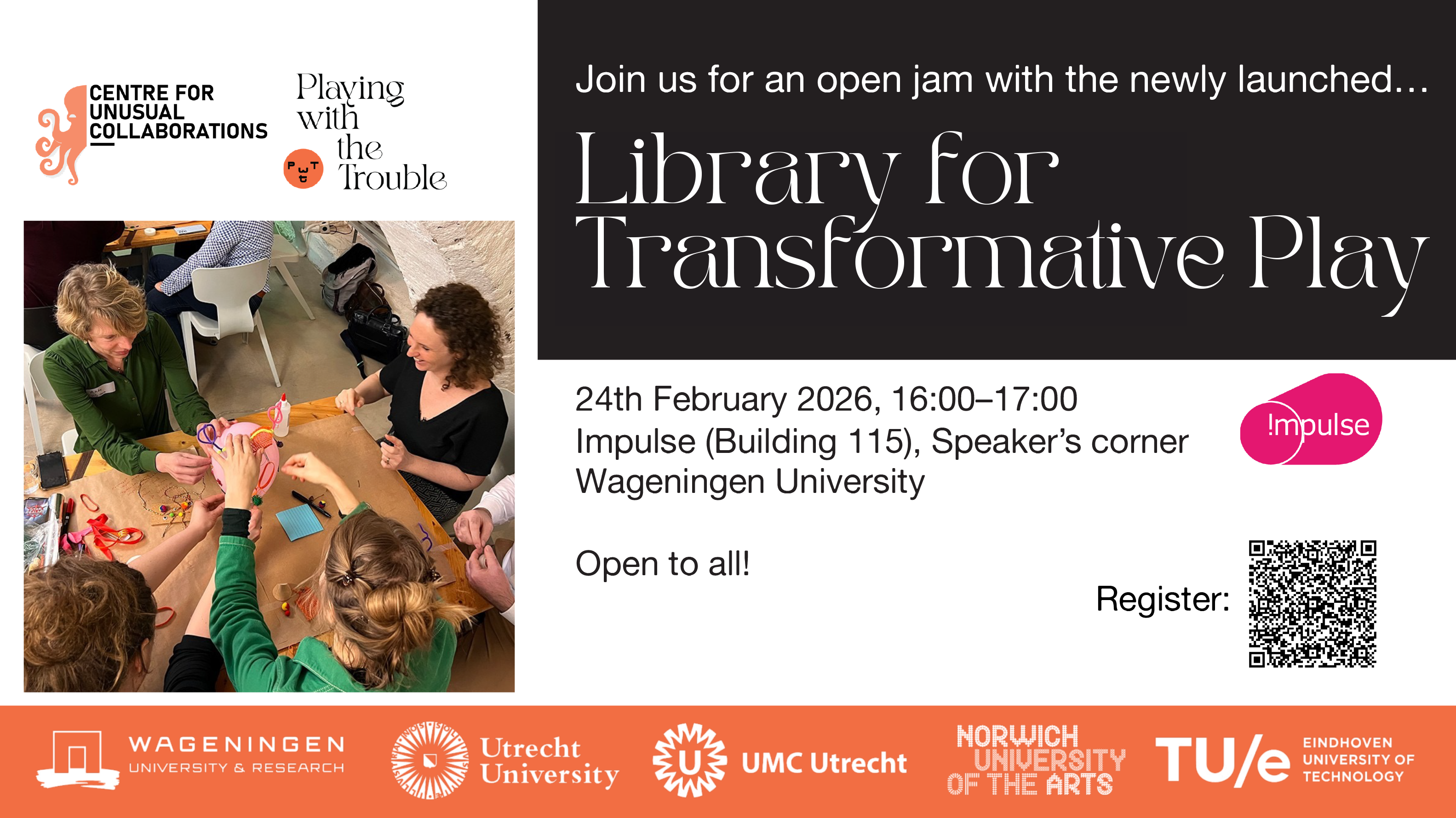
We’re happy to share the upcoming launch of the Library for Transformative Play. On 24 February (16:00–17:00), the library will be launched at Impulse, Wageningen Campus, inviting participants to explore how playful and creative activities can support collaboration across disciplinary boundaries.
The Library brings together games and materials designed to: – surface worldviews – facilitate collective imagination – stay with the trouble – unmake systems – embrace ambiguity
Playing with the Trouble is a 4-year project funded by the Centre for Unusual Collaborations (CUCo). For questions, please reach out to Jessica Duncan.
Today, I’m on my way with a friend to visit an agroecological farm started a few years ago by a group of purged academics—scholars dismissed from their university positions during Turkey’s 2016 political crackdown. Once part of the local university, they turned to cultivating a few acres of land just outside the city. The farm still survives, though not without struggle.
As we bumped along the road toward the fields, our conversation drifted across dozens of topics—including the use of pesticides. Then suddenly, my friend turned to me and asked, “Have you heard of the ‘Black Wounds’—Birîna Reş?”
I hadn’t.
It was the early years of the Cold War. Turkey had been included in the U.S. Marshall Aid plan—not for post-war reconstruction, but for building a strategic alignment near the border with the Soviet Union. Alongside shipments of powdered milk and food came military bases. And toward the end of the 1950s, a shipment of wheat seeds treated with pesticide arrived in Turkey. The government distributed these seeds for free to landowners affiliated with the ruling party. But instead of planting them, many landowners sold the wheat cheaply on the open market. Easy money.
The CULTIVATE team at Wageningen University & Research is thrilled to announce the pre-launch of the Citizen Engagement Library! This resource is a growing collection of strategies, materials, and tools designed to foster greater participation among citizens, policymakers, and organizations in food-sharing activities.
From participatory budgeting and citizen assemblies to mobile kitchens and European-wide campaigns, there are countless ways to engage communities in shaping food systems, addressing challenges, and driving meaningful change. However, reliable, detailed information about these engagement mechanisms can be hard to find. That’s where we need your help!
We are seeking input to improve and expand the Citizen Engagement Library, and there are two ways you can contribute:
1. Fill Out the Citizen Engagement Library Survey
We’ve created a survey to introduce you to the Library and gather your feedback on its current format and content. Your input will help us make the Library as useful and accessible as possible!
Together, we can create a robust resource that empowers communities and fosters collaboration in food-sharing initiatives worldwide. Thank you for being part of this exciting journey!
On Monday 4 December 2023 at 16.00 CET Maite Hernando Arrese will publicly defend her PhD thesis entitled ‘Let it flow: Navigating hydropower conflicts in southern Chile’. The defense will take place in the Omnia Auditorium and will also be broadcasted live (a link will appear in the events box, in the upper left corner of the screen). The full thesis can be read online or downloaded (usually from the first day after the PhD defense onwards) from the repository of Wageningen University PhD theses or by clicking on the DOI link.



 Rural Sociology Wageningen University