Sus domestica Alie; Bunte Bentheimers

I am living with Alie, Rinus, Anna and Bom today. I am assistant-farmer for 24 hours. This means I have the responsibility for the care and well-being of four ‘Bunte Bentheimer’ pigs. This breed is known to be very social but also a bit slower in growth and with a bit fattier meat. Such meat is not in fashion at the moment. The breed almost disappeared. 

Alie, Rinus, Anna and Bom are part of the art project “The year of the pig” of Elles Kiers and Sjef Meijman which connects visual and culinary art with animal husbandry (see also tomorrow’s Volkskrant). The industrial production of meat – and food in general – is more and more seen problematic. Pig production takes place behind closed doors and hygienic corridors. The confined and artificial circumstances alters their natural behaviour. Today’s livestock industry is a complex story with many different points of view. To make rearing pigs visible, such as is done here, is a guarantee for debate. 

Alie

 Nearby farmers came to visit. Afraid of contamination they were extremely careful. And angry. For the difference in what they have to comply with and take into account in contrast to the simple way in which the pigs are held here. Vegetarians have been angry too. For the fact that these pigs are reared to be eaten. Rinus – the gentle red-haired male – is most likely the first candidate being the larger of the two men.

How art and rural life meet

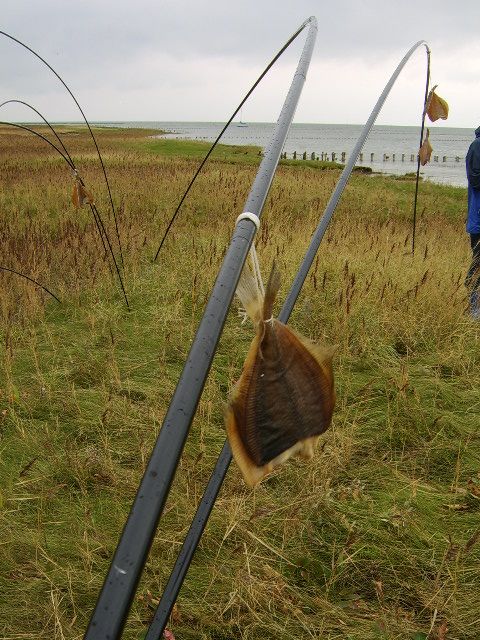
Drying fish in Sarah's work

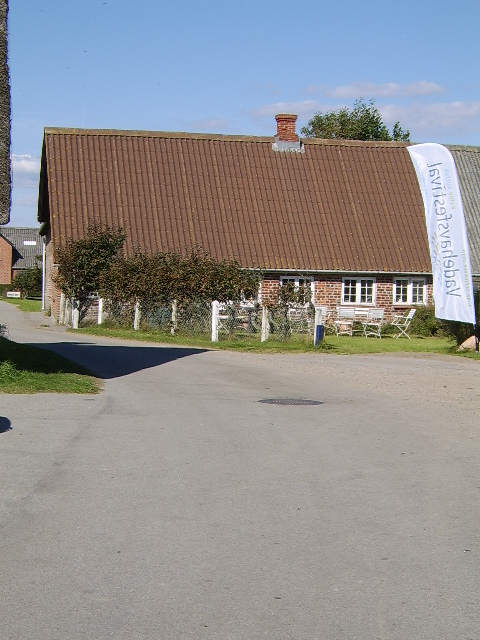
At best sceptical were most of the islanders of Mandø about the Any Questions? art project on their island. Not many were fond of modern art. Their highlight of the year is the Mandøfest which brings back many related to Mandø in july for a celebration of tradition and island culture in big family gatherings. The Vadehavsfestival is different and the ‘elite’ art is distant this culture. However, the aim of the festival was to instill inhabitants of the wadden region with new wonder about their own environment.

How to prevent that the project on Mandø would completely bypass the community because of separated mental worlds? Inspired by theories on action research – in particular appreciative inquiry – and on social interaction (see Collins 2004. still the best explanation) we formulated a social process to embed ourselves in the place. In three steps (oct/june/sept) we worked at building a positive chain of interaction with the islanders which accumulated – also to my surprise – in openness to and interaction with the artists and the art works.

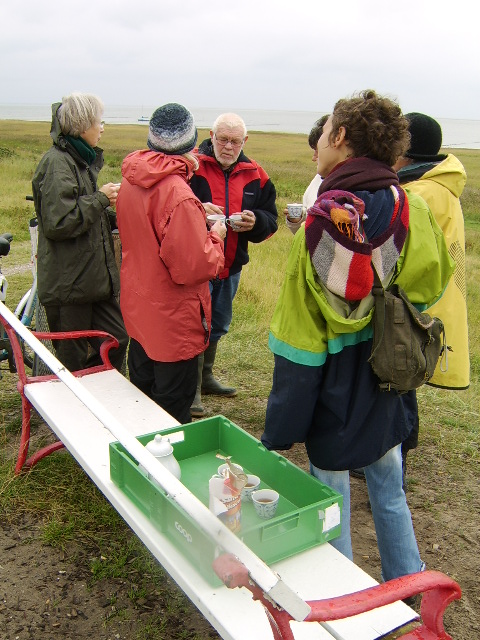
Tea and cookies

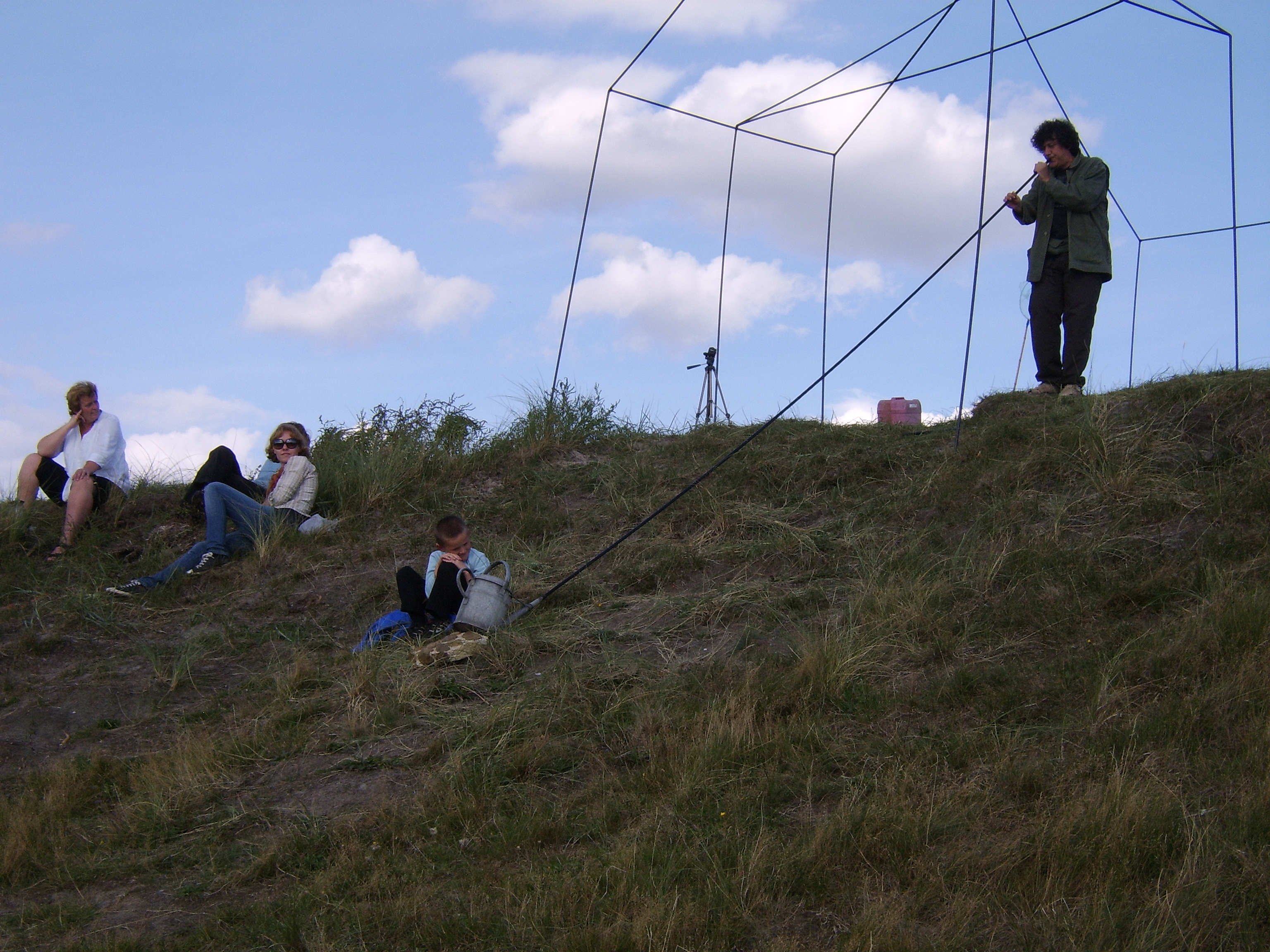
The shopkeeper commented how moved she was by the threedimensional house drawing on top of the dune and that it was this moment rather than big audiences which was – maybe-  important too. An unannounced barn concert attracted islanders who normally do not go anywhere we were told. People passed by our café with a bottle of wine or wiskey or came to have ‘tea and cookies’ in and near the house of Sarah and holding up her window. Our bonfire in the withdrawing sea at the landart site of Liesbeth attracted ‘a record of people’ according to the man who fanatically helped building it with lots of diesel (however many stayed at the dunes because the way through the grass was too dark unfortunately).

Peter With's Café

We became part of this community for a week, using the closed café, sleeping in people’s summerhouses, struggling with internet as they do, enjoying the wadden nature and the endless horizon. The embedding of the project and the dialogue in which it resulted inspired us too, as can be read on the waddenart weblog. Thanks, people of Mandø for opening up to us.

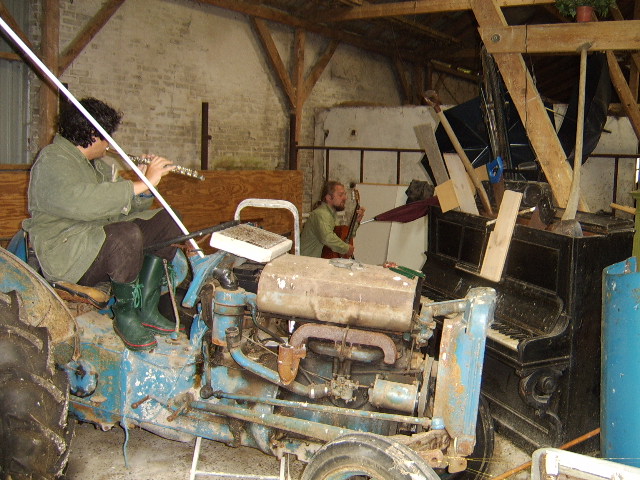
concert with barn materials

Modern art in a rural setting. The art week on Mando, DK

Dario makes music with tent poles of Sarah inside her threedimensional drawing

The sunny weather, a great mix of people, the lovely atmospheric cafe and the beautiful wadden nature have contributed to a kick start of the Any Questions art project on the Danish wadden island Mando. We officially started yesterday with a reception with the inhabitants and for the week to follow there will be daily performances, concerts and ongoing art works made by the individual artists as well as in collaboration with each other. Two writers will observe and reflect on how modern art is meeting people on this island, see previous blog

You can follow us at www.waddenart.wordpress.com

The waddenart group blog will be daily updated by the organisers, the artists and the writers with stories and pictures about the art works, the island and the people.

Art and social interaction on Mando; Call for Researchers

The Wadden Sea coast of Denmark from Tønder to Blaavand is a beautiful natural and rural area with three wadden islands Romø, Mandø and Fanø. For the third time, the biannual Wadden Sea Festival from 4 to 12 september draws attention to this area with various forms of Contemporary Art at many different places. One of the art projects is organised by Foundation Waddenart on the island Mandø. This is a special island, very small and only accessible at low tide through a gravel road at the sea bottom.

The project Any Questions on Mandø is an interdisciplinary project, an experiment to integrate art and research in one project and at the same time embed the project in a local place. Foundation WaddenArt started in collaboration with SDU to explore the question of quality of life for the inhabitants at Mandø in October 2009. The findings fed into the Call for Artists to attract Contemporary Art in Installation art, Performance art and Landart. Five different artist(groups) have been selected to work daily to create works of art during the festival in september. 

There is also space for three researchers to be involved in the project in september. We ask researchers to reflect from a research background in the social sciences or art & humanities to what they observe during the festival. We ask you to observe and write a short story based on personal experience and empirical observation which can be performed during the closing event on Mandø. Are you interested questions such as; How does contemporary art relate to the cultural and social life of the community on Mando? How do the people on Mando relate to a festival that is not theirs? How is Mando expressed? What symbols the links between past, present and future? What are defining factors in change and stability? Then please look at this link for the full Call text and the way to submit your interest to Foundation Waddenart.