Yet another crisis in the hog industry

During my time in Ames I met quite a few current or previous students of the Graduate Program in Sustainable Agriculture (GPSA) in which both Jan and Cornelia Flora teach. The GPSA is a truly interdisciplinary program in which students with diverse (and often international) backgrounds meet. Although each student has a ‘home department’ such as sociology or agronomy, they go through the program together as a group, learning the social, biological and economic aspects of sustainability in agriculture.

I already heard from current students that they really appreciated course ‘509’. This Agroecosystems Analysis course starts with a two week tour around Iowa, in which the students visit a wide variety of farms and related industry. STA72350I was allowed to join the new group of students at start of the excursion tour last Saturday to the hog farm of the Struthers family in Collins, half an hour south west of Ames.
Before departure, Gretchen Zdorkowski, from the Agronomy Department, gave us an introductory lecture on agriculture in Iowa. In some ways, Iowa is quite similar to the Netherlands. Of all states, Iowa probably has been altered the most, with hardly any original landscape left. Like the Netherlands, Iowa has plenty of rainfall and is equally phenomenally drained to serve agricultural needs. Although the dominance of corn and soybean production (20% and 16% of US production respectively) contrast with the Netherlands, another similarity is the large number of pigs and chickens in Iowa. Whereas the Netherlands counted over 12 million pigs in 2008, Iowa had over 16 million pigs in 2005. Also, Iowa has the largest egg production industry in the US.

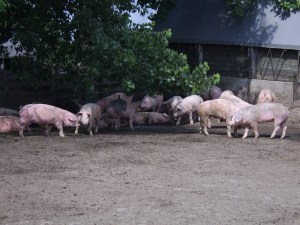
The US chicken industry is ruled by only 6 companies nowadays. The hog industry is not quite as concentrated as that but, according to farmer Dave Struthers, it is unfortunately moving in the same direction. Dave runs the family hog business, a breed to finish operation based on 750 sows at 8 different locations around Collins. It is one of a diminishing number of independent businesses which do not raise and finish on an integrator contract, but sell to the cash market.
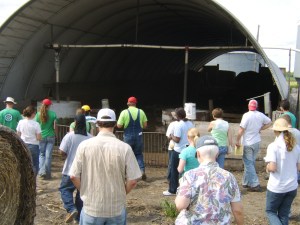
STA72357The hogs are partly housed in individual crates and partly housed in groups in hoop houses. There are also 1000 acres of corn, exclusively used for feeding the hogs and for straw in the hoop houses. A combination of hogs and corn is rare nowadays but it allows Dave a better use of his own resources. The slurry and the partly composted manure from the hoop houses is used as fertilizer, accompanied by a ‘sideshower’ of artificial nitrogen when the corn is a few feet tall.

Dave showed us around on two of his locations, and we were even allowed to enter the nursery. “I want the farm to be open to people and I received visitors from all over the world” Dave explained. “I believe that when people know where their food comes from, they have more respect for it”.STA72371

Although a true family business, Dave is currently doing the larger part of the work by himself. He is forced to do so, because the hog industry is in crisis again. “I had a 20 dollar a head loss last week” Dave told us; 20 out of the last 22 months have known red numbers. This crisis is different from the one in the late nineties Dave explained, there seems no end to it now. “They say we need a production cut of 5 to 10 %, but that’s not happening for the moment.” The large integrators hardly cut down, as they can repair losses at one end with profit at the other – retail – end of their production pipeline. Awaiting better times, Dave tries to survive by downsizing production, cutting costs such as labor and intensifying the use of his own resources.

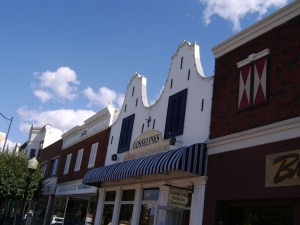
Proper Dutch spatial planning in Pella, IA

STA72319

There is a real Dutch looking town in Iowa, people kept telling me about. “Go and see it, it will be fun”. So I did, and, it was. When turning off the highway 163, I immediately saw what everybody meant. Even in the shopping mall strip outside the downtown area all buildings had some kind of a “Dutch” front. It made the well know fast food restaurants look funny. Signs with a symbol of a little mill guided me to downtown, alongside the road an abundance of flowers in the lawns. Downtown, all houses looked somehow 19th century, with reference to Dutch fronts such as the ‘trapgevel’. A huge tulip arch could not be overlooked and next to it a small replica of a mill housing the tourist information. Further down, a working mill for grinding wheat (korenmolen) could be visited. It was late afternoon, too late for the last tour. I ended up chatting to the lady in the mill visiting centre.

Like some other towns in the Iowa, or in the US, a large number of the population is from one particular country in Europe, in this case, the Netherlands. Early immigrants often went to places where fellow countrymen could be found. Somebody estimated that nowadays some 85% of the Pella population (between 10 and 15 thousand people) has Dutch ancestors. STA72322Therefore, the section starting with a ‘V’ is the biggest section in the telephone guide, listing all the “Van Something” such as the Vander Ploeg family running a bakery.

But unlike other towns, why did the people of Pella hold on to 19th century Dutch looks? Well, it turns out, they did not hold on to their original Dutch way of building. They reinvented it. And the reinvention story, I guess, says more about the Dutch mentality than the 19th century looking fronts. Before the 1960s Pella was just a regular American looking town. Except for a small period in the spring, when the tulips flowered. The reinvention started, therefore, with the increasing number of visitors to a longstanding local tulip festival. The people in town figured that a distinct Dutch look would be a unique selling point, a tourist attraction serving the local economy.

STA72333After good Dutch tradition, the town council imposed planning regulation in the 1960s; each building in Pella had to have a Dutch looking front. This, of course, met opposition. However, a local bank helped ease the pain by lending money against no interest for the refurbishment of the fronts. Gradually all fronts turned into ‘historical’ fronts and new buildings have to be approved by the council before they receive planning permission. Community engagement helped to establish a Dutch ‘klokkenspel’, which was finished in 1984, with bells singing regularly. I found a replica of a Dutch canal, half a meter deep, with a blue painted concrete floor and crystal clear water accompanied with a sign saying “water is chemically treated P- E – SE, stay out!”.

Nowadays the Tulip Festival is the biggest festival in Iowa and an attraction to people from everywhere. Last year the town welcomed 165.000 visitors for the festival alone. STA72344The woman in the mill visiting centre showed me the visitor’s book which had 160 new entries that day, from people from many different, mostly neighboring states. Quite an achievement for a town 45 miles from Des Moines and not located at an Interstate Highway.

Social coordination at the food coop

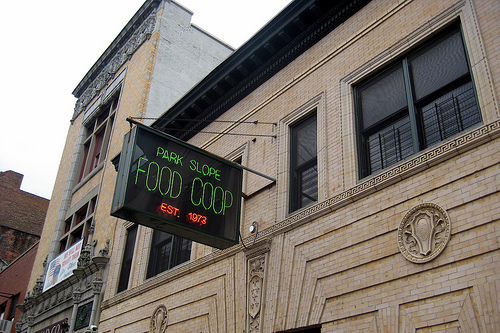
While being in Brooklyn, NY, I visited the Park Slope Food Coop, established in 1973. I only visited, because in order to buy something, you have to be a member. I could actually only enter the Coop in the first place, because Mikey, with whom I explored Brooklyn, is a member. In the upstairs office we had to identify ourselves after which I received a visitor card. Downstairs, I had to give the card to one of the two persons guarding the entrance. It was quite an intense experience, but the coop had more strict policies like this, needed to prevent that people take advantage. With only a 21% mark up across the board, good and mostly local and organic food is relatively cheap here. This is possible because the food coop is a not for profit organization in which 75% of the work is done by members themselves. So almost all persons I saw working are members; upstairs taking our identification, downstairs guarding the entrance, the cashiers, the people who walk you to the car and take the shopping cart back, all were members. Mikey works a three hour shift every four weeks in the basement, unpacking incoming supply and sending it up to the shopping floor. With over 14.000 members, this coop is an astonishing example of intense level of social coordination which pays off to all its members.

Urban agriculture in Red Hook, Brooklyn NY

STA72194I took opportunity to visit New York City while on my way to my friend Jessica in Ithaca. Fortunately, I had the opportunity to ‘go local’ because Mikey, a friend of her agreed to show me around. We went on bikes exploring Brooklyn, a great experience. I soon learned that you only have to remember one thing; you are on your own, there are no rules in urban jungle traffic.

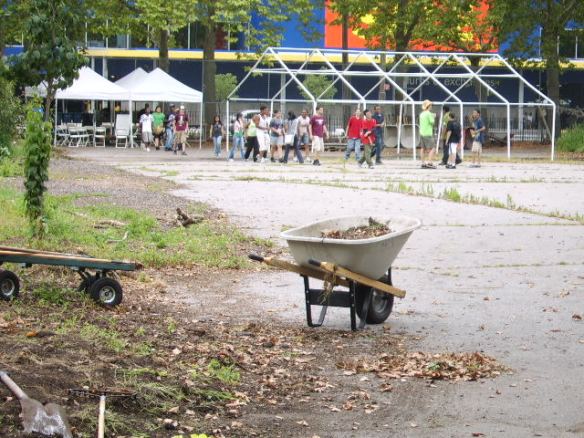
We visited an urban farm in Southern Brooklyn, in the Red Hook neighborhood, a predominantly black and low income community. The Added Value farm is experiencing its third growing season. The farm is located on a run down playground, still visible as a grey spot on Google earth, but now a green oasis, with a small hoop house nursery and a composting section.

STA72196The playground is still there but most of it is covered, underneath 18 inches of rich compost soil. All vegetables you can imagine are growing here, except carrots which go too deep. The produce is sold at the weekly farmers market at the spot and serves a twenty member CSA. The farm now neighbors a gigantic new and heavily opposed IKEA outlet. The outlet symbolizes the start of gentrification of the neighborhood, of which we saw an example at the waterfront, where abandoned industry buildings have been converted into lofty apartments. As more white people move in, rents and living costs increase, which forces the current inhabitants to move to other, cheaper parts of the city.

 The controversy around the outlet is one of the factors influencing the struggle of the farm to reach out to its immediate neighborhood community Donna explained. She is one of the farm workers and kindly showed us around. Showing and explaining the farm to whoever passes by is an important aspect of the openness of the place; the gate is always open while work is going on. Without a programmatic structure such as the youth education program, it has been hard to reach the neighborhood. For many the farm is still a bridge too far in the daily struggle to make a living while on a totally different diet due to the lack of affordable fresh produce and lost cooking skills.  

STA72195Donna is one of 4 farm interns. We met the manager briefly on his way to a meeting. There are also 4 youth workers employed on the farm. One of them was working with a new group of teenagers from the Bronx, who were introducing themselves to each other at the start of their Summer Youth Intensives. Weeding, harvesting, learning about vegetables and composting. But it all starts at a very basic level. Because more than anything else, the farm program is trying to teach these kids a different set of values. Learning the benefit of working as a team. Learning that it is not about the show, wearing appropriate working clothes. Turning compost; doing the dirty jobs. Respect for each other and for every living creature. The value of sharing. The taste of fresh basil.

 The skeptics (see blog Han) or the question alone really, about whether or not urban agriculture can actually provide enough produce to feed an entire city is the narrow economist argument of linear industrial thinking. The remnant of a past modernist era which by default end up in cost efficiency, scale enlargement and mass production solutions. At the cost of soil fertility and hard working people, Marx already taught us in the 19th century. Urban agriculture is about so much more than “only” providing “a bit” of fresh and healthy food.

To eliminate our networking desert

How to share experiences with people working in establishing local food systems in other places? What is going on where? In Iowa, the Leopold Center for Sustainable Agriculture, serves as a linking pin around building local food systems. Today I joined a meeting of the Regional Food Systems Working Group. This group is a Community of Practice of around a hundred people who meet four times a year to network, learn and share with other Iowans from all over the state, but today, there were also quite a few visitors from other states. Because it seems there is a lot going on in Iowa, compared to some other (Midwestern) states.

The Leopold center is a research and education center of ISU established under the Groundwater Protection Act of 1987 committed to systemic change in agriculture. Currently, there are three programs around the themes of marketing food systems, ecology and policy. Next to the center’s outreach through workshops, network meetings, seminars, and the like, it provides grants to researchers and educators of all Iowa universities and to private and nonprofit agencies throughout the state. These project grants, 33 this year, worth over 700.000 dollar in total, are a very important catalyst for furthering sustainable agriculture. Projects range from research on nitrogen management to improve water quality, developing alternative swine production systems, targeting perennial conservation practices, analysis of the value chain of local produce to targeting on-farm energy needs through renewable energy.

one of the fields on the Small Potatoes Farm

One of the fields on the Small Potatoes Farm

Today the center presented their ongoing work in local food. For example they are putting together a resource guide which will give an overview of all organizations and programs working in local food. We also reviewed a draft on local food procurement information about regulations around raw agricultural products. There are still a lot of myths and fears around the use of local raw agricultural products in commercial institutions, but there are no laws prohibiting direct sale from a producer to an institution.

The Community of Practice brings together various regional food initiatives. Those initiatives gave short presentations and updates on their activities before the more interactive sessions started. For example the Hometown Harvest initiative in Southeast Iowa started a feasibility study to come to a farmer owned food coop and announced a new website and logo. The Northern Iowa Food and Farming partnership shared their experience on how to set up local food distribution among various producers. And the Southwest Iowa Food and Farming Initiative is building a database mapping all local producers and potentially interested consumers as part of the first step in building a food system. The initiative in Marshall town, COMIDA also presented their ongoing work, for example their seminar with Ken Meter (see blog.)

These quarterly meetings are very important for the people working in the regional food initiatives. “I come here and hear about what others do which gives me new ideas” one of the participants said. “Sharing here is a big source of information” and, “things are changing fast now”. There is more acceptance nowadays, that whereas some continu to target the world, others actually want to feed their neighbor.