Localising food in context; Marshall county

“Over the past four years momentum has grown for sustainable agriculture” Angie Nelson said as part of the introduction to the meeting for interested people in the County of Marshall to start joining forces for localizing the food economy. The meeting was held in the Community College in Marshalltown and it was entitled ‘Finding Food in Marshall County’. It is one out of three meetings during the summer to build partnership and engagement for establishing a local food infrastructure. Invited speaker Ken Meter of Crossroads Research Center gave a very revealing overview of Marshall county, Iowa and US food economy through lots of figures and tables (see also his website for more details). Marshall county is one of the 99 counties of Iowa, with 39.000 residents and 928 farms on a total of 92.856 farms in Iowa (2007).
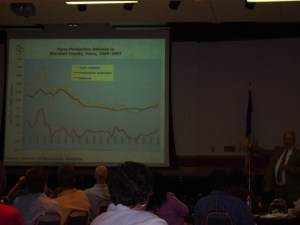
STA71628He convincingly showed how bankrupt the current monoculture commodities agro-industry is and how, corrected for inflation, there is no progress in farm income since 1969. The main commodities in Marshall county and Iowa in general are corn, soybean and hog production.

From census data, Ken showed that for Marshall county the total farming income was 175 million dollar, with 171 million dollar going to costs, leaving 4 million dollars income from farming, a positive figure because of a good year 2007, in 2002 it would have been negative. Other income (rents) counted for 11 million dollar. However, the biggest income source was subsidies, with 80% of the farmers receiving 18 million of farm subsidies in 2007. He also estimated that as much as 90 million dollar of the 104 million dollar Marshall county consumers spend on food is going to food from outside the county, bought in one of the 5 big groceries which have 49% market share nationally (Wall Mart as market leader). In total, he estimated that 166 million dollar is leaving the county each year through the current system of placeless production and consumption. He questioned why farmers are given subsidies to keep on farming while money leeks out of the community to the big corporations that are in the middle; the farm input industry and the retail industry and made a plea for localizing the food economy.

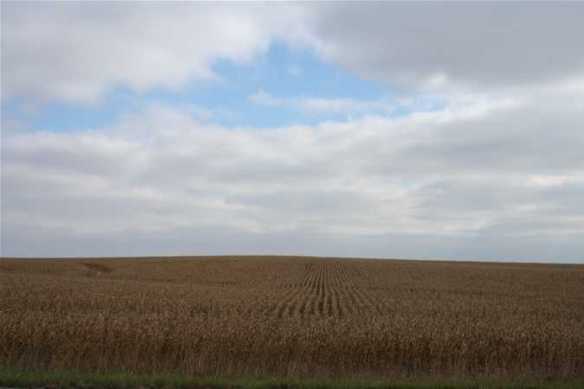
It is not the first time while being here that the strong emphasis on ‘local’ and on ‘community’ as part of the solution towards sustainable forms of agriculture strikes me. However, driving around in this state and looking at these figures, you get a sense of the overwhelming dominance of this industrial agro-food system, the vastness of its scale and the high level of vertical chain integration. In the heart of rural America, food production is an anonymous business with land purely as one of the production factors rather than as a meaningful connection to people and food. In constructing the practice and discourse of sustainable agriculture, therefore, scale matters a lot in this context. A more sustainable agriculture here also means a more humane agriculture, a more humane scale, through which people are able to relate to the food they eat. Only 43 acre (13 farms) is registered in use for producing vegetables together with 25 acre of farm orchards. No doubt there is grown a bit more than this in gardens and small unregistered farms but there seems to be room for locally grown fresh produce in Marshall County and Iowa without amounting to the size of one single agro-food industry farm, let alone ‘threatening’ the industry as a whole.cornfield iowa
Localising food in Marshalltown

STA71629Today I visited the Community Gardens in Marshalltown for the second time. Last Sunday I went there with Jan Flora and Diego Thompson to meet with the group of migrant Hispanic growers to discuss their progress and needs.

The community garden project runs its first year and aims to diversify the availability of locally grown vegetables in this area, while giving new people a chance to start their (part time) business in agriculture through direct selling at farmers markets. The current group of growers, Hispanic and American, followed an eight week course at the Community College (in cooperation with Iowa State University, ISU) this winter called ‘The diversified farm’. After this course they had the opportunity to start growing vegetables on organic certified grounds for a symbolic 50 dollars a year. Each of the growers has a plot of land between 1 and 3 acre. Hispanic migrants, who came to work in the meat processing industry- also in Marshalltown, have agricultural knowledge as they often came from rural areas. One of them told me how he enjoyed being back on the land.

STA71585The neighboring Community College and colleagues from ISU support the project with facilities such as a greenhouse and the use of the tractor, with agricultural and technical knowledge as well as with (helping) to solve practical problems.

Currently, one of the practical issues is the supply of water for irrigation, which now has to come from further down with a small tank behind the tractor which is very labour intensive. However, in a month’s time, water might come from the fire brigade facilities directly neighboring the plots. By that time, pest control will be high on the agenda as crops start to grow now. The first year will be a steep learning curve for all involved, hopefully with promising results.

Fieldwork in Columbus Junction, Iowa

100_8428The last few days I jointed the fieldwork which Cornelia and Jan Flora are doing with their master students in Columbus Junction on the Hispanic immigrant communities.
Ever since the free trade agreement with Mexico, there has been an influx of rural Mexicans displaced because of US corn export. Predominantly Mexican but also other Latin American migrants came to work in agriculture and the related agro industry. In Columbus Junction for example, they work at the pork meat processing plant now owned by Tyson. The way the agro-food industry is operating here is capitalism in its most raw form. Tyson does not allow any visitors so we cannot interview there. But a community health worker whom we spoke to last night told us about the bad working conditions in the plant. A lot of accidents happen because of having to cut too fast in understaffed lines. Another example is a very large farm where temporary migrants are housed in a warehouse with very poor facilities

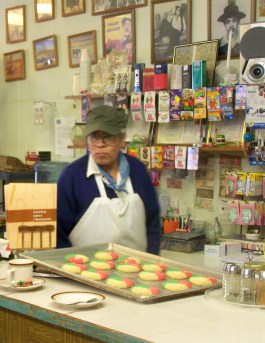
100_8438Some of the legal migrants, however, see a chance to start their own business. In fact, the main street in Columbus Junction has most of its shop signs in Spanish and we have been eating tacos, fajitas and other good Mexican food, among which at this bakery.

Aim of the fieldwork is to better understand how entrepreneurship and innovation impacts new immigrant communities and to see what further can be done to sustain these communities. To find out how the communities works, what the structures and networks are, and what kind of resources people can draw on in developing their businesses we interview all Hispanic business owners. Knowledge of the Spanish language came in handy when interviewing three different shop owners yesterday, with Diego doing the talking and me taking notes (as well as taping i100_8431t).

There are four cases being studied, this town we are now in, West Liberty, Marshalltown and Denison; all in Iowa. There is a comparative study being done in North Carolina by East Carolina University. The towns differ greatly in how vibrant community life is, with West Liberty having the most new community and entrepreneurial activities. Somewhat counter intuitively this is the town with the largest Hispanic population in relative terms, and the factors contributing are being studied in a comparative way.

Conference State College, Pennsylvania

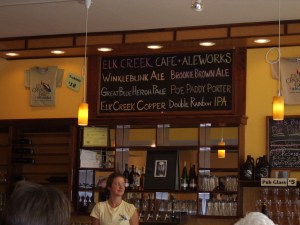
At the joint AFHVS and ASFS conference at State College Pennsylvania, we started with a day of excursions. I joined the ‘local food and flavors’ tour where we visited Tim Browser’s Elk Creek Café and Aleworks and tasted his home-brewed beer and locally sourced food. The local food tasted very good and was as Tim explained, centered around Nouveau Dutchie Cuisine. With humous and black beans as part of the menu, I could not really make a Dutch connection there, but it certainly was delicious.

STA71528

The next stop was the Tait Farm Foods in the Happy Valley where the owner Kim Tait explained the manifold activities of the farm. They work as a Community Supported Agriculture (CSA) farm and have around 120 families as members. Members come to the farm on a weekly (summer) or bi-weekly (winter) schedule to pick up their seasonal share. STA71544

There are different types of shares, but a full year share for a family costs 1100 dollars. It is also possible to have a workshare, where members can work on the farm for a share of the produce to reduce costs. They have to commit 5 hours a week.

After this we visited a local vineyard the Mount Nittany Vindeyard and Winery in the Brush Valley and tasted some great wines as well as cheeses from a neighboring dairy farm.

What was striking to me especially in the visit of the CSA farm is the strong emphasis you can find here on ‘the community’. As the leaflet of the Tait Farm explains:

“In its most simplified form, the farm grows food for the community and the community supports the farm”.

Yesterday, at the first day of presentations, a session on ‘terroir’ explained differences between the US and Europe regarding their sense of territoriality. Whereas the notion of ‘terroir’ has a strong connection with proximity and social ties in the US, in Europe it has more relation with the specificity of food, the cultural heritage and the cultural history this food expresses. So whereas a ‘local’ sausage from a French region can be found in extralocal market places in Europe, the US understanding of local food as direct marketing, locally embedded in social ties, confines the produce much more to a specific place. Hence, you won’t find many geographical indications protecting specific products here (also because of other reasons).

Rural development in Iowa

The coming two months, I will join the North Central Regional Center for Rural Development in Ames, Iowa. This center, part of the Iowa State University, is working with rural communities, native American communities and small producer groups to increase the capacity and resilience of these communities in tackling their problems. In the United States, the development of modern agriculture had a large impact and often devastating effects on rural communities. And, nowadays changing lifestyles, declining knowledge of food and less connection with farming and land have resulted in an obesity epidemic and diet-related diseases. Native American communities also suffer from diet-related diseases. One of the communities the center works with is a Hopi community in Arizona. A recently finished project worked with Hopi women to search for how they define, access and use traditional Hopi food. Using a community capitals approach, the participants assessed together their natural, cultural, social, political, financial and built capital. Through this, they identified their strong and weak or lacking capitals in search for improving health and living circumstances. See this website for an example of a Hopi farm.