Last November, the SWIFT consortium gathered in Geneva for an inspiring and thought-provoking mid-term meeting. Over four days, researchers, farmers, and activists came together to share progress, exchange ideas, and discuss the future of gender and diversity in agriculture. From immersive discussions at Ferme du Lignon to policy debates at the Geneva Graduate Institute, the event highlighted the importance of feminist and queer perspectives in shaping agricultural policies.
Key topics included: – Building feminist viability indicators with women farmers – Participatory video-making for agroecological storytelling – Gendered analysis of the EU’s Common Agricultural Policy – Strengthening visibility and rights of LGBTQIA+ farmers
Georgia Diamanti and Clara Lina Bader have captured these moments beautifully in their reflections, from engaging panels to farm visits that demonstrated alternative models of agriculture in action. Read their insights on the challenges and opportunities ahead for gender justice in food and farming!
Elective evening course: Major Works in Social Sciences (RSO59030)
What is citizenship? Why does it matter? How does it help us understand power in society? Citizenship serves on one hand, as an apparatus of governance—a mechanism through which power is exercised via institutions, policies, and practices that determine the conditions under which rights are granted or withheld. On the other hand, citizenship is also a tool for empowerment, enabling individuals and groups to claim rights and, on that basis, drive political, social, and environmental change. But how does this process work in practice? And why is it particularly relevant for students aiming to address pressing crises in the environment, ecology, and food systems?
In this elective course we will read and discuss a book that outlines a critical theory of citizenship, with an emphasis on how citizenship institutes power relations and organizes different rights and obligations.
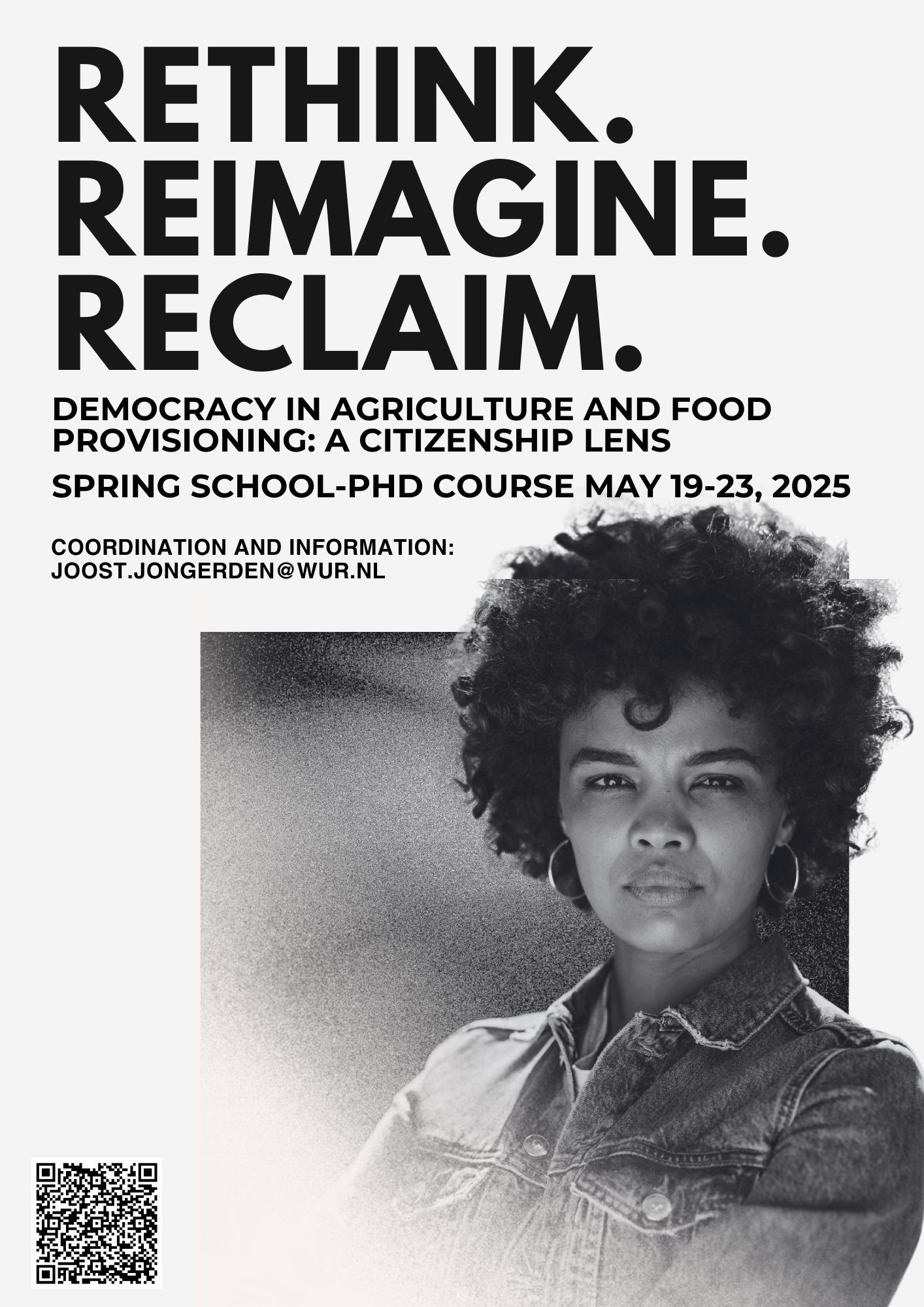
𝗥𝗲𝘁𝗵𝗶𝗻𝗸 the way citizenship shapes our agricultural and food systems. Engage with critical debates on justice, fairness, and the democratization of food provisioning.
𝗥𝗲𝗶𝗺𝗮𝗴𝗶𝗻𝗲 agriculture through the lens of agrarian and food citizenship. Explore how individuals and movements challenge existing systems and build equitable alternatives.
𝗥𝗲𝗰𝗹𝗮𝗶𝗺 agency in shaping the future of food and agriculture. Learn how acts of citizenship drive meaningful change toward fairer and more inclusive systems.
Join us in this graduate course, 𝗗𝗲𝗺𝗼𝗰𝗿𝗮𝗰𝘆 𝗶𝗻 𝗔𝗴𝗿𝗶𝗰𝘂𝗹𝘁𝘂𝗿𝗲 𝗮𝗻𝗱 𝗙𝗼𝗼𝗱 𝗣𝗿𝗼𝘃𝗶𝘀𝗶𝗼𝗻𝗶𝗻𝗴: 𝗔 𝗖𝗶𝘁𝗶𝘇𝗲𝗻𝘀𝗵𝗶𝗽 𝗟𝗲𝗻𝘀 (May 19–23, 2025). Participate in seminars, workshops, and excursions led by leading scholars like Engin Isin and Cristina Grasseni, and contribute to envisioning just and sustainable futures.
SDC@CSPS and RSO@CSPS invite you to Geopolitics of food, nature and development: crises, narratives and challenges
Seminar with dr. Natalia Mamonova – RURALIS, Norway prof. Anja Nygren – University of Helsinki , Finland prof. Mike Goodman – University of Reading, UK
Join us for an engaging seminar featuring three distinguished scholars exploring critical global issues at the intersection of political ecology, food security, and environmental transformations.
Topics and Speakers:
1. ‘From Climate Saviour to Tinfoil Hats and Factory Slop: An Analysis of the Narrative Grammars of Cultured Meat in UK Food and Farming Media’ by prof. Mike Goodman (University of Reading, UK)
Internship opportunity at Boerengroep & AgroEcology Works
Goals • Improving food sovereignty in Gelderland province • Improving the income of CSA’s (Community Supported Agriculture) • To give people with a low income ( f.e. people who go to the Food Bank), the opportunity to become a CSA member and harvest their own organic, local food • Expand the movement for Solidarity Payment and increase awareness Description of the internship We are looking for a (preferably Dutch speaking) student who is passionate to be involved in the movement for food sovereignty and solidarity payment. You will contact municipalities in the province Gelderland to indicate whether there is a fund available for people with a low income, and explore the opportunities of linking this fund to a CSA membership. You will co nduct research by finding out CSA’s in the surroundings of interested municipalities, communicate with CSA farmers, CSA members and municipalities.
We are open to your own suggestions about the focus on the internship and there are always side projects possible, such as organising an excursion to a farm that uses solidarity payment, working with Boerengroep on other topics that are running, transcribing interviews on solidarity payment, and we encourage you to work 1 or 2 days a week on a farm and get hands on experience.
Background information As solidarity payment becomes more and more used and explored in the Netherlands, we want to dive into the support of municipalities of this agroecological practice. There are several examples of CSA’s that are part of a municipal program in which people with a low income get financially supported to become part of a CSA. In this way, people with a low income benefit from it, obtaining access to organic, local food. Next to it, the CSA will benefit from it, by obtaining more members and thereby a better income. Moreover, this collaboration helps farmers to ask for a fair income, as the responsibility of food accessibility is taken off their shoulders.
Requirements • Passion for social just food systems • Willing to learn how to interact and communicate with diverse parties: municipalities, farmers, CSA members • Understanding and speaking Dutch language is a pre as you need to reach out to municipalities. In case you’re really enthusiastic and don’t speak Dutch, we are open to discuss options. What we offer • A working space in Wageningen • A lot of freedom within the focus of the internship • Opportunity to meet our wide network in the agroecological movement • Working in a passionate team • 2 contact persons; Elske Hageraats (AgroEcology Works), Marcha van Wijk (Stichting Boerengroep) • An office dog How to Apply If you find yourself enthusiastic about the topic of solidarity payment and want to put your effort in making the world a bit more fair, you can contact us by sending an email to st.boerengroep@wur.nl. Please include reasons what you are enthusiastic about and how you would like to shape the topic into something you are passionate about.


 Rural Sociology Wageningen University