Thesis or internship: Nature assisted therapies

Can nature be used as ‘treatment’ for adults with psychological complaints?

Evidence supporting the beneficial effects of nature on our health and wellbeing is accumulating. These insights are being used increasingly for the treatment of people with psychological problems, the so-called nature assisted-therapies, like walking therapy. On the one hand, using ‘nature as a treatment room’ is suggested to be more effective than receiving treatment indoors, whereas on the other hand, healthcare professionals themselves report being more vital and healthy providing treatment outdoors, which is a prerequisite for high quality of care. However, the use of nature in the mainstream healthcare practices is far from accepted.

For students looking for a thesis or internship opportunity we offer the following vacancy:

Investigate the experiences of clients and therapists with nature-assisted and nature-based therapies, and explore how stakeholders involved in the mainstream healthcare sector perceive of this kind of therapy.

Interested or want to know more about the project? Contact Esther Veen at esther.veen@wur.nl

Effects of high-tech urban agriculture on healing environments in Dutch nursing homes

It feels a bit odd to post about research results while the Corona virus is keeping us all occupied. However, last week Paulien van de Vlasakker defended her MSc thesis, and the results are nice to share. Moreover, so many of my colleagues are working very hard to keep education going – why not report on some of the nice things that are being done here at Wageningen University. For all those currently involved in cursory education: keep up the good work, you are heroes!

The text below is written by Paulien and describes the findings of her thesis. The thesis was preceded by an internship on the same topic, on which she reported earlier.

“In recent years, an increasing number of urban agriculture initiatives have been initiated to offer locally produced and fresh food products. One newer form of urban agriculture is high-tech urban agriculture. Advanced technologies, such as led lightening and hydroponic cultivation methods, allow the production of fresh vegetables and herbs inside the built-up environment. High-tech indoor gardens are a form of high-tech urban agriculture, combining food production with greening, and can offer advantages such as all-year-round production of leafy greens, improved air quality of the indoor space and enhancing the aesthetics of the location. The multifunctionality of high-tech indoor gardens can be of value for places where people live who are in need of improved well-being. In the Netherlands, welfare, housing, daily care and treatment for vulnerable elderly people come together in nursing homes.

I studied how high-tech indoor gardens can contribute to the well-being of elderly living in Dutch nursing homes. In care settings, the term ‘healing environment’ is often used to describe aspects of the environment that have health-improving benefits. The purpose of this study was to identify how and to what extent high-tech indoor gardens can contribute to the healing environment of nursing homes. High-tech indoor gardens have two distinct aspects: 1) the appearance of the garden itself, and 2) the production of food. I hypothesized that the appearance of the garden influences the perceived ambiance, enhancing mental and social well-being, and that the production of fresh vegetables and herbs contributes to the vegetable intake, improving physical well-being.

This case study research was inspired by social practice theory and looked at the emergence and transformation of existing practices in four different nursing homes, located in Velp (Province of Gelderland). I looked at how different leisure practices among elderly residents evolved around the indoor garden, and how the cooking practices performed by the caretakers were affected by the use of the freshly harvested products. For my data collection, I conducted interviews with elderly residents and decision makers. In addition, I used surveys to collect information from caretakers and performed observations at all four nursing homes. For the qualitative data analysis I used NVivo and for the quantitative data analysis I used SPSS.

The thesis concludes that high-tech indoor gardens are effective in the creation of  healing environments because they create more livable environments by improving the ambiance and influencing residents’ vegetable intake. I showed that vegetables produced by indoor gardens can influence vegetable intake by changing the meal experience. Residents explained that they could clearly distinguish the difference between a meal prepared with the vegetables from the indoor gardens and a dish without fresh vegetables. Most residents find it very important to eat fresh foods. They enjoy the taste of the different products from the garden and appreciate that they are locally and freshly produced. Many residents were used to growing vegetables in their own vegetable gardens and expressed feelings of familiarity and recognition towards the garden and its products. Especially typical Dutch herbs and vegetables, such as parsley, chives and butterhead lettuce are popular among the elderly residents.

Whether or not the harvest was used in cooking practices by caretakers was influenced by several factors: 1) Caretakers who have gardening experience and enjoy cooking, are more likely to integrate the harvested fresh vegetables and herbs in existing cooking practices than caretakers with no gardening experience and who do not enjoy the task of cooking; 2) In nursing homes in which mostly non-fresh ingredients are used for the preparation of meals (frozen meals), caretakers are more motivated to use the fresh vegetables and herbs from the garden, and 3) For optimal use of the indoor garden, it is important that it is placed close to the kitchen and close to the living area of the residents. Caretakers can more easily integrate harvesting practices with cooking and other practices when the garden is located at a place that they often pass by. When the garden is placed close to the living area of the elderly residents, the residents can enjoy the aesthetic aspects of the garden.”


Young people with practical education and sustainable food

Carlijn de Kok, student International Development Studies, wrote her MSc thesis on young people studying cooking, baking or food studies and their engagement with sustainable food. I ask her to share some of her findings.

Why did you choose this topic?

“The literature tends to argue that it is mainly highly educated people who buy sustainable food. It remains unclear, however, to what extent people with a practical education are interested in sustainable food (as well) and if and to what extent they consume sustainable food. Following Karl Marx and his thoughts about the alienation of labour, it can be assumed that people who are engaged with food in their daily lives are more likely to be critical regarding food – and thus to consume sustainably. This is why I decided to focus on people studying cooking, baking or food studies: I expected that their engagement with food in general would lead to more interest in sustainable food.”

What was your theoretical starting point?

“Studies on consumption often use rationalist approaches whereby the individual is taken as a starting point to understand consumption. However, we also know that there is a difference between caring for the environment and changing consumption: this is explained by the ‘attitude-behaviour gap’. This is why I wanted to take a more contextual approach, using Social Practice Theory. This theory puts everyday social practices at the centre of analysis, and considers consumption in terms of its practical, contextual and everyday nature, leaving room for both agency and structure.”

So what practices did you study?

“I defined the general practice of food consumption as a range of sub-practices, including acquisition practices (buying and growing food) and use(r) practices (food preparation-, eating-, and disposal practices), following the work of Sargant (2014). I also made a distinction between how respondents view sustainable food (their cognitive engagement), what they are doing in practice (their practical engagement), and the underlying motivations and reasons for participating in these practices (I called this the narrative behind their engagement).”

Ok, that sounds interesting. But how did you study this?

“In order to understand students’ cognitive engagement with sustainable food and the narrative behind their engagement, I used interviews, a focus group and questionnaires. I interviewed fifteen students following a practical education: five bakery students, five cooking students and five students of food studies. Fifteen cooking students participated in the focus group, and seventy-five students filled out the questionnaire. In order to better understand people’s actual engagement with sustainable food I complemented these methods with food diaries: six of the students interviewed recorded for one to three days what they bought and consumed, where they bought that, and whether there were any sustainability labels on those products.”

And? What did you find?

“There were a few interesting findings. First of all, my respondents are in fact rather knowledgeable about sustainability, the issues in the food system and sustainable food, and they see urgency in acting sustainably. Especially animal welfare, environmental friendliness, a fair price for farmers and naturalness are considered important. All respondents participate in at least some sustainable forms of food consumption. Second, part of the respondents is rather interested in and knowledgeable about sustainable food. This group often performs sustainable food acquisition practices, mostly out of sustainability motivations (for respondents who only occasionally buy sustainable produce, sustainability is less often a motivation). Students of food studies are most often interested in sustainability, followed by the cooking students – for whom sustainability mostly relates to quality.

Thirdly, the extent to which respondents perform food consumption practices sustainably differs per locale. In general, respondents more often act sustainably when they are grocery shopping. They much less do so while eating out, on-the-go or at school or work. In these places sustainable food is less accessible and available, and students feel that their choices have less impact. Finally, I found that respondents’ cognitive and practical engagement with sustainable food does not always align. While some respondents stated to act more sustainably than their food diaries showed, in some cases it was the other way around. These students did not connect much to the concept of sustainability, but they were motivated by certain elements of sustainability such as animal welfare, and so they did make sustainable choices.”

Taking all of these findings into account, what is your main conclusion?

“Young adults who are following a practical educational programme related to food are to a certain extent interested and engaged in sustainable food. Sustainable food plays a role in their daily lives: respondents perform certain food consumption practices sustainably, mostly out of sustainability motivations. The extent to which respondents manage to do so, however, depends on the locale.”

Honourable Distinction for RSO PhD candidate Lucie Sovová

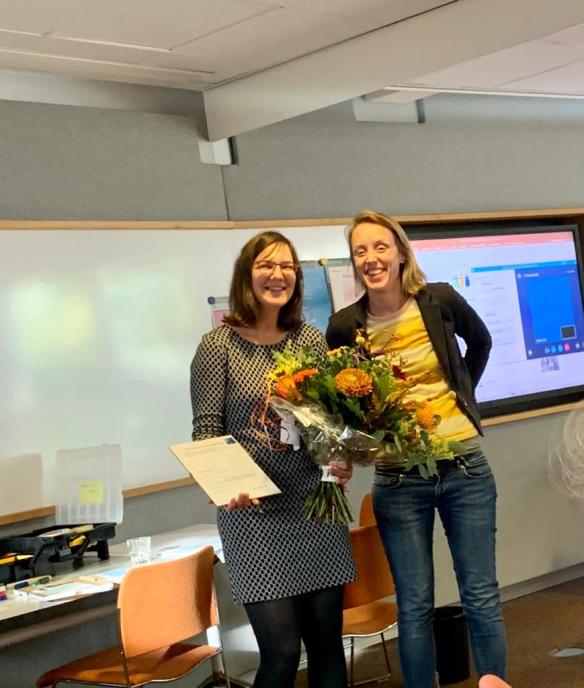
On Tuesday the 29th of October, Lucie Sovová, PhD student at the Rural Sociology Group, won an honourable distinction from the Storm-van der Chijs Fund. The objective of this fund is to encourage and support Wageningen University female PhD students to pursue their study and career in science. 

The RSO chair group nominated Lucie, and soon found out that she was awarded the honourable distinction. As head of the jury Prof dr ir Arnold Bregt stated that Lucie bridges urban gardening and alternative food networks. In her work on Central and Eastern Europe, she questions framing informal food economies as remnants of the socialist era. She shows how they are not necessarily “inferior” to, but merely coexisting and interacting with their market-based counterparts. Next to her academic work she is in many ways involved and contributing to NGOs in this field.” 

The honourable distinction comes with 500 euros, which Lucie plans on spending by visiting a conference in Manchester.

Click here and here for more information. IMG-20191029-WA0000 (002)

Onderwijs op de boerderij: samenwerking met scholen en gemeenten (scriptie of stage mogelijkheid)

Binnen het wetenschapswinkelproject ‘Leerarrangementen in het Groen’ is plek voor een stagiair of MSc thesis student. Doel van het wetenschapswinkelproject is te komen tot een sterke, geaccepteerde en professionele sector van boerderijen die onderwijs bieden aan leerlingen die om verschillende redenen tijdelijk niet passen op een reguliere school.

Voor een deel van de leerlingen in het primair en voortgezet onderwijs werkt een schoolse omgeving soms contraproductief. Deze kinderen hebben het moeilijk met zichzelf en hun omgeving en willen, kunnen, mogen, of durven daarom tijdelijk niet naar een reguliere school. Deze leerlingen komen vaak noodgedwongen thuis te zitten, wat kan leiden tot moeilijk gedrag, een negatief zelfbeeld en een toekomst zonder perspectief. Verschillende zorgboeren bieden deze leerlingen onderwijs op de boerderij. Een groep van ongeveer 20 van deze boeren heeft een netwerk gevormd om ervaringen en knelpunten te delen. Problemen zijn bijvoorbeeld knellende regelgeving en de kloof tussen zorgboerderijen en scholen. Klik hier voor meer informatie.

Verschillende studenten hebben al een rol gehad binnen ons project, zowel voor hun stage, als voor hun scriptie, als binnen vakken. Zo krijgen wij steeds een completer beeld van het onderwijs op de boerderij en hoe boerderijen dat vormgeven. Waar we echter nog geen zicht op hebben, is de visie van gemeenten en scholen: hoe kijken zij aan tegen de samenwerking met boerderijen, wat spreekt ze aan als het gaat om de boerderij als leeromgeving, wat zijn volgens hen de knelpunten in de vormgeving of uitvoering van onderwijs op de boerderij, en hoe zou de samenwerking tussen scholen en gemeenten enerzijds en boerderijen anderzijds verbeterd kunnen worden?

Een specifieke opdracht op basis van deze vragen kan samen met de student worden opgesteld. Studenten zullen onderdeel worden van het wetenschapswinkelproject (stages worden begeleid door Jan Hassink van Wageningen Plant Research). Voor meer informatie: esther.veen@wur.nl