Unknown's avatar

About FoodGovernance

Jessica Duncan is Associate Professor in Rural Sociology at Wageningen University (the Netherlands). She holds a PhD in Food Policy from City University London (2014). Jessica’s main research focus concerns the practices and politics of participation in food policy processes, particularly the relationships (formal and non-formal) between governance organizations, systems of food provisioning, the environment, and the actors engaged in and across these spaces. More specifically, she maps the diverse ways that actors participate in policy-making processes, analysing how the resulting policies are shaped, implemented, challenged, and resisted, and she theorizes about what this means for socio-ecological transformation. Participation and engagement is at the core of her approach. In turn, she is active in a broad range of local, national and international initiatives with the aim of better understanding participation processes with a view towards transitioning to just and sustainable food systems. She is involved in several research projects including ROBUST, HortEco & SHEALTHY. Jessica is published regularly in academic journals. She recently co-edited the Handbook on Sustainable and Regenerative Food Systems (2020). Her other books include Food Security Governance: Civil society participation in the Committee on World Food Security (2015) and an edited volume called Sustainable food futures: Multidisciplinary solutions (2017). Jessica has received several awards for her teaching and in 2017 she was awarded Teacher of the Year for Wageningen University (shortlisted again in 2018 and 2019, longlisted in 2020). With the funds she has received for these awards she launched a story-telling workshop for students and faculty, with storytelling trainer, Emma Holmes. Jessica is on the Editorial Board of the journal Sociologia Ruralis and is an advisor to the Traditional Cultures Project (USA). She is a member of the Wageningen Young Academy and sits on the Sustainability Board of Experts at Wageningen University.

Video: Dutch Delegation to Nyeleni Europe Forum 2016

FoodGovernance's avatarFood Governance

In October over 500 people from across  Europe gathered in Romania for five days to multiply food sovereignty platforms across the continent.

The Dutch Delegation was followed by a professional filmmaker who put together this short video of our impressions and our vision for the future of food.

Directed and filmed by Ton van Zantvoort / www.newtonfilm.nl.

More information on the Nyéléni Europe Forum:
www.nyelenieurope.net

View original post

Local Public Policies for Food Sovereignty – A recap of the International Seminar in Donostia, Spain

Former RSO student Jordan Treakle blogs about his experiences at the Public Policies for Food Sovereignty conference held last month.

FoodGovernance's avatarFood Governance

By Jordan Treakle

This entry is part of a special series of blog posts about the UN’s Committee on World Food Security (CFS): The Future of the CFS? Collectively reflecting on the directions of UN’s most inclusive body. Read more about this project here. This is not an exclusive project. If you would like to participate, please let us know: foodsecuresolutions@gmail.com

This week we take a diversion and focus on the outcomes of the International Seminar on Local Public Policies for Food Sovereignty that took place in mid-November in the Basque Country.  In this post Jordan Treakle identifies key themes to emerge out of the Seminar. We note that these themes relate to discussions taking place at the CFS and are thus relevant for this special series. Further, while focussing on global policies, there is a need to also address local-level policies.

treakle_donostia2

In mid-November over a hundred participants from across…

View original post 1,479 more words

A light shining on Cluj – Nyeleni Europe Forum for Food Sovereignty

file2-1

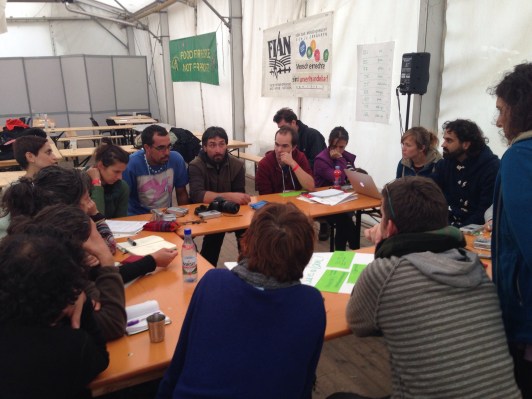
Participants discuss strategies to advance food sovereignty in Europe

Last week the second Nyeleni Europe forum for Food Sovereignty was held in Cluj-Napoca, Romania. The Forum brought together different delegations from European countries and beyond representing producers, consumers, NGOs and researchers involved in the Food Sovereignty movement. The Forum set out create new initiatives and ties among people in opposition to the dominant food paradigm. Continue reading

5 things you need to know about the CFS

I am here at the CFS with 6 students from Wageningen, Don’t know what the CFS is? Check out this blog post.

FoodGovernance's avatarFood Governance

This week I am teaming up with Nadia Lambek to research, reflect and write about the CFS. 

cfs43_150_enIn our conversations with people over the last few days (well actually, the last 6 years), we have been asked a lot of questions about the UN Committee on World Food Security (CFS), and often, the questions are the same.

To save you, and us, some time, we have identified the top 5 questionswe get about the CFS and provided our answers below.

View original post 656 more words

Meet the WUR UN Food Security Bloggers

cfs43_150_enFor the next week, 6 WUR students will be participating in the UN’s Committee for World Food Security (CFS) annual meeting as part of the official Social Media Team, an initiative coordinated by the CFS and the Global Forum on Agricultural Research (GFAR).

Their contributions will be posted here as well as on this blog.

If you are on Twitter, follow the meeting and the  #CFS43 Social Media Team by following this list.

The CFS is the most inclusive international and intergovernmental platform for all stakeholders to work together to ensure food security and nutrition for all. The Committee reports to the UN General Assembly through the Economic and Social Council (ECOSOC) and to FAO Conference.Using a multi-stakeholder, inclusive approach, CFS develops and endorses policy recommendations and guidance on a wide range of food security and nutrition topics.

Click here for more information about the 43rd session of the CFS. Continue reading