CS: Food crisis? Strategies to transform our food system: course outline

On the 16th of October it is World Food Day. The theme this year 2011 is ‘Food prices –from crisis to stability’. Price swings, upswings in particular, represent a major threat to food security in developing countries. It is predicted that instability in the world food economy will continue during the decade to come. What can we do? How can we create resilient food systems? The World Food Day has inspired the NGO’s Otherwise, RUW and the Boerengroep, to jointly organise a series of activities and lectures: Food, Farmers and Forks: moving beyond the crisis in agriculture.

In collaboration with Petra Derkzen of the chairgroup Rural Sociology (RSO) the series can be followed as one of the learning activities in this Capita Selecta course under the code RSO 51303 ‘Agricultural and Rural Innovation Processes’. The Food Farmer Fork lecture series together with the book: Food movements Unite! Strategies to Transform Our Food System (ed. Eric Holt-Giménez; see foodfirst.org) and a written essay form the basis of the course.

So, listen to critical lectures on the role that social movements can play in rural development, the future for European farmers after the CAP, the contribution of urban agriculture to food security and consider your own Ecological Footprint in the Food Farmer Fork series! And, the course literature consists of a just released and super timely book which gives the necessary background and concepts to understand the relationships between food sovereignty, resilient food systems and social movements. We will read Part I. You will learn to formulate your own vision on these relationships through the course essay assignment. The full course outline will be available soon.

Credits: 3. See under this link the course outline: Capita Selecta RSO 51303 v2

Language: English

Start: Tuesday evening 1th of November. Lectures/activities; every tuesday evening until 13th of December. Deadline essay delivery 14 of December.

Subscribe to the course until 31 of October at Boerengroep st.boerengroep@wur.nl

Is facilitating citizen initiatives a food strategy?

One can be quite busy at the moment just going to interesting food strategy events. After all, it is harvesting time. Hence, we have the Week of Taste with activities all over the country and the Capital of Taste which is Groningen this year and the Food4You festival in Wageningen and.. probably many more events that I am not aware of. The Capital of Taste activities are situated inside the City of Groningen but in the meanwhile the city is also involved in the making of a Regional Food Strategy. Not so easy (see also Foodlog blog). What is the region? The province with its capital city? Or the administrative region Groningen-Assen which cuts across two provinces? (and who has money? Labeled for what?)

Moreover, what is the problem? Again, difficult. Maybe broadly covered under the heading of ‘urban-rural relationships’ but in fact more narrowly focused on how to get the urban citizen to buy regional products (with no specific focus on sustainable agriculture). Is this a problem? Not really, it is a chance it was agreed in the meeting. A chance which could be facilitated by the government without standing in the way. So there you have your strategy and it resonates with Hinrichs (2000) defensive localism.

It also resonates in another way with Proeftuin Amsterdam, where also the key focus was to facilitate initiatives already there. The task; bringing together, connecting, inspiring, communicating across the energy which crystallizes in a particular topic, food is the hottest at the moment. “We should ask ourselves, where is the energy is flowing towards” I heard in the meeting. Hence, the most important driving force of Proeftuin was according to a presentation, the attention for citizen initiatives. A conclusion too in the Schuttelaar debate in Wageningen, same day. Research done by students of Wageningen university confirms the trend; municipalities busy with food policy/strategy/projects were those activated by their own active citizens. 

After this, the next question often asked, becomes a bit weird. How to anchor the food strategy for the long-term? There is nothing to anchor where the ‘policy’ is to facilitate citizen initiatives, this goes as long as citizens are active. Proeftuin Amsterdam does not exist anymore. Amongst others because there was no political problem (“er lag geen bestuurlijke vraag”). Food security, policies for social exclusion and poverty and access to good food, problems the Food Banks now address, were deliberately not part of the Proeftuin focus.

So what’s wrong with stimulating enthusiastic citizens busy with creating sustainable food systems in various ways? Nothing of course. However, if that’s all, it seems that despite the many ‘nice’ activities, food keeps being seen as a private responsibility. There is a serious problem in the articulation of public interest addressing structural problems in our food system and in fact, no attention at all for social justice. Do-it-yourself for those who can.

Cursus Voedsel en Stad met Carolyn Steel, 14 en 15 November 2011

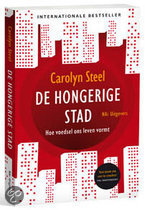
De stad heeft de toekomst. Maar heeft zij ook voedsel? Fluctuerende voedselprijzen, klimaat verandering, voedselkilometers en schandalen zijn reden tot zorg. Carolyn Steel heeft de zeer kwetsbare stedelijke  toegang en relatie tot voedsel op meesterlijke wijze in historisch perspectief gezet in haar boek De Hongerige Stad. Bovendien biedt zij een ontwikkelingsperspectief. Gebaseerd op haar boek en onder haar leiding organiseert de Wageningen Business School een tweedaagse cursus Voedsel en de Stad op 14 en 15 november.

Hoe kunnen we op een nieuwe manier naar voedselvoorziening in de stad kijken? Hoe kunnen we de stad weerbaarder maken en voedsel beter integreren in stedelijke ontwikkeling en cultuur? Wat kunnen planners doen? En architecten? Of stadsontwikkelaars? Of ontwerpers? En welzijnswerkers of wethouders? Deze cursus is bedoeld voor iedereen die in de breedte werkt aan duurzame stedelijke ontwikkeling en beseft dat onze dagelijkse maaltijd daarbij een essentieel scharnierpunt is.

Voor meer informatie en opgave kijk op de website van de Wageningen Business School waar ook de cursus brochure gedownload kan worden. Opgave vóór 21 Oktober.

Harvesting the fruits of labour

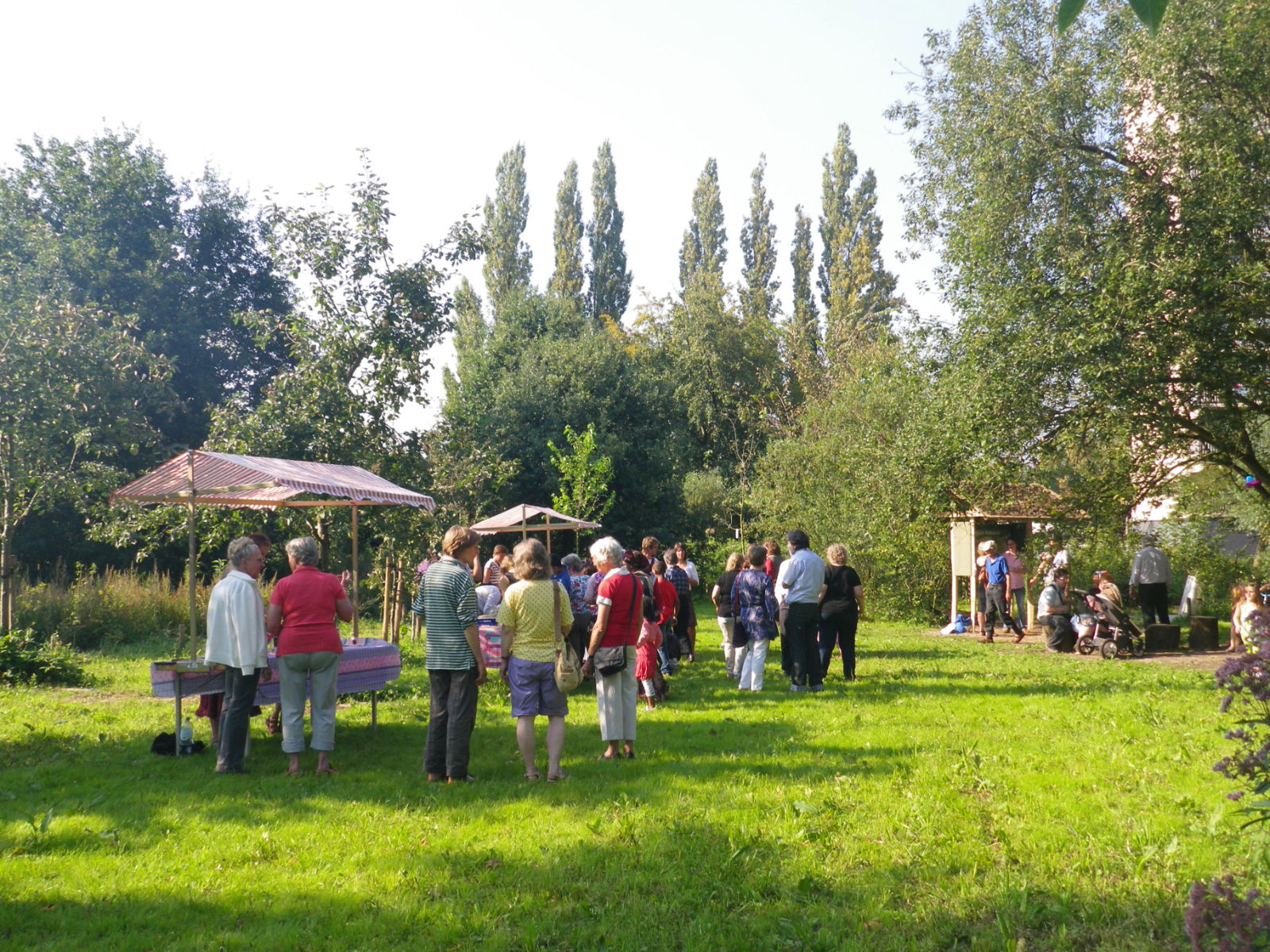
Exactly two years after a film eveningorganised by Transition Town Vallei united some people of the neighborhood, the ‘forest garden’ in the Pomona neighborhood in Wageningen was officially opened by municipality Alderman Lex Hoefsloot on the 3rd of September. The implementation of the design made by the neighborhood (see previous blogs) was finished just in time. After planting many different fruit trees and bushes in March and April, numerous watering sessions during the dry spring and some rainy working days in May and June, we used the summer to build a few wooden structures such as a pergola, a tree- trunk bench and an information panel. Also…..the weeds kept appearing and we sowed grass which is regularly cut by one of the residents. Additional plants were planted too, offered by a resident who maintains them. In the week before opening, the community centre went into the garden with children to harvest the first apples. Not from the newly planted trees but from those trees we rescued from under the brambles. The apples were used by children in the weekly cooking class run by the centre to make apple pie. This was precisely how we envisaged the function and use of this ‘garden’ when we started writing the plan two years ago. I love it when a plan comes together. (pictures below; making fruit juice on the spot and garden excursion)

Notes from the ESRS conference (5)

Back in Wageningen, I am still digesting all the inspiration, material and knowledge that was floating around freely last week at the ESRS conference in Chania, Greece. For example, related to the earlier blog on the conference (2) the Working Group “New forms of citizen-consumer engagement in food networks: diversity, mechanisms and perspectives” had much to offer in addition to our own working group. Indeed, of all the types of consumer driven initiatives, such as food coops, CSA, consumer purchase groups, adoption schemes and landshares, the grow-it-your-own was largely absent. We concluded that a fusion of self-provisioning strategies and consumer driven engagement initiatives are necessary to understand the full spectrum of engagement with food growing.  Another conclusion of the Working Group was that the driving force behind an initiative does not need to correspond with the nature of the initiative. Examples from Czech Republic showed how citizens had set up a farmers market, which is usually seen as a producer initiative. Also here, new terms and definitions were considered such as “civic food networks” or “pro-sumers” to move away from the consumer – producer dichotomy, a distinction which obscures more than it reveals.

The enormous differentiation in initiatives was another key finding when one looks across the presentations in this Working Group. We concluded that it is difficult to discover ‘hidden realities’ and that we most likely underestimate the number of alternative food networks around. Initiatives have different names across countries or sometimes do not want to be known in statistics and databases as they deliberately try to operate outside ‘the system’. The last point includes a tension. We would like to show and make visible the size of the alternative food networks, also to show its significance. But it also reminded me of a paper which I use in a course on political sociology on “Governmentality and territoriality” by Jonathan Murdoch and Neil Ward (1997). Statistics are a useful instrument to govern at a distance and one of the technologies of government now widely used and abused, but which we take for granted now. The paper, however, showed how the collection of statistics of Britisch agriculture from the 19th century onwards failed “not least because of a relunctance on the part of many farmers and landowners to cooperate, based on their belief that the exercise was an interference in their private affairs” (1997: 314). All governments depend on modes of representation by which the domains to be governed become visible. Freedom, according to Foucault, is “the art of not being governed quite so much” (Oksala 2008). A careful approach to visibility sounds healthy to me.