Four corners Indian country

Since Saturday I am staying in Keams Canyon, in the Hopi Reservation in Arizona. For the last ten years, Cornelia Flora has been doing research and extension work with a colleague from Arizona State University, Matt Livingston and organizations at the Reservation. This visit therefore includes some meetings on current projects.

Hopi Indians are a pueblo tribe living in 13 villages located on the 2472320 acres (just over a million hectares) of the Hopi Reservation in north-central Arizona. With their ancestors coming from the south, they are sometimes categorized under as Anasazi; southern based tribes sharing a coming language root.  However, we learned in the Archeology Museum in Blending, Utah, that this is a name taken over into English from Navajo. In Navajo (themselves coming from north) it means something like ‘ancient enemy’. A more correct way to talk about the different tribes that came from the south, therefore, is Ancestral Puebloans. The Hopi Reservation is surrounded by the Navajo Reservation and there is an Apache Reservation nearby.
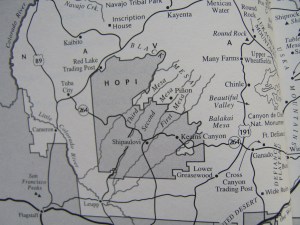
STA71894The Hopi villages are mostly located on three peninsular “mesas” that are the southwestern “fingers” of Black Mesa, high ridges elevated around a 1000 meters above the Canyon land plateaus. The Hopis are the oldest continuous inhabitants of northern Arizona; some of their ancestors may have lived in the region as early as A.D. 700 (Linford 2005).


“I never saw so much empty land”, I remarked to Matt in the car yesterday. Indeed, books talk about this desert land as some of the most desolate country in the United States. “It might seem empty to you” Matt replied, “but it is not for the Hopi”. It might not seem ‘productive’ in any Western economic sense, but this land represents many things for them. “There can be trails or holy places where their shrines live”. And, “their cattle graze here and they cultivate their indigenous ground races maize” Matt explained. In such an extensive way that it is hardly visible for the eye! With approx 300 millimeters rainfall a year and no rivers in the neighborhood they are adapted to their circumstances, quite different from the Dutch wetlands….

Hopi CookbookOne of the projects is centered around Hopi food. The aim of the project is to help communities to understand Hopi traditional food, to collect best practices about growing and gathering food as well as to appreciate the spiritual aspect of food. It is an awareness raising project, helping people realize what they already know. One of the result so far has been a Hopi traditional cook book and follow up activities are now planned, such as intergenerational cooking workshops.
First in time, first in right

For opposite reasons as why we created our “Waterschappen” in the Netherlands, there are Water Laws in the Western States of the US. In the states where I have been the last couple of days, Colorado, Utah and Arizona rainfall is pretty scarce. On our field excursion as part of the Changing Lands, Changing Hands conference, our guides tried to explain the extremely complicated water rights system of Colorado. Fortunately, somebody already told me over diner. “You don’t own the water that rains down on your land” my diner partner had said. Eehh?

It means that you cannot put a well on your land or use creek, river or lake water running on or near your land. You can only use water if you have water rights. Water rights are connected to ditches dug by the first settlers in 1860, and to Ditch companies who manage them. Those who claimed first, have more senior rights. The right equals to a share in the company; a certain quantity of water, measured in acre-feet (literally an acre of land with a foot water on top). In years of drought, those who claimed last will not receive any water, only for those with senior rights, the tap will be opened. Not all farm land has water rights, those who farm without, are known as the dry land farmers, usually farming wheat and/or cattle.

Right can be traded separately from the land. Each new development (housing, offices, malls) needs to have water rights too. Water rights are therefore sometimes more worth than the land itself. And it even happens that, in years of drought, it is more profitable for farmers to lease the water rights to a city or county than to farm. 

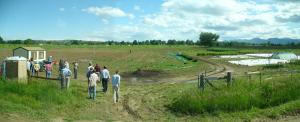
The Boulder county, one of the counties near Denver has a very progressive land use policy in place ever since 1978, an exception to the rule. This county is active to facilitate a new generation of farmers, such as those willing to start farming vegetables for farmers markets on small plots. We visited one such farmers association, which started two years ago. The land, including the water rights needed, is owned by the Boulder county which leases it to them against reduced prices. Otherwise this enterprise – and to many a dream – would not be possible.

colorado growers association 2 

(picture of Bart Eleveld Oregon State University)


Times of change?

At the Changing Lands Changing Hands conference in Denver, Jess Gilbert reminded us in his opening speech of the agricultural policies that were put in place with the New Deal policy in the depression of the thirties. Henry J. Wallace was the driving force behind a set of progressive and innovative policies, many of them, still existing today. One of the policies was aimed at land reform establishing 100 new communities from nothing all throughout the country. The state bought the land, built houses and health centers for poor shared croppers. A loaning program offered 100 to 150 families to buy the land, house and tools in one community. Much of the organization was coordinated in tens of different cooperatives per community.

The experiment ended in World War II but the places became strongholds in the civil rights movement of the sixties. What the example illustrates is how powerful a working combination of bottom up and top down can be; activism among the shared croppers and visionary leadership of the ruling elite. Our current time has been compared with the time of the Great Depression, for the severity of the financial and economic crisis. And so maybe the analogy also has to be, that this can be a time of progressive social change.

Not everybody here at this conference is a believer of such ‘sociologist talk’. At the end of one of the sessions, an agricultural economist said me that we can not get around the market forces dictating what farmers will do. “And I don’t see anyway in how that is going to change.”

The session was about farm viability and business transfer. Session presenters all stressed the need for financial management. “Farmers try to produce their way out of trouble” one of them said, but it is not production what counts, “it is financial management which makes the farm profitable”. The session was aimed at the ‘real’ farmer. Statistics were misleading, the agricultural economist said. It was said that the US has around 2 million farmers. Not true, according to him, maybe 200.000 could qualify as a farmer, if you would be able to distinguish them from hobby and small farmers as well as those who are registered for tax reasons.

And besides that, “all this fuss about corporations nowadays I don’t understand, these are still family farms” he said, “who put their business in business models to manage them”. These several million worth ‘family farms’ are, like any other industrial operation, a high capital investment, high sales volume and low profit margin operation. Future successors certainly cannot do without financial training.

Changing Lands, Changing Hands

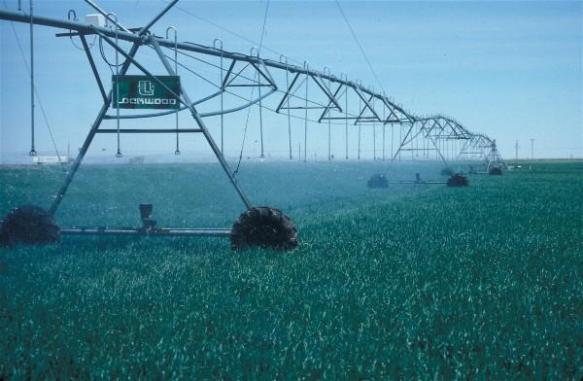
Yesterday we drove a bit more than a thousand kilometers and crossed all the way through Nebraska into Colorado to arrive in Denver for a two day Changing Lands, Changing Hands conference. Nebraska is even more sparsely populated than Iowa and driving through I saw more irrigation installations than houses!irrigation corn


This national conference is part of the FarmLASTS project. This project addresses one of the “most pressing issue inUS  agriculture”; the access to, the affordability and security of agricultural land to (young and new) farmers. This conference addresses many of these topics, to a mixed audience of farmers, NGO members and academics from land grant public universities (such as Iowa State University).

The statistics provided by the project are quite startling. Agricultural land is increasingly in the hands of older owners (60+ years). Of all farm landlords, over 60% are over the age of 60 and 40% are over 70 years old. Many of them are women, because women often outlive their husband. Investor ownership is increasing. For example, in Iowa, 34 % of farmland owners were investors (2002). Nationally the percentage of farmland owners who are NOT farm operators is as high as 88%. So there are multiple challenges in farm entry, exit, tenure relationships and transfer to discuss here. Especially, because the estimates are that half of the US farm land will change hands in the next 20 years, which amounts to approximately 400 million acres.

Sioux City and Community Development

Monday, I embarked on a 15 day travel with Cornelia and Jan Flora, stopping by various meetings, projects and conferences in a south west direction from Ames, Iowa to Arizona and back. The amount of car miles involved would get me twice around the Netherlands I suppose. We started with a meeting in Sioux City, a city in the north west of Iowa bordering Nebraska.

STA71678We are meeting in a recently restored old boiler building which once served 46 building in this neighborhood. This old industrial neighborhood is being redeveloped as Sioux City tries to reinvent itself as an arts and cultural city. However, its history is tightly connected to agriculture through the stock yards, the traditional trading place for farm animals. Therefore it stays as somebody said “a cowmen’s town with an opera”.

Well, I heard last night that it was not only about men. Traditionally, the stock yard was surrounded by cowboy saloons and brothels. The brothels, where a Madame ruled, were important places for local business and access to capital.The Madame had a very powerful position and was often involved in providing micro loans and other financial services in a time where banks were not easily accessible.

However, we are here for another type of community development…. Faculty members of 5 Midwestern universities discuss here the Community Development On-line Master’s Program in which they are involved together. This is quite a unique situation, a full online course offered jointly by the universities of Iowa State, North Dakota State, Kansas State, South Dakota State and Nebraska-Lincoln under the Great Plains Interactive Distance Education Alliance.

The Community Development Program began in the fall of 2005, and it was initially funded through a National Higher Education grant. Since the grant has ended, the program continued and supports itself. Students in the program are from all over the United States, as well as other countries. Many of them combine the Master with their (community) work and/or family. The program won two awards in 2008, a state and a national award. Jan and Cornelia Flora are both involved in the Program as teachers and Jan Flora won two grants in 2008 which allow for the development of two new courses within the Master, one on Sustainable Communities and the other on Immigrants in Communities.

Online Bachelor and Master programs are becoming rapidly popular. For universities, such as those in the Midwest it represents an opportunity to new attract students to universities in States which show a downward demographic trend. And the online – placeless programs also attract new categories of students, such as those who are forced to come out of retirement because of financial problems and need to ‘rewire’ themselves.