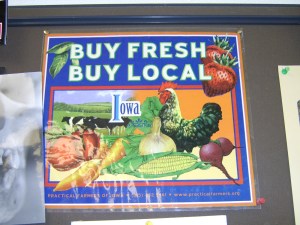
Knee-high by the 4th of July

Independence Day, the 4th of July is of course an important day in the US. And it therefore serves as a marker in time, if the corn is knee-high by the fourth of July, you can be happy. STA72046Well, here in Ames, one can be satisfied. The corn is more like shoulder-high already. Maybe this is caused by the “black gold of Iowa.”

A series of glacial events (Quaternary) delivered an extremely black and fertile soil throughout the middle of the state Iowa. Soil like this can deliver an abundance of fresh and varied produce. But driving through Iowa this weekend on my way to Mount Rushmore in South Dakota, I actually drove through a food desert. The corn, grown at each side of the road, cannot be eaten.

 The various F1 hybrids which are grown here are not essentially vegetables but an industrial raw material. During the eighties, the integrated farm made way for the integrated agro-industry. The nutrient cycle at farm level broke once the diversified farm specialized into different and geographically separated monoculture operations. The nurturing cycle in which there was no such thing as ‘waste’ was replaced by a system producing at least three new categories of dangerous waste.

1. Nitrogen in (drinking) water from artificial fertilizers. Hybrid corn consumes more oil – that is, fertilizer – than any other crop. And since it is corn after corn each year, more fertilizer is needed to keep production figures high. Much of it ends up in the rivers. Rivers which provide drinking water. Iowa has the largest nitrogen filter in the world in their Des Moines River water treatment facility. They take out so much nitrogen for which they do not have a storage place that they dump some of it into the river again downstream.
2. Antibiotic residue’s in (drinking) water. Over half of all corn grown in the mid west goes into animal feed. Much of it goes to the cattle in the feedlots or to hog CFO’s. After half a year of grazing, the beef cattle are confined for over half a year more in feedlots to be fed nothing but corn. In this last phase, they are fast fed into steaks and burgers, but there is no need to say that the cow’s stomach is not made for an exclusively low structure energy rich diet (despite the difference in stomachs, much like humans). Moreover, the amount of animals per square meter standing in their own dirt is just the kind of environment for whatever disease to arise. Their feed contains therefore a standard amount of preventative antibiotics which pollute the animals as well as the environment; not least the water. Ultimately a danger to all of us creating resistances and superbugs.
3. Toxic manure. The large concentration of animals in a feedlot produce a large and concentrated amount of manure, stored in pits, tanks or open air lagoons. Manure leeks from these types of storages into the ground water, or as emissions in the air. And the level of concentration of the manure is often so high that it is useless as fertilizer. Existing feedlots are often exempted from many water and air regulations.

Fighting from inside capitalism

Last week I joined Jan Flora to a meeting in Des Moines called the “Midwest Meat Roundtable”. It was organized by the Interfaith Center on Corporate Responsibility (ICCR). ICCR is a nationwide consortium of faith based intentional investors, such as the Adrian Dominican Sisters from Michigan or the United Methodist Church in Illinois.

The meeting brought together a very wide range of civil society organizations, faith based as well as non-faith based. All are concerned with one or another damaging aspect of the agro-industry. Here I was in a room with people whose life task is the “fight against factory farms”. A fight of David against Goliath. “I have been in the fight for 20 years” is how some would introduce themselves. Or, “I fought Tyson for years, we took them to court, but two anonymous jury decisions were stolen from us.”

The government was not present. It seems again, that the public sector is not regarded as an ally in these issues. The effect of the Bush Administration has been devastating, remarked one of the participants. Less and less regulation, and an ever stronger intertwining of corporate and political interests through for example campaign financing. “Industrial Ag has split and damaged our communities”. And families; one of the participants told how the intended establishment of a CFO by one family member had ruined family relationships for years. “People live alongside each other in small communities and go to church together.” To cope, “they tend not to talk about it.”

A CFO is short for Confined Feeding Operation. There are other terms as well like Concentrated Animal Feeding Operation, which essentially mean the same. For example, Indiana government defines a CFO as:

“as any animal feeding operation engaged in the confined feeding of at least 300 cattle, or 600 swine or sheep, or 30,000 fowl, such as chickens, turkeys or other poultry.”

However, usually CFO’s contain far more animals than the minimal used for this definition. I have seen feedlots on our way to Denver which contained thousands of cattle, much like this image.

The problems with Industrial Ag are multiple, social as well as environmental and can fill many blogs. What was unique to this meeting was presence of organizations who work towards change from the inside, from their position as shareholder in for example the large meat processing companies. This means that inside and outside tactics can be combined to reach more effect. The inside – shareholder – tactic can be used if one has some minimum amount of shares held over a certain period. Intentional investors then go to file a resolution, which has to be done usually 6 months before a shareholder meeting.

Resolutions are around 500 words requests asking two things: show us data on e.g. air emissions, and, please adopt our proposed change/principles. The company then, has three options. They can do nothing, so that the resolution will be on the ballot at the shareholders meeting. Second, they can challenge it before a committee (SCC) and plea for their interest by saying that it is ordinary business or that they already implemented some. And thirdly, they can start negotiations to see how they can get the filer of the resolution to withdraw it.


It is a sensitive game. The intentional investor wants to end up at the negotiation table for dialogue, preferably even before filing a resolution. Usually, companies don’t like resolutions to be flagged up, and they will try to prevent them from being on the ballot. If they appear on the ballot anyway, and a resolution receives more than 10% of the shareholders votes, this means a victory for the intentional investor because there is a big chance that the issue will get more attention the next year. As you can tell, it is a slow and tedious process. And, it can only be done with those corporate businesses which are not privately held – like one of the biggest; Tyson, where the family will always vote as a block.

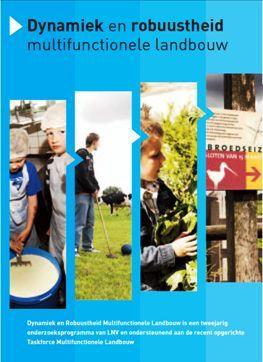
Folder Onderzoek Dynamiek en Robuustheid Multifunctionele Landbouw

Voorkant folderOnlangs hebben we een mooie informatiefolder gemaakt voor ons onderzoek ‘Dynamiek en Robuustheid van Multifunctionele Landbouw’. In deze folder is, naast een beknopt overzicht van de onderzoeksfasen, ook informatie te vinden over o.a. de achtergronden, doelstellingen, resultaten en partners van het project.
De folder is hier te downloaden.

Overige informatie is te vinden op ons ‘Multifunctionele Landbouw Weblog’. Op deze plek houden we u op de hoogte over de recentste ontwikkelingen en resultaten van het project.

Food democracy

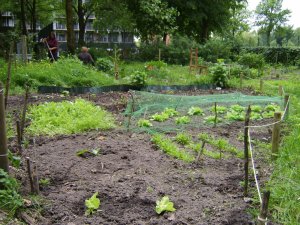
Nothing but corn in Iowa. So I did some serious weeding and hoeing of corn this weekend……..Of white corn. Not the regular uneatable corn which goes into feed fodder, energy production or corn sweetener. These immense fields are round-up ready anyway. The corn grown in the community garden in Marshall town (see blog) can be eaten, it will be used to make corn flour tortillas.

my garden in wageningen

my garden in wageningen

It has been a wet summer so far. So weed is quite a challenge for the starting community gardeners. I was glad I could help out; a sort of substitution for missing my own 20 m2 in Wageningen.


Self sustenance in food. Once a dismissed and declining (if we could help them) ‘farming system’. Bound to disappear under influence of progress; by ever increasing economies of scale and market integration. However, self sustenance or small scale production is loosing its negative connotation of backwardness. It is being redefined and revalued in both developed and developing countries, in both urban and rural circumstances (see yeomanry).

Our global agro-food industry has not been able to reduce hunger as it privileges capital accumulation for already wealthy elites while externalizing environmental and social costs to societies. The consolidation of power in the food chain, the world food crisis and environmental degradation have instigated a variety of movements towards self reliance and community focus, towards returning to a scale which can be influenced. It can be seen as a re-appropriation of a sense of self determination and autonomy to increase resilience of livelihoods and to reduce dependence on situations with high levels of power asymmetries.

While we do not accept anything less than democracy to rule our societies we are nearly being ruled by autocracy in the food chain, hidden behind the myth of ‘consumer choice’. The diversity of food and farming initiatives emerging, points to a process of democratizing food, the people’s right to

“healthy and culturally appropriate food produced through ecologically sound and sustainable methods, and their right to define their own food and agriculture systems” (Food First)

STA71596

Suburban Ag

Land use planning and housing development can bring farming and food production closer to (sub)urban citizens. Similar to trends in the Netherlands, suburban agriculture is taking form in new developments projects. There are two pathways. First, development organised by citizens in co-housing projects such as the Ecovillage in Ithaca. Co-housing projects often involve the creation of an ‘intentional community’ of people who have chosen to live and work together in a lifestyle that reflects their shared core values. Projects often include a community owned and operated farm.

Intentional communities rebel against two dominant American features; individualism and property rights/ownership. Both features are reflected in the overall perspective on land use planning and housing development here. In order to understand it, Dutch assumptions on land use planning need to be left behind.  In most places, state and county legislators refrain from ‘interfering’ with land ownership. Without zoning or specific designations, any land, no matter how far from an urban centre, represents a bundle of rights. For example water rights (see blog), and more importantly ‘development rights’. Development takes place where developer and landowner agree. Around cities, this causes a large ring of ‘urban sprawl’; fragmentation of land and a random patchwork of malls, offices, agricultural land, housing and roads without any visible coherence. Although farmers, who farm in the middle of this, oppose to the developments, they oppose to land use planning at the same time; nobody wants to give up their right to sell their rights.

A second type of suburban agriculture, therefore, is often led by private or public land trusts.  This means that land use planning is applied on the coherent whole of land owned by the trust on a certain location. Some parts are developed for housing, other parts for farming and other parts for nature conservation. A good example of this is Prairie Crossings, set up in 1987 by a group of citizens. This can only take place if development rights are taken off the land even though it is not used for building (‘easement’) to prevent future unwanted development. Rights are taken off by conservation easements in two ways; by being sold or being donated to the trust (the latter for receiving advantagous tax breaks). Whereas until 10 years ago, easements were only for nature conservation, nowadays there are agricultural easements possible too now environmentally sustainable farming is becoming a practice.

It is remarkable how absent the state is in land use planning. Planning in the Netherlands, such as Reconstruction Law land use planning, including the movement of entire farms for preserving natural habitats, equals to an unthinkable intrusion of property rights here.