AFNs in Pelotas, Brasil

This week I am visiting the city of Pelotas, some 250 kilometers from Porto Alegre. As one of the three in the whole of Brasil, the Universidade Federal de Pelotas has a specialised Bachelor degree in anthropology. Today I will give a guest lecture within the course on food culture of Professor Renate Menasche on the link between Alternative Food Networks and food culture. Last week in the course for the PGDR in Porto Alegre, many students believed there are no AFNs in Brasil and that consumers are not willing to make an effort to engage with farmers. However, on our fieldtrip of yesterday we saw two very interesting examples of innovative farmers around Pelotas who produce differently ánd who market their produce differently.

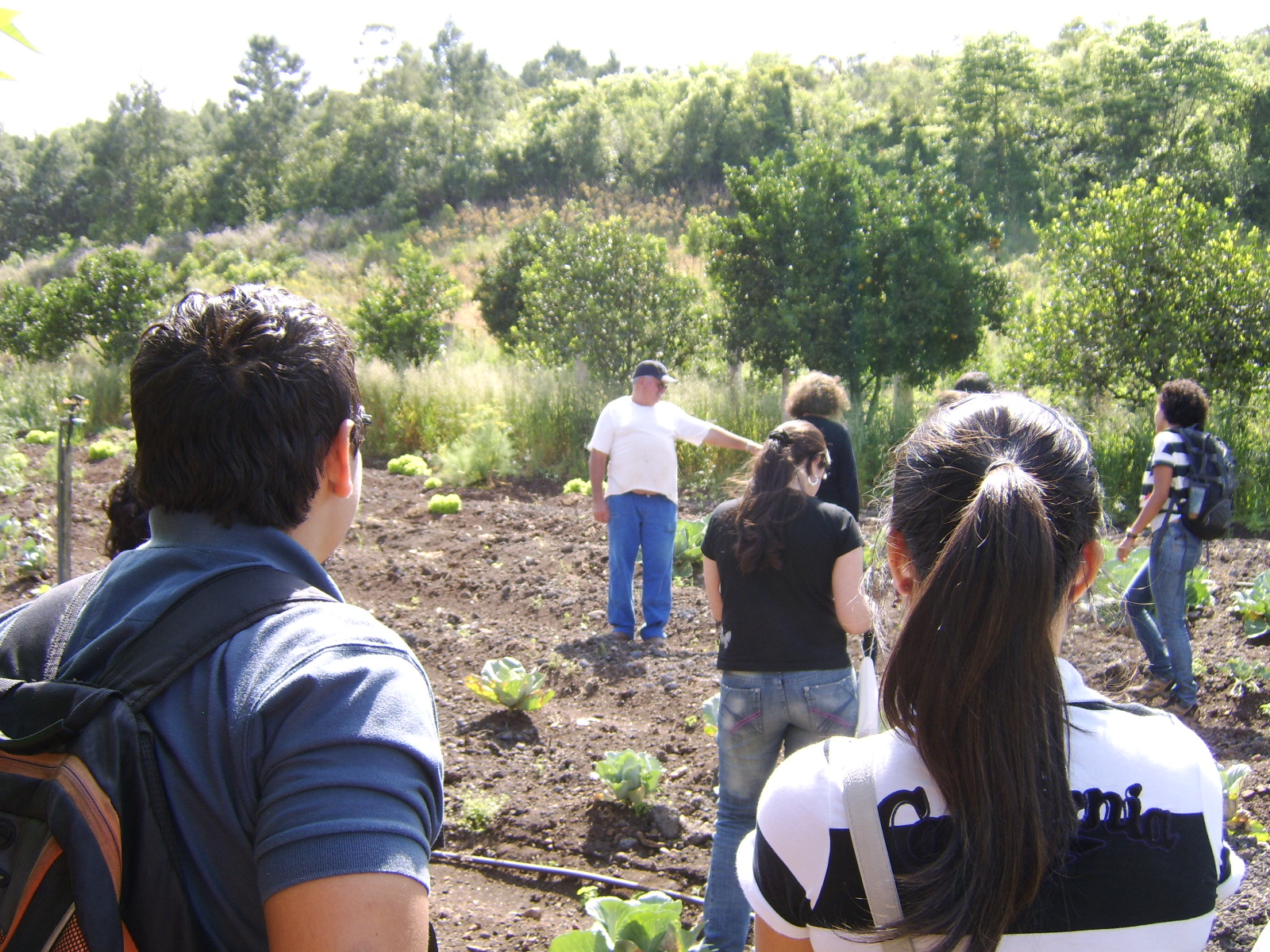
Enio Nilo Schiavon took the time to lead us around his farm where he combines agro-forestry and agro-ecology practices in producing organic peaches, grapes, clementines, banana, sweet corn, broccoli, carrots, beets, fish and flowers and home-made juices. His production is organic but not organically certified, something which for smaller farmers is very normal; organic certification is too expensive. However, there are various ways to market organic produce without the official farm certification. For example by being part of a cooperative which has the certification and through this, the farm is also recognised as such. Or by building a trust relationship directly with consumers by way of selling on a farmers’ market. The latter is what Enio Nilo does, two times a week in two cities in this region. The farmers’ market are an initiative of the farmers themselves and are organised through their association ARPA-SUL. They are with 27  farmers, each offering other complementary products. Interestingly, they not only sell to the middle-class urban consumer, but also to many other small farmers in the region who are themselves tobacco growers.

A school meal in Dois Irmáos (3)

The school meal program in Dois Irmáos is an exceptionally good example for multiple reasons. First, there is a dialogue between rural extension, family farmers, the nutritionists and the municipality. This cannot be taken for granted and the absence of mutual understanding and trust is often a barrier in other places. The state is often not trusted by farmers, governments can change. Nutritionists may think too much in terms of nutrients and hygiene whereas family farmers are often not organised enough to meet the supply requirements.  Or the cooking staff might object. In class, the example was given of a land settlement women’s cooperative baking bread which was refused by a school because the breads were too big and the cooking staff objected against having to cut the bread (instead of individual bread rolls).

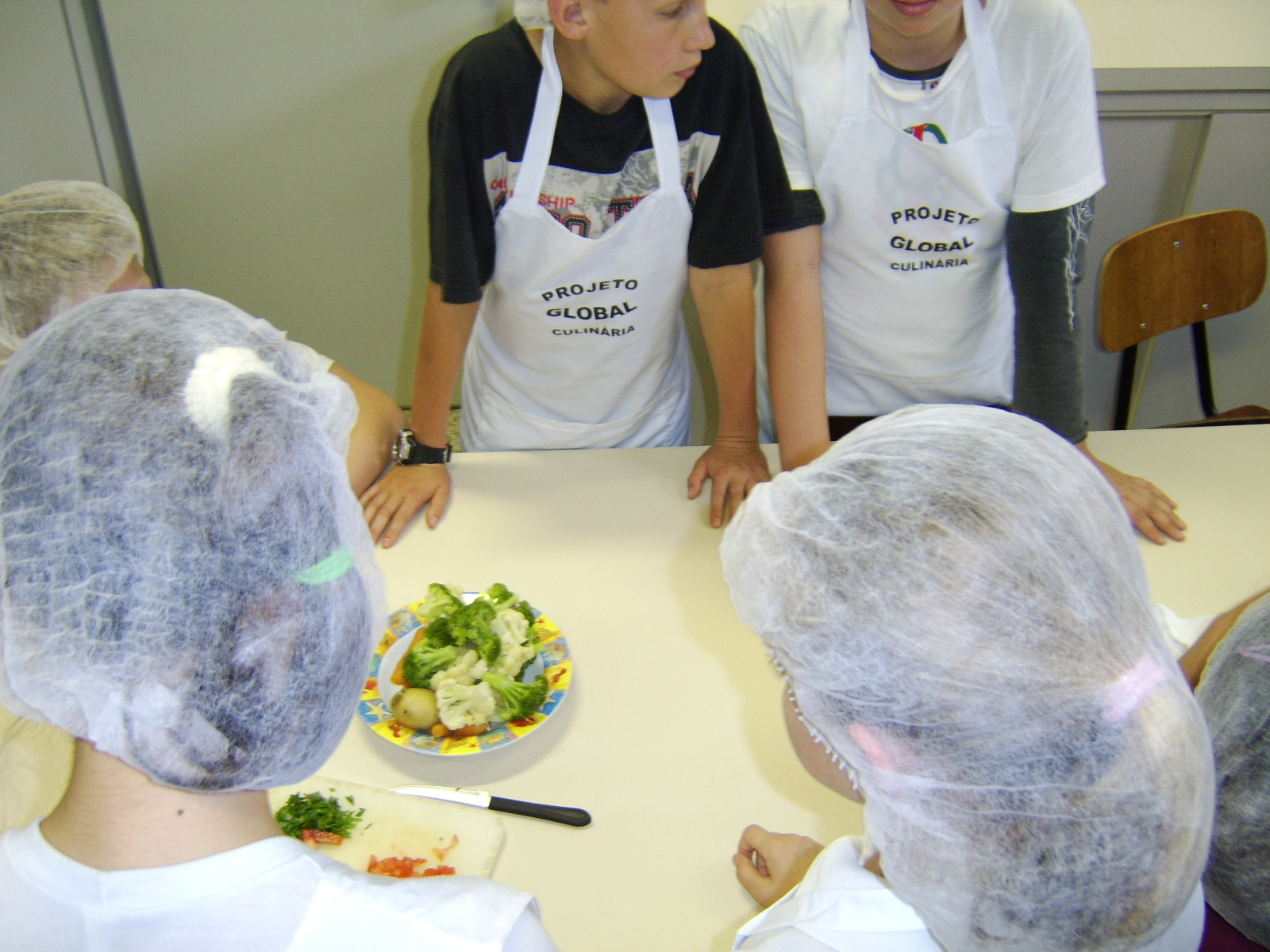
Secondly, the facilities were modern, clean and spacious with lots of different activities for children. The school meal is strictly speaking not served at school but at the after-school day care center. It is normal in Brasil that children only go to school half a day. Most children go home afterwards and eat at home. A school meal is for those who need it, this can be because there is food insecurity at home, or quite the opposite, because both parents are working. In the case of the center we visited, it was aimed at children from the latter category. One of the activities is cooking lessons.

Thirdly, the scale of Dois Irmáos is that of a small town which makes it easier to localise the school meal. Not only because there are not too many mouths to be fed but also because of the logistics and coordination of getting the supply at times and intervals needed. The city of Porto Alegre is only now starting to look at possibilities to localise the school food from surrounding family farmers. Quite a challenge with the amount of children in schools and the metropolitan landscape.

A school meal in Dois Irmáos (2)

Municipal garden farmer explains

The Brazilian School Food Program underwent a lot of changes and, as posted earlier, the biggest change is related to localisation of the school meals. Previously, national menu’s with national tendering contract for enormous quantities to which only big companies were able to bid competitively were what the program was about. To give an idea, for 2010 the estimation was a total school food procurement market of 3 billion dollar providing food for 47 million students. Now cities and municipalities are responsible for contract tendering and supply selection. This has created opportunities to shorten the food chain although many municipalities still follow the logic of mass production and long supply chains (Triches and Schneider 2010). Therefore, additional Law 11947 created the rule that 30% of fresh produce has to come from the ‘family farm’.

Opportunities, but it has also created challenges. At municipal level, capacity is now assumed for things like the nutritional balance of menu’s based on local products, the legal process of tendering and supplier selection with many more suppliers and overseeing the many other issues such as logistics. Not all municipalities do have this capacity yet. Equally, not all ‘family farmers’ are equipped to supply particular quantities and collaborate with colleague farmers to meet demand.

However, in the State of Rio Grande do Sul many good examples can be found too. One of these is the school food program in the city of Dois Irmáos (see also Triches and Schneider 2010 in Portuguese). The municipality created a municipal ‘huerta’, a vegetable production garden which produces almost all greens for the school meals. Furthermore in collaboration with Rural Extension a pool of 160 family farmers is working with the program. Every 6 months, the municipality calls a tender to buy its supply for the coming half a year. Each time, 10 to 15 farmers of this pool are selected to supply foods like potatoes, onions, milk and meat. Although the bureaucracy involved in this tendering process is one of the biggest problems, the family farmers are not subject to the same legal scrutiny as is normal for other products. Buying from family farmers is done through a separate program PAA (Food acquisition program) where a certificate is needed which proves that the farmer can be classified as a ‘family farmer’ but where the language is different and the product descriptions simpler such as ‘salad’ or ‘potato’ rather than a legal description. The after-school which we visited invested in its own meat-cutting room in response to buying fresh meat from local farmers. Local nutritional studies show that the children like the meat and other food better.

CS: Food crisis? Strategies to transform our food system: course outline

On the 16th of October it is World Food Day. The theme this year 2011 is ‘Food prices –from crisis to stability’. Price swings, upswings in particular, represent a major threat to food security in developing countries. It is predicted that instability in the world food economy will continue during the decade to come. What can we do? How can we create resilient food systems? The World Food Day has inspired the NGO’s Otherwise, RUW and the Boerengroep, to jointly organise a series of activities and lectures: Food, Farmers and Forks: moving beyond the crisis in agriculture.

In collaboration with Petra Derkzen of the chairgroup Rural Sociology (RSO) the series can be followed as one of the learning activities in this Capita Selecta course under the code RSO 51303 ‘Agricultural and Rural Innovation Processes’. The Food Farmer Fork lecture series together with the book: Food movements Unite! Strategies to Transform Our Food System (ed. Eric Holt-Giménez; see foodfirst.org) and a written essay form the basis of the course.

So, listen to critical lectures on the role that social movements can play in rural development, the future for European farmers after the CAP, the contribution of urban agriculture to food security and consider your own Ecological Footprint in the Food Farmer Fork series! And, the course literature consists of a just released and super timely book which gives the necessary background and concepts to understand the relationships between food sovereignty, resilient food systems and social movements. We will read Part I. You will learn to formulate your own vision on these relationships through the course essay assignment. The full course outline will be available soon.

Credits: 3. See under this link the course outline: Capita Selecta RSO 51303 v2

Language: English

Start: Tuesday evening 1th of November. Lectures/activities; every tuesday evening until 13th of December. Deadline essay delivery 14 of December.

Subscribe to the course until 31 of October at Boerengroep st.boerengroep@wur.nl

Is facilitating citizen initiatives a food strategy?

One can be quite busy at the moment just going to interesting food strategy events. After all, it is harvesting time. Hence, we have the Week of Taste with activities all over the country and the Capital of Taste which is Groningen this year and the Food4You festival in Wageningen and.. probably many more events that I am not aware of. The Capital of Taste activities are situated inside the City of Groningen but in the meanwhile the city is also involved in the making of a Regional Food Strategy. Not so easy (see also Foodlog blog). What is the region? The province with its capital city? Or the administrative region Groningen-Assen which cuts across two provinces? (and who has money? Labeled for what?)

Moreover, what is the problem? Again, difficult. Maybe broadly covered under the heading of ‘urban-rural relationships’ but in fact more narrowly focused on how to get the urban citizen to buy regional products (with no specific focus on sustainable agriculture). Is this a problem? Not really, it is a chance it was agreed in the meeting. A chance which could be facilitated by the government without standing in the way. So there you have your strategy and it resonates with Hinrichs (2000) defensive localism.

It also resonates in another way with Proeftuin Amsterdam, where also the key focus was to facilitate initiatives already there. The task; bringing together, connecting, inspiring, communicating across the energy which crystallizes in a particular topic, food is the hottest at the moment. “We should ask ourselves, where is the energy is flowing towards” I heard in the meeting. Hence, the most important driving force of Proeftuin was according to a presentation, the attention for citizen initiatives. A conclusion too in the Schuttelaar debate in Wageningen, same day. Research done by students of Wageningen university confirms the trend; municipalities busy with food policy/strategy/projects were those activated by their own active citizens. 

After this, the next question often asked, becomes a bit weird. How to anchor the food strategy for the long-term? There is nothing to anchor where the ‘policy’ is to facilitate citizen initiatives, this goes as long as citizens are active. Proeftuin Amsterdam does not exist anymore. Amongst others because there was no political problem (“er lag geen bestuurlijke vraag”). Food security, policies for social exclusion and poverty and access to good food, problems the Food Banks now address, were deliberately not part of the Proeftuin focus.

So what’s wrong with stimulating enthusiastic citizens busy with creating sustainable food systems in various ways? Nothing of course. However, if that’s all, it seems that despite the many ‘nice’ activities, food keeps being seen as a private responsibility. There is a serious problem in the articulation of public interest addressing structural problems in our food system and in fact, no attention at all for social justice. Do-it-yourself for those who can.