Sustainable Food Planning Conference

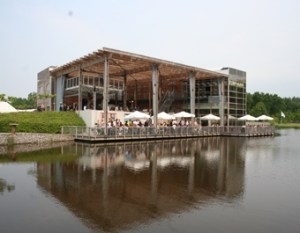
De KemphaanIn her recent blog, Petra already reflected on the Sustainable Food Planning Conference that was held in Almere (at De Kemphaan) on 9 and 10 October. My personal impression is that it was a very successful kick-off of the AESOP thematic group on sustainable food planning. In addition to lots of interesting presentations, there were interesting discussions and the strong will and desire among the participants to continue collaboration. One of the ways to continue collaboration is by means of an annual conference. Another is to create an electronic platform to facilitate exchange of experiences, examples, articles, reports, etc… Soon we will launch such a platform by means of a weblog similar to this one. For the time being, this post provides the links to the dowloads of the presentations and the discussion.

De Kemphaan, 9 and 10 October 2009, Almere, The Netherlands

The program
The participants
Presentation 1 Mr. Henk Mulder Including food and agriculture in urban planning: The Almere approach
Presentation 2 Prof. Han Wiskerke An integrated and territorial perspective on food studies, policy and planning
Presentation 3 Mr. Henk de Zeeuw Feeding the city: Practices, challenges and lessons from developing countries
Presentation 4 Prof. Gianluca Brunori Reconnecting consumers and producers: Dynamics, diversity and potentials of alternative food networks
Presentation 5 Dr Roberta Sonnino Urban food and public spaces: Planning for security and sustainability
Presentation 6 Dr Marin Caraher Food and the city: The links between food, public health and sustainable urban development
Presentation 7 Mrs. Lenie Dwarshuis Food and agriculture in Europe’s peri-urban regions
Presentation 8 Dr. Nevin Cohen The practice of food planning in New York City
Presentation 9 Mr. Bart Pijnenburg, MSc Amsterdam’s food strategy (“Proeftuin Amsterdam”)
Presentation 10 Prof. Jerry Kaufman Including food in planning studies and planning practices: Experiences from the USA
Report of the discussion

Planning sustainable food systems

Planners are discovering food. Until recently, planners left food to the market. But times are changing and so are attitudes towards planning for food. This was the general notion during the first European Sustainable Food Planning conference, held last friday and saturday in Almere (see blog for program).

There is less timidity to interfere with what until recently was seen as the private sphere of consumer choice. Neoliberalism has lost its credibility and the myth of consumer choice is weakening. Food becomes part of the urban public agenda again. Jerry Kaufman, professor emeritus in Urban and Regional Planning at University of Wisconsin showed how food slowly gained the interest of the US planning community over the last ten years with many young people interested nowadays.

R0020679

Food is back in the public realm for two reasons. First the recognition that access to healthy food is a citizen right. People with low income eat less well, pay more and have less access to healthy foods. Planners have a task in changing obesogenic environments. We were reminded that the first health policies 150 years ago started with food.

And second, food is related to a large number of domains which all are facing food related problems. Transport congestion through consumer shopping and supply delivery; health and well being of a rapidly increasing obesogenic population; environmental problems related to food miles, food scares and pollution of industrial agriculture and so on.

The sustainability agenda which is now penetrating to all sectors of the economy demands a holistic view. We saw examples of how city departments can not work in isolation to this problem in a meaningful way. We need cross-department and cross-disciplinary working to bring planning, health, transport, supply, production and consumption knowledge together. “We spent 20 years defining sustainability, we now can design it”.


Pumpkin harvest and local food

Last Saturday 30 adults and children came to help with the harvest of pumpkins of farmer André in the village of Hemmen, just four kilometers from Wageningen. We harvested around 9 thousand kilo of the approximately 15 thousand kilo on the one hectare field. The invitation to help was the first event organized by a new NGO called “Stichting Hemmens Land” of which I am a board member. This NGO aims to facilitate the cooperation between the organic farmers and organic shop in Hemmen, to engage citizens with local food and farming and to organize educative activities on and around the farms.

pompoen oogstMainly families from nearby towns and villages in the Betuwe came to help with the harvest and for the children it was great fun to stand in and fill the box in front of the tractor. The people who came were happy with the possibility to engage actively with local food and the work of the organic farmers. Some were customers of the organic box scheme, others read the announcement in the newspaper and were just drawn by the activity itself. Citizen engagement with local food is a topic of increased interest in the academic literature. Engagement with local food can strengthen regional food systems and local community and can contribute to human and environmental health. However, as has been noted, in our consumption oriented economy, ‘local’ easily becomes a new ‘brand’, a way to distinguish and create space; market space. Or ‘local’ becomes an experience, part of the cultural economy in which “harvest festivals provide an enactment of leisure activities and the urban lifestyle” (Tellstrom et al 2005: 354).

None of the Hemmen villagers came to help with the harvest or came even to look what was going on. The organic farmers and shopkeepers are newcomers, all of whom established over the last six years. Part of the reason for setting up the NGO and a real challenge is also to try to connect and integrate into the village. Local is important as a non-monetary value and at the same time it is an economic factor for entrepreneurs who are seeking multiple ways to make a sustainable living. But as Laura B. DeLind rightly argues “without an emotional, a spiritual and a physical glue to create loyalty, not to a product, but to layered sets of embodied relationships, local will have no holding power.” (2006: 126)

pompoenoogst 2

Food and urban planning

MorgenTomorrowLast week the municipality of Amsterdam, together with the Netherlands Institute for Planning & Housing and the Ministry of  Housing, Spatial Planning & the Environment, organized and hosted the International Urban Planning Conference entitled MorgenTomorrow. The two-day conference was a combination of plenary sessions in the morning and parallel workshops in the afternoon. I had the honour and pleasure of convening a workshop entitled ‘Food and the City’. Although the food system is, as Pothukuchi and Kaufman (2000) rightfully state in their article in the Journal of the American Planning Association, a stranger to the field of urban planning it was good to see that the conference organizers had put food very prominently on the conference agenda. Not only by means of the workshop I convened but also by means of keynote lectures in the plenary sessions by LaDonna Redmond and Tim Lang. Both are extremely critical about the prevailing food system.

LaDonna is a community activist as well as founder and CEO the Institute for Community Resource Development (ICRD) in Chicago (Illinois). The ICRD’s mission is to rebuild the local food system by building grocery stores that bring access to sustainable products to urban communities of color, organizing farmers markets, converting vacant lots to urban farm sites and distributing local grown produce to restaurants. I was unable to attend LaDonna Redmond’s keynote, but she participated in my workshop and reflected on the different presentations.

Tim is Professor of Food Policy at the Centre for Food Policy of City University London. He has authored and co-authored many articles and books about food policy, especially focussing on the relation between food, health, social justice and the environment. His current work is about ‘omni-standards for sustainable diets’. I attended his keynote lecture and what I very much appreciated about his vision is that, despite the food system being a major contributor to climate change, devising sustainable food systems is not simply a matter of creating ‘climate neutral’ food systems. It will only be truely sustainable if it is able to meet a whole range of sustainability standards (a set of omni-standards as he calls them) in which social and health aspects are as important as economic and environmental ones. What struck me most in his presentation, and which will undoubtedly become the new issue in food debates, is the water footprint of the conventional food system.

Around 65% of all fresh water is used for food production and with growing water scarcity and an increase in water-stressed countries, water use is likely to become the main threat for food production. The table below, of which Tim displayed a part in his presentation, is rather shocking. It shows how much water is needed to produce one portion of a whole range of mainly food products and drinks. It surely makes one (at least is does make me) aware of the urgent need for change.

Portion Litres Portion Litres Portion Litres
Pint of beer, 568ml 170 Cup of coffee, 125ml 140 Glass of orange juice, 200ml 170
Glass of milk, 200ml 200 Cup of instant coffee, 125ml 80 Glass of apple juice, 200ml 190
Cup of tea, 250ml 35 Glass of wine, 125ml 120 Orange, 100g 50
Slice of bread, 30g 135 Bread with cheese, 30g + 10g 90 Bag of potato crisps, 200g 185
Egg, 40g 135 Tomato, 70g 13 Hamburger, 150g 2400
Potato, 100g 25 Apple, 100g 70 Bovine leather shoes 8000
Sheet of A4, 80 g/m² 10 Cotton tee-shirt, medium 500g 4100 Microchip, 2g 32
Source: http://www.igd.com/index.asp?id=1&fid=1&sid=5&tid=48&cid=326

Eten van dichtbij

Werkplaats 10 - Eten van dichtbij

Werkplaats 10 - Eten van dichtbij

Vorige week verscheen een nieuwe uitgave van het blad “Werkplaats voor de Leefomgeving” van de Koninklijke Nederlandse HeideMaatschappij (KNHM). Deze 10e uitgave van dit blad heeft als thema “Eten van dichtbij” en gaat onder meer over stadsboeren, pergolabedrijven, stad-plattelandrelaties en publieke sector catering. Verder bevat het tal van korte beschrijvingen van en web-links naar initiatieven over regionale voedselvoorziening uit zowel Nederland als andere landen. De diversiteit aan activiteiten en benaderingen is zonder meer indrukwekkend. Voor een ieder die geïnteresseerd is in verschillende vormen en aspecten van regionale voedselvoorziening en/of stad-platteland relaties biedt dit themanummer een informatief en toegankelijk overzicht.