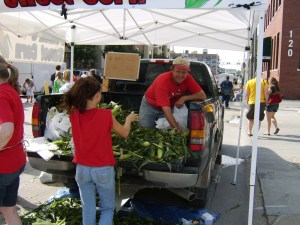
Buying fresh local organic sustainable and just food….

Corn! The first harvest of sweet corn at the farmers market in Des Moines

While I am staying in Ames, I am enjoying the fresh fruits and vegetables of the Community Supported Agriculture (CSA) farm in which the Flora’s have a share. All throughout the growing season, the weekly share can be picked up at the church, organized by the Farm to Folk Collaborative, which serves as an intermediary organization in order to connect the local producers and consumers. Different CSA farmers and other local producers offering ‘a la carte’, deliver each Tuesday after which the Farm to Folk people take care of assembly and payment handling.

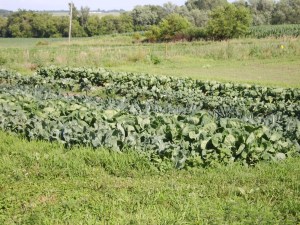
Now I know my way around, I picked up their share at the church this week. It is a share of the Small Potatoes Farm, based in Minburn, southwest of Ames. I had onions, kohlrabi, carrots, squash, potatoes and kale. All the certified organic produce of the Small Potatoes Farm finds its way to the customer through CSA shares. The nature of the CSA model, based on a direct and trusting link between producer and consumer is the closest you can get to an unambiguous ‘honest’ product. It is both organic ánd local. But in the market place both ‘organic’ and ‘local’ can obscure different meanings and practices.

Organic can be produced in an industrial way within the limits of the label. Much of the organic produce in supermarkets is coming from industrial-size farms or companies with farms, which often have an organic line next to conventional production; organic is just another market. The local, at the other hand, has no regulation as to what sustainability standards should be applied. Local produce can come from small scale, but conventional farms, can include the use of pesticides and herbicides for example.

Des Moines Farmers Market

Des Moines Farmers Market

Since organic production has become an industry too, the ‘local’ is often elevated above the organic because the local – by its very nature – cannot be incorporated easily into the centrifuging forces of global commerce. Buying local is an act of opposing corporate food chain powers by going back to a less asymmetrical peer-to-peer relationship between buyer and seller.

A popular platform for these relationships is the farmers market. There are 18 farmers markets in Greater Des Moines (the city and the surrounding counties including Story County in which Ames is located). Saturday, together with Rick, Stacy and Tillie from the Small Potatoes Farm, their worker Brian and his friend, we visited the Des Moines farmers market, one of the biggest in the country. It is huge. Over 200 stands with a variety of products, from vegetables to ‘Dutch letters’ (??), a peculiar S-formed pastry letter, from clothes, to ‘Frisian Gouda’ cheese and from bread to garden equipment.

The beets are 'pesticide free'

The beets are 'chemical free'

Vegetables are promoted as ‘fresh’, ‘without pesticides’ or ‘local’. But that does not necessarily apply to all vegetables at one particular stand. I bought some tomatoes, thinking that I bought local produce. I found out later that it will take a few weeks more before tomatoes can be harvested in Iowa. I have no idea where my tomatoes came from. Being a conscious consumer is hard work.

Knee-high by the 4th of July

Independence Day, the 4th of July is of course an important day in the US. And it therefore serves as a marker in time, if the corn is knee-high by the fourth of July, you can be happy. STA72046Well, here in Ames, one can be satisfied. The corn is more like shoulder-high already. Maybe this is caused by the “black gold of Iowa.”

A series of glacial events (Quaternary) delivered an extremely black and fertile soil throughout the middle of the state Iowa. Soil like this can deliver an abundance of fresh and varied produce. But driving through Iowa this weekend on my way to Mount Rushmore in South Dakota, I actually drove through a food desert. The corn, grown at each side of the road, cannot be eaten.

 The various F1 hybrids which are grown here are not essentially vegetables but an industrial raw material. During the eighties, the integrated farm made way for the integrated agro-industry. The nutrient cycle at farm level broke once the diversified farm specialized into different and geographically separated monoculture operations. The nurturing cycle in which there was no such thing as ‘waste’ was replaced by a system producing at least three new categories of dangerous waste.

1. Nitrogen in (drinking) water from artificial fertilizers. Hybrid corn consumes more oil – that is, fertilizer – than any other crop. And since it is corn after corn each year, more fertilizer is needed to keep production figures high. Much of it ends up in the rivers. Rivers which provide drinking water. Iowa has the largest nitrogen filter in the world in their Des Moines River water treatment facility. They take out so much nitrogen for which they do not have a storage place that they dump some of it into the river again downstream.
2. Antibiotic residue’s in (drinking) water. Over half of all corn grown in the mid west goes into animal feed. Much of it goes to the cattle in the feedlots or to hog CFO’s. After half a year of grazing, the beef cattle are confined for over half a year more in feedlots to be fed nothing but corn. In this last phase, they are fast fed into steaks and burgers, but there is no need to say that the cow’s stomach is not made for an exclusively low structure energy rich diet (despite the difference in stomachs, much like humans). Moreover, the amount of animals per square meter standing in their own dirt is just the kind of environment for whatever disease to arise. Their feed contains therefore a standard amount of preventative antibiotics which pollute the animals as well as the environment; not least the water. Ultimately a danger to all of us creating resistances and superbugs.
3. Toxic manure. The large concentration of animals in a feedlot produce a large and concentrated amount of manure, stored in pits, tanks or open air lagoons. Manure leeks from these types of storages into the ground water, or as emissions in the air. And the level of concentration of the manure is often so high that it is useless as fertilizer. Existing feedlots are often exempted from many water and air regulations.

Food democracy

Nothing but corn in Iowa. So I did some serious weeding and hoeing of corn this weekend……..Of white corn. Not the regular uneatable corn which goes into feed fodder, energy production or corn sweetener. These immense fields are round-up ready anyway. The corn grown in the community garden in Marshall town (see blog) can be eaten, it will be used to make corn flour tortillas.

my garden in wageningen

my garden in wageningen

It has been a wet summer so far. So weed is quite a challenge for the starting community gardeners. I was glad I could help out; a sort of substitution for missing my own 20 m2 in Wageningen.


Self sustenance in food. Once a dismissed and declining (if we could help them) ‘farming system’. Bound to disappear under influence of progress; by ever increasing economies of scale and market integration. However, self sustenance or small scale production is loosing its negative connotation of backwardness. It is being redefined and revalued in both developed and developing countries, in both urban and rural circumstances (see yeomanry).

Our global agro-food industry has not been able to reduce hunger as it privileges capital accumulation for already wealthy elites while externalizing environmental and social costs to societies. The consolidation of power in the food chain, the world food crisis and environmental degradation have instigated a variety of movements towards self reliance and community focus, towards returning to a scale which can be influenced. It can be seen as a re-appropriation of a sense of self determination and autonomy to increase resilience of livelihoods and to reduce dependence on situations with high levels of power asymmetries.

While we do not accept anything less than democracy to rule our societies we are nearly being ruled by autocracy in the food chain, hidden behind the myth of ‘consumer choice’. The diversity of food and farming initiatives emerging, points to a process of democratizing food, the people’s right to

“healthy and culturally appropriate food produced through ecologically sound and sustainable methods, and their right to define their own food and agriculture systems” (Food First)

STA71596

Urban Ag

Concern about our food, the quality, the exploitation of farmers and workers in the production chain and how it affects our health has induced conscious and political consumerism. But making a statement with the wallet supporting sustainable production might only be the first step. Once food conscious is awakened, it is a small step to grow your own food. Probably also fuelled by the recession, the demand for seeds has skyrocketed recently. The Washington Post (19-6) comments that

“After years in the doldrums, the consumer demand for vegetable seeds has abruptly climbed at a rate even industry veterans have never seen.”

Growing your own food is rapidly becoming a trend as part of an urban agriculture movement. There is a continuous emergence of new initiatives. For example, initiatives which somebody called “Gleaning social networks”; groups who harvest from public places and private places. Wild edibles, such as nuts, berries, fallen fruit, mushrooms and herbs are collected, sometimes to be distributed among the poor. In LA, 120.000 pounds of fruit was harvested within the city last year. Recently Amsterdam was mapped for its wild edibles.

Another type of urban agriculture initiative is “peer-to-peer agriculture”, initiatives which are about sharing land, tools and other resources for more efficient use. For example, how to find an allotment if there are waiting lists? Through internet people can search for pieces of land or gardens which might be (partly) used by someone willing to grow food.

With the rise of more and more urban agriculture initiatives and local food production, new farmers are born each day. These examples show that our idea of what a farm is will soon need serious reconsideration.

Hopi Agriculture

Kachina dolls

Kachina dolls

The Hopi have many spiritual and ceremonial places and events. We experienced one of these events, a Kachina dance in a village on Third Mesa. In the months of April, May and June, the ‘day dances’ take place. From February until July these dances involve Kachinas. The Kachinas are the spiritual essence for the Hopi, their appearance connects the Hopi to their ancestral spirits, the elements and the universe. The Kachinas are believed to live at the San Francisco Peaks, they appear from February to July in different types of dances. All dances are connected in some way to rain and harvest. As rain is the limiting factor, their religious and ceremonial life cannot be separated from agriculture and food and being Hopi.

The Hopi strongly hold to their ceremonies and traditions and tribal rules. After some experiences with unethical use of material gathered by visitors, one is reminded everywhere that taking pictures or notes of the ceremonies, the people, the villages and the landscape are forbidden. Doing research in this area is also subject to tribal rules. The data collected cannot be possessed by the researcher/ university. It remains with the Hopi and each usage of material has to be negotiated and agreed upon.

Hopi agriculture and gathering were once the sole source of sustenance. Mainly dependent on rain in the high arid dessert of Arizona, the Hopi planted corn, beans, squash, cotton and gourds that were particularly resistant to the drought and pests of the area. We saw cornfields where the corn is now approx 30 centimeter high. It has been a good spring so far, with quite a bit of rain. Corn is planted very deep, with a planting stick around 6 seeds are sown together up to 18 inches deep into the soil. The depth of the hole depends on judgment in terms of soil moisture. Many corn plants growing together could push through the sandy soil. And each bundle of seeds stands 4 footsteps from each other. In between beans are sown as well as squash around the edges.

Hopi ceremony requires a number of different kinds of Hopi corn, blue, white, yellow, red, purple and mixed. There are at least twelve types of Hopi corn, each with separate ceremonial functions. Grinding corn is a particularly important ritual act for women. At menarche, young girls have a grinding ceremony where they make piki, a wafer-thin flat bread made from blue corn and water. Piki bread is part of the food that the women cook for the various dances and rituals. We saw a piki bread cooker, a thick flat back stone over a fire. Courage and skill is needed to cook the bread because the women cover their hand in the batter and quickly whip their hand over the extremely hot stone. The result is a super thin rolled bread.

Canyon de Chelly, where de Navajo farm

Canyon de Chelly, where de Navajo farm