SWIFT blogpost | Policy Dialogue; “A competitive Europe demands a gender-sensitive Common Agricultural Policy.”

By Georgia Diamanti, with Jessica Duncan, Lucia Demicheli

On the chilly, sunny morning of October 2nd 2025, a team from RSO, including Jessica Duncan, Jasmijn Bakker, Lucia Demicheli, and Georgia Diamanti, boarded a train to Brussels together with Lotte Opdam, from Toekomstboeren.

We were headed to the SWIFT project’s fourth and final policy dialogue, to be held at the Spanish National Research Council, in the center of Brussels. Three such policy dialogues had already taken place at the national level of different EU member states; in Spain, Austria and Poland (read the SWIFT policy brief here). Only the EU-level policy dialogue remained.

We arrived with a few hours to spare before the start of the event, and so we went about helping with the small tasks that remained; such as setting the interpretation devices to the different language channels. For the food sovereignty movement, there is no revolution without interpretation and indeed, having professional interpretation was critical to ensuring participants could engage effectively.  

Georgia, Lucia and Jasmijn help set up the interpretation devices

Upon re-entering the main space where the dialogue was to take place (and in whose empty space we had previously sat, fidgeting with the interpretation devices) we now encountered a much livelier sight. This time the room was filled with people, chattering away. Soon Louise Legein (our SWIFT partner from Oxfam Solidarité) took the floor, and, welcoming us all to Brussels, signaled the start of the event.

Louise Legein presenting the SWIFT project ©Tineke Dhaese/Oxfam

Following a brief overview of the SWIFT project from Louise, Brussels-based journalist, Natascha Foote, took the floor. Here, Natasha took us along on a quick dive into the draft proposal for the upcoming CAP (an impressive feat to take on in 15 minutes – one which she nevertheless took on with an exceedingly engaging and humorous demeanor). Though she outlined various aspects of the CAP that are set to change (among the biggest of them, the scrapping of the Rural Development pillar and an overall drop in the EU CAP budget compared to the last programming period) it was also emphasised that this is only the first draft, which will serve as the basis for upcoming negotiations and that as such, “the road ahead is still a long one”.

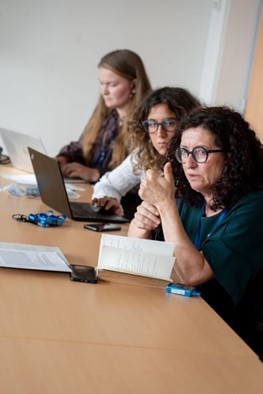
Having by now warmed up, it was time to break out into rooms and proceed with the dialogue. And so, we were split into five groups; the aim was to have stakeholders representing different points of view in each group (farmers, policymakers and representatives of EU institutions, civil society,  researchers). We had just over an hour to discuss the following question: “What are the opportunities in the CAP (and related policies) to better support gender equality?”

Break out group discussion ©Tineke Dhaese/Oxfam

Lively conversations ensued, the dialogues were a precious opportunity for farmers to engage with people on the policy side of the CAP.15 minutes left. 5 minutes left. The Oxfam facilitators discreetly slipped in and out of the breakout rooms, holding up signs that silently informed us that discussions were nearing their end. And so we reconvened back into the main room to share the fruits of our discussions.

Common themes that permeated discussions between the different groups were; generational renewal, social security, social conditionality, and the divide between EU policy and farm-level reality. Within multiple discussion groups, farmers were clear that if the CAP failed to address structural inequalities and area based payments, there would be no opportunities for them.

Finally, groups highlighted the tension between the EU trying to address critique that it governs from Brussels by renationalizing many responsibilities and the concern that the EU should be the moral compass and upholding broader values and standards like gender equality and environmental protection, but that this seems to be less and less the case.

After the dialogue, there was a social gathering. Reflecting on the event, we spoke of mixed feelings; on the one hand, the inspiration and hope that came from sharing this space, on the other hand, feeling overwhelmed at the work ahead if we are to really move towards a Common Agricultural Policy for Europe that respects the diverse way women and non-binary people farm.

Sharing discussion results ©Tineke Dhaese/Oxfam


Meet Our Visiting Scholar: Andrea Rizo Barroso, Universitat de Barcelona

We are delighted to welcome Andrea Rizo Barroso, a PhD candidate from the Universitat de Barcelona’s Food Action and Research Observatory (FARO), as a Visiting Scholar at RSO. Andrea’s work sits at the intersection of gender, food systems, and social inequality—an area of growing importance in contemporary food studies.


Research Focus

Andrea’s research explores how gender inequalities shape urban food environments and influence food security, particularly among vulnerable communities in Spain. Centering women’s lived experiences, her work seeks to build a critical and situated understanding of how urban food systems operate within broader structures of gender, access, and vulnerability. Her ambition is to shed light on the often-overlooked gendered dimensions of food insecurity and to contribute to more just and equitable food system transformations.


Current Work at RSO

During her stay at RSO, Andrea is focusing on advancing her paper, “Exploring Gender Dimensions in Urban Food Environments: A Systematic Scoping Review.” She is also refining the analytical framework for her PhD thesis and immersing herself in participatory methodologies such as photovoice—tools that will allow her research to more fully reflect the realities and perspectives of the women she works with.

Her work resonates strongly with collaborative initiatives like SWIFT, a project dedicated to equitable, gender-responsive food system transformation, creating rich opportunities for synergy and shared learning.


Why RSO and Wageningen?

Andrea chose RSO for its international reputation in research on power, inequality, and food systems—themes central to her own scholarly focus. The Rural Sociology Group’s commitment to equity and social justice aligns closely with her values and the communities she aims to represent in her work. Wageningen, with its vibrant academic environment, provides the ideal setting for interdisciplinary engagement and critical dialogue.


Beyond Research

Outside her academic pursuits, Andrea brings great energy and creativity to her life. She loves dancing salsa and bachata, enjoys hiking, and is always ready to explore new places through travel. Her passion for movement, nature, and discovery enriches both her personal and professional journey.


We are excited to have Andrea with us and look forward to the insights her research will bring to ongoing conversations about gender and food system transformation.

Agriculture in Rojava and the Making of a Decolonial Future

How a grassroots revolution in northern Syria is redefining democracy, ecology, and decolonization from the ground up. An blog-post/article by Joost Jongerden and Necmettin Türk

When the Syrian civil war fractured the authority of the central state, a new kind of revolution took root in the country’s north. In the Kurdish-majority regions known as Rojava, communities seized the opportunity not to build a new state, but to build a new society based on self-administration. Much of the existing scholarship on Rojava has focused on this network of self-organized communes and regions, particularly in relation to questions of recognition, namely the development of a governance model that is inclusive of various cultural, ethnic, and religious communities. Yet far less attention has been paid to the decolonization of Rojava’s agrarian economy—a transformation that is equally fundamental to the region’s broader project of liberation.

read more here: https://theamargi.com/posts/agriculture-in-rojava-and-the-making-of-a-decolonial-future

The harm supply chain: food, agriculture and colonialism in Kurdistan[1]

Joost Jongerden

Introduction
Food is not the first thing that comes to mind when thinking about politics. Yet the political does not always present itself explicitly as political (Day 2022). This is certainly the case for food. While food is essential for the reproduction of biological life and an important cultural and economic artefact, various authors have shown it is political too. Single food products, such as sugar (Mintz 1985), palm oil (Csevár and Rugarli 2025) and soy (Hiraga 2025), have been shown to be inseparable from the histories of capitalism and colonialism. Their examples illustrate how food is entangled with broader systems of power, exploitation, and domination. Similarly, in the development of a food supply chain in Kurdistan, we see that food can both foster life and community, and foil it, serving as a vehicle for the deliberate destruction of political and socio-economic existence.        

Continue reading

Field Notes: On the way

Today, I’m on my way with a friend to visit an agroecological farm started a few years ago by a group of purged academics—scholars dismissed from their university positions during Turkey’s 2016 political crackdown. Once part of the local university, they turned to cultivating a few acres of land just outside the city. The farm still survives, though not without struggle.

As we bumped along the road toward the fields, our conversation drifted across dozens of topics—including the use of pesticides. Then suddenly, my friend turned to me and asked, “Have you heard of the ‘Black Wounds’—Birîna Reş?”

I hadn’t.

It was the early years of the Cold War. Turkey had been included in the U.S. Marshall Aid plan—not for post-war reconstruction, but for building a strategic alignment near the border with the Soviet Union. Alongside shipments of powdered milk and food came military bases. And toward the end of the 1950s, a shipment of wheat seeds treated with pesticide arrived in Turkey. The government distributed these seeds for free to landowners affiliated with the ruling party. But instead of planting them, many landowners sold the wheat cheaply on the open market. Easy money.

Continue reading