Vacature Master Thesis Onderzoek – De politiek van Nederlandse steun in Palestina en het stopzetten van de medefinanciering van een Palestijnse NGO

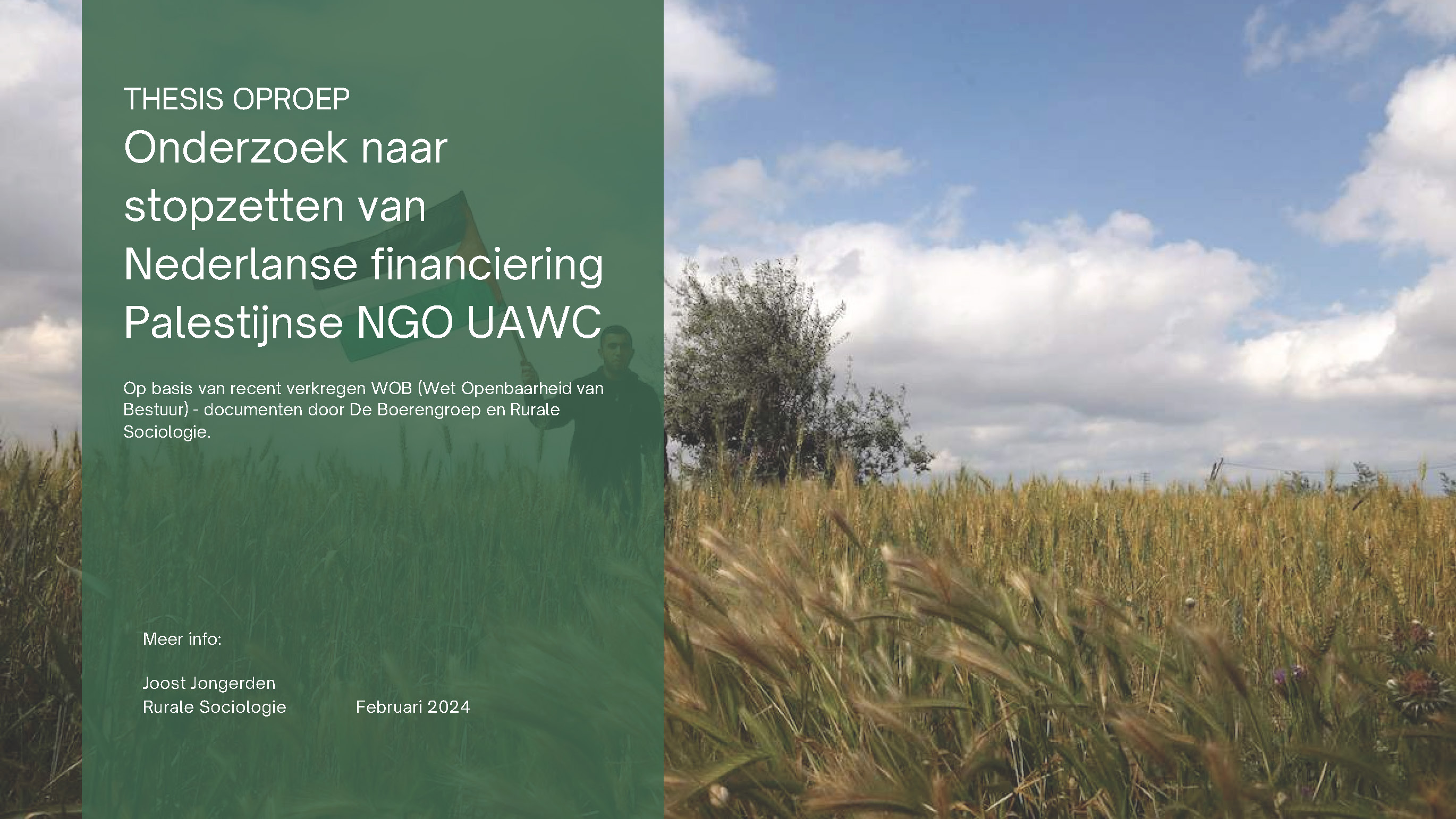
Nederland besloot in 2022 de financiering voor de Palestijnse NGO UAWC (Union of Agricultural Work Committees) stop te zetten. UAWC ondersteunt duizenden Palestijnse boeren, vooral in gebieden op de Westelijke Jordaanoever waar Israël een illegale kolonisatiepolitiek voert. Israël heeft lang druk uitgeoefend op donoren om de steun aan UAWC te stoppen, omdat het volgens Israël een mantelorganisatie is van de Palestijnse verzetsbeweging PFLP (People’s Front for the Liberation of Palestine).

Nederland heeft UAWC extern laten onderzoeken door een bureau dat gespecialiseerd is in veiligheidsvraagstukken. Uit het externe onderzoek zou blijken dat sommige (voormalige) medewerkers banden hebben met de Palestijnse verzetsbeweging PFLP. De UAWC reageerde geschokt op het besluit van de Nederlandse overheid en betoogde dat het externe onderzoek geen aanwijzingen had gevonden voor financiële stromen tussen UAWC en de PFLP, noch voor organisatorische banden tussen beide organisaties.

De Boerengroep en Rurale Sociologie hebben in mei 2022 met een beroep op de Wet openbaarheid van bestuur (WOB/WOO) verzocht om informatie met betrekking tot het besluit van Nederland om de financiering aan de Union of Agricultural Workers Committee (UAWC) stop te zetten. In januari 2024 is de gevraagde informatie toegestuurd, bestaande uit meer dan 600 documenten, variërend van (korte) e-mails tot notities. De WOB/WO-documenten bieden inzicht in hoe de Nederlandse overheid tot het besluit is gekomen om de financiering aan UAWC stop te zetten, en meer in het algemeen:

  1. De politieke context waarin een dergelijke beslissing is genomen;
  2. De criteria die het hanteert, en;
  3. De afwegingen die de overheid daarbij maakt.

Voor een kwalitatieve analyse van de documenten en het doen van vervolginterviews wordt gezocht naar een masterstudent. Deze masterstudent dient te beschikken over Nederlandse taalvaardigheid en bij voorkeur bekend te zijn met kwalitatieve onderzoeksmethoden. Het onderzoek is interessant voor die studenten die geïnteresseerd zijn in onder meer i) het politieke krachtenveld waarin overheidsbeleid en besluitvorming tot stand komen, ii) veiligheidsvraagstukken in relatie tot medefinanciering en iii) de politiek van hulp in de context van langdurig conflict. Gezien de omvang van het materiaal, is er ruimte om een eigen invulling te geven aan het onderzoek.

Voor meer informatie: Joost Jongerden (RSO) en Gemma van der Haar (SDC)

Boerderijovernames als mogelijkheid voor landbouwtransitie: van stoppende conventionele naar startende ecologische boer

Marcha van Wijk*

Introductie
Deze blog is een samenvatting van mijn masterscriptie over de overname van conventionele boerderijen naar ecologische boerderijen. Het scriptieonderzoek heeft deze overname verkend als potentieel onderdeel van een landbouwtransitie naar meer ecologische vormen van landbouw. Terwijl boerderijovernames vaak worden bekeken vanuit een financiële lens, belicht mijn onderzoek de emotionele en relationele aspecten, die vaak over het hoofd worden gezien, terwijl ze een grote invloed hebben op de overname.

Meer dan de helft van de Nederlandse boeren van boven de vijfenvijftig jaar heeft nog geen opvolger. Dit is een van de oorzaken dat gemiddeld drie boerenbedrijven per dag worden gestopt in Nederland. Vooral kleinschalige boeren vinden vaak geen opvolger, wat ervoor zorgt dat steeds meer kleine boerderijen verdwijnen en grote boerderijen groter worden door het opkopen van vrijgekomen land. Dit is in tegenspraak met opkomende visies over duurzame voedselsystemen, zoals de Farm to Fork Strategy (2020) en iPES FOOD (2016) die juist pleiten voor natuur-inclusieve en kleinschalige landbouw.

Mijn onderzoek verkent een alternatief op deze trend. Wat als we de overname van conventionele boerderijen door ecologische – bijvoorbeeld biologische, regeneratieve en agro-ecologische – boeren kunnen faciliteren? Dit zou zowel het gebrek aan een opvolger oplossen, als een landbouwtransitie richting ecologische landbouw op gang brengen.
 
Echter, toegang tot land is een grote barrière voor zij-instromers. Hoewel dit vaak in verband wordt gebracht met de financiële kosten van grond en een boerderij, onderstreep ik de noodzaak van een holistische aanpak en onderzoek ik affectieve processen tijdens deze overname. Wanneer een boerderij wordt overgedragen, vinden er namelijk grote veranderingen plaats en dat heeft emotionele en relationele invloed op de boeren.

Continue reading

Navigating Precarity:  (Un)documented immigrants in Spain’s agri-food industry

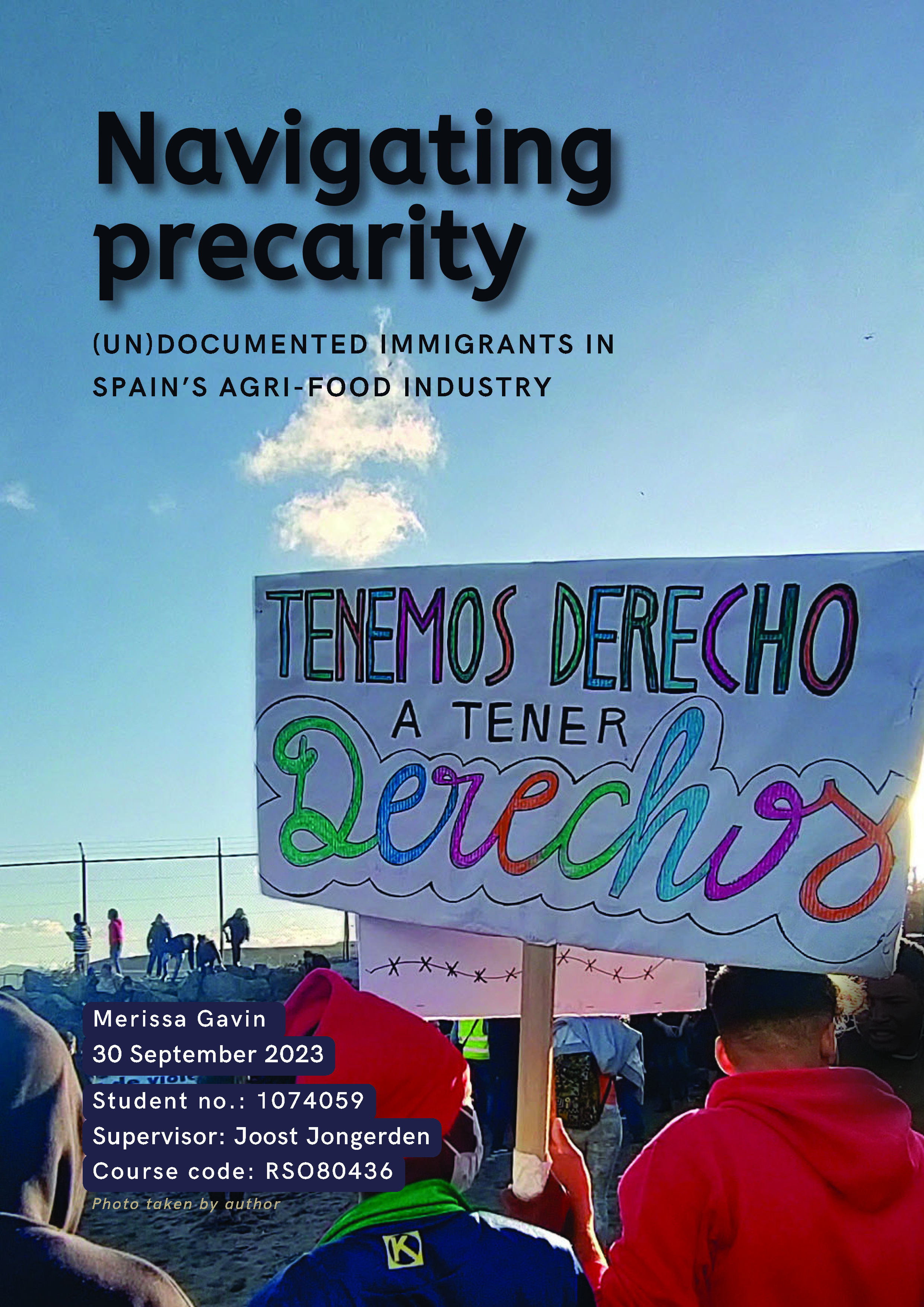
In the master thesis “Navigating Precarity:  (Un)documented immigrants in Spain’s agri-food industry” Merissa Gavin discusses the strategies employed by immigrants in navigating precarity from the perspective of the immigrants themselves and new forms of being political are being created. The main question that guided her research was: “How do undocumented immigrant workers in Spain’s agri-food industry engage in claim-making and claim-living to navigate precarity?”

Over the last two decades, immigrant workers have become a structural element of Spain’s agri-food industry. Arriving to Spain undocumented, immigrant workers have few options other than the exploitative working conditions of the agricultural sector. The present research centres on the precarity of these workers, highlighting the multitude of ways they navigate vulnerability and uncertainty. This research is important, firstly, to raise the voice of undocumented immigrant workers and demonstrate how they exercise agency in everyday activities. Secondly, to investigate the socio-spatial conditions that facilitate, or obstruct, the emergence of a collective political being.

Continue reading

Struggling to find struggles: developing a research on social movements of Florence

Cristiano Bartolini

I began my MSc research thesis in June 2021, at the end of the second pandemic wave, which forced the world (back) inside, into our homes. I was frustrated and upset that I would probably not be able to conduct research beyond Europe’s borders – or outside my own room, even. At the start of my master’s, I was looking forward to the thesis, quite naively romanticising, in fact, picturing myself as a young researcher in the middle of rural fields, maybe in Latin America, living near native communities that struggle for social and human rights. After the pandemic hit, I had to surrender this idea and recalibrate my research expectations. I refocused my research aims and decided to start a study on social movements in Florence, my hometown.

I had never really thought of researching in a city: during my studies, I had unconsciously neglected its potential to enact a real change in society. The urban context, to me, was a negative environment from which good changes could not emerge. As various authors argue, the city is the centre of capitalistic life, it is the producer of huge economic surpluses, always looking for new outlets to absorb this endless profit that it constantly generates, and this, eventually, brings a lot of socio-economic problems to residents. Let me explain this with an example that ultimately becomes the background of my research.

Continue reading

Thesis opportunity in Galicia (NW Spain) with the Post-Growth Innovation Lab at the University of Vigo

Commons, or commonly managed land, seem to be a relic of the past. The enclosure of the commons and concomitant rise of modern agriculture and capitalism have received much attention in academic literature. However, in Galicia, an autonomous region in the Northwest of Spain, a quarter of land is still managed as commons, typically referred to as ‘montes vecinales en mano común’. This way of land management means that land cannot be divided, owned individually, traded, or sold but is rather decided over by the people living in the parroquia or parish. The intricate link of household economies to the common lands, materializing through for example the grazing of animals in the commons or the harvesting of toxo (a nitrogen-rich shrub) to turn into fertilizer, was violently put to an end by the dictatorial state that usurped common lands between 1937 and 1989 to afforest them according to principles of industrial forestry. The rupture of household, rural economies is linked to substantial changes in these spaces, most notably, a significant drop in the rural population from 71.8% in 1950 to 14.3% in 2000 (Seijo 2005). The State’s forestry program was incredibly ambitious, planting five and a half million hectares of forest in the period between 1940 and 2006 (Vadella, 2016) with Galicia being a particular area of interest for the State’s reforestation program (Picos, 2017). After the Franco dictatorship ended, lands were returned to communities yet the processes and reasons for the devolution are contested and context-specific. Some communities never received their lands back, some received fractured parcels, some lands were filled with monocultures of eucalyptus and pine, while others house public facilities like schools and hospitals. About 3,000 montes vecinales en mano común exist throughout Galicia and each is shaped by a particular historical and situated process, allowing us to explore the cracks, resistances, and adaptations that have shaped the Galician commons becoming what they are today and what they could be tomorrow.

Thesis projects can be formulated around the following:

  1. Chronicling diverse economic practices over time in a historical perspective. People’s physical presence in the commons has changed over time, in line with modernization and economic ‘development’. Using qualitative methods such as interviews, these changes can be studied to learn about how commoning changed over time, what this meant for rural livelihoods, and commoners’ subjectivities.
  2. Exploring current configurations of diverse economic practices in the monte and how these came to be. Here students can examine how the commoning community has come to be, how initiatives have arisen in the commons, and how diverse economic practices have taken shape and relate to human flourishing.
  3. Futuring and imaginaries. Here we consider the futures commoners imagine or aspire to. Through qualitative research methods, this part of the project considers the meanings people ascribe to the commons and what commoning could look like in the future. We ask what role the commons have in human well-being as imagined by commoners but also by other actors like policymakers, scientists, and research centers.

The research takes place in connection to a PhD study by Noortje Keurhorst (University of Vigo). She will also be the local supervisor for this research.  For fieldwork a good command of Spanish and/or Galician is useful.  

MID, MOA or MDR students interested can send an e-mail to joost.jongerden@wur.nl