Edible Academic Garden in the making…

IMG_0077Since half a year, an enthusiastic group of students has set as their goal to establish a productive landscape garden in which education of various disciplines and agroecological design will fuse in a space where students and staff can learn and relax at the new University Campus. The process so far has shaped itself organically as a learning opportunity for many, very much in line with the principles behind the garden. Around 20 students take care of the daily organisation with around 80 active followers and up to 300 students interested. After an initial pre-proposal supported by many chairgroups that was received well by the Board of the university, the phase of making a full proposal has now arrived, including a design, the budget, and issues such as care taking and maintenance.

Last night, the first of two public participatory design sessions was held. It was inspiring to put our dreams of the space around the new Orion building on paper. Next week Monday the second one will be held. If you want to participate, please register yourself through this link or look at the website EAT website/email

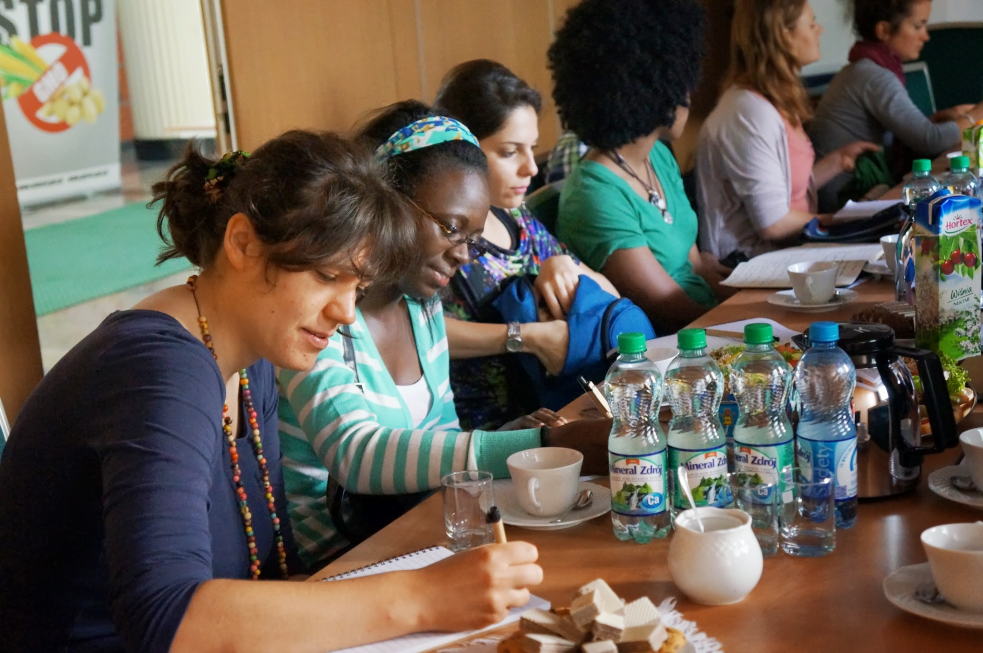
Study trip to Poland

polandAre you interested in rural development, agricultural policy, nature conservation and climate change? Do you want to know more about how globalization processes affect these areas in an EU Member state, and what local responses can be identified? Join the study trip to Poland, organized by RUW Foundation and the Rural Sociology Group. In a 10 day intensive program, we will visit different cities and rural areas in Poland, meet with interesting organizations and work on a farm! Continue reading

Thesis: the vegetable network

100_5864By Esther Veen, PhD student of Rural Sociology

Urban Agriculture is a trendy concept for a lot of recently set up neighbourhood gardens in cities. The goal is to connect people and food again is often said. I researched four neighbourhood gardens, looking specifically at the social and dietary effects for the people involved. While the new gardens are part of a trend, some gardens have a long history of a traditional allotment complex. Especially THOSE gardeners who not necessariy identify themselves as part of an urban agriculture movement, generally harvest large amounts of produce, that they cannot all consume themselves. Many of them therefore share their harvests with friends, families and colleagues. Continue reading

Agro-ecology debated in Wageningen – grassroots science series

Under the heading of Grassroots sciences St. Otherwise has organised a new series to debate the agro-ecology approach, see the website for the programme and to make a reservation.

Monday, March 18 will be the next event, called The power of agro-ecology. This is part of the Rode Hoed debate series ‘It is the Food Stupid’. Venue: Forum building, Wageningen.

The agro-ecology movement is gaining momentum worldwide. Family farmers, sometimes in collaboration with researchers, have successfully developed agro-ecological innovations that use local resources and work with nature to strengthen production systems, increase farmer autonomy and maintain productivity. This makes farming more resilient, and less dependent on expensive external inputs such as chemical fertilizer and pesticides. What has agro-ecology achieved? Can  it feed the world? What choices can we make to give it a fair chance? And what  challenges are there for Wageningen University? Irene Cardoso (professor of soil science and vice chair Brazilian Agroecology Association) and Tom Saat (organic farmer and winner of the 2012 Ekoland Innovation Prize) share their insights and experiences. You are invited for a drink afterwards. Follow it live at http://wurtv.wur.nl/. Find out more on Facebook.

Continue reading

Thesis: Studying the social effects of community gardens on the wider neighbourhood

3973780265_157e56b55fThis thesis concerns community gardens and their influence on the wider neighbourhood, especially people not involved in the gardens. The starting assumption is that people maintaining and working in community gardens meet others by doing so. That way these gardens create or strengthen their social relations. However, not all residents of the local community are involved in the community gardens and the gardens may be maintained by people from outside of the direct neighbourhood. To what extent does the social cohesion that exists and is grown at the community garden ‘spread’ beyond that garden, into the neighbourhood? Do local residents that are not involved benefit from the social cohesion created by the gardeners? (I.e. because they see the neighbourhood being beautified, because they stop and talk to those working in the garden, because they feel that something is brooding…). Continue reading