Values in place – open acces publication and thesis opportunity

Students interested in doing a thesis on this topic can contact me:  lummina.horlings@wur.nl

Societal change toward sustainability is accelerated not only by political systems or practical actions, but also by values which influence our attitudes and actions. The latter point has been termed as change ‘from the inside-out’ or the ‘interior’ subjective dimension of sustainability. However, not clear is what values exactly are and how they play a role in places. Therefore I have drafted an article on this topic now published in Regional Studies, Regional Science (open access): Values in place; A value-oriented approach toward sustainable place-shaping.

The aim of this paper is to understand how specifically processes of sustainable place-shaping are influenced by human values, rooted in culture. The argument is that practices of place-shaping can contribute to sustainable development of communities and regions using local resources, people’s capacities and the distinctiveness of places. The development and engagement of participant’s values in places can build co-creative capacity, contributing to change. The challenge of incorporating ‘values in place’ is to create a dialogue between actors, not based on personal interests, but on common agreed-upon motivational and symbolic values, directed to the common good.
The concept of value is often discussed in the context of economic value, expressed in monetary terms. However, values also reflect people’s core principles and motivations rooted in broader cultural value systems and worldviews. Furthermore they reflect how people value and appreciate their place, and subscribe symbolic meanings to places. Values hinder or foster the fulfilling of what people consider as worthwhile. In the paper different value-oriented approaches in the context of sustainable place-shaping are explored, an economic, intentional and symbolic dimension. Values are not self-standing concepts which can be mapped or analysed as atomized issues, but they are intertwined, context-determined, culturally varied and connected to how we see our self and how we perceive our environment and place. Values such as freedom, solidarity and justice only gain meaning in actual people and practices and can be considered as dynamic in space, place and time. A value-oriented approach can provide a more in-depth insight into what people appreciate, feel responsible for and are willing to commit to in the context of their place.
For more information see the abstract and full article: L.G. Horlings (2015) Values in place; A value-oriented approach toward sustainable place-shaping. Regional Studies, Regional Science, Volume 2, Issue 1, pages 256-273, open access, DOI:10.1080/21681376.2015.1016097.

Sign in now for the course A global Sense of Place!

vechtdal 1

A Global Sense of Place (RSO-55306) is an optional interdisciplinary course on sustainable place-based development for students from various master programmes (e.g. MDR, MES, MID, MLP, MUE, MOA, MFN). The course builds on the BSc course RSO-56806 Sociology and Anthropology of Place-shaping providing an introduction to place-based approaches in development. Knowledge of this introductory course is an advantage, but is not assumed.

The course aims to make students acquainted with an interdisciplinary and place-based approach to development. A relational place-based approach is seen as key to the understanding of interrelated rural and urban transformation processes and ergo sustainable development.

By means of this course students will achieve profound understanding in key-concepts and methods on place-based sustainable development. Work from key thinkers in sustainable place-making will be critically discussed and examined on the basis of various cases. Guest speakers are invited to reflect on place-based approaches to sustainable development and illustrate these through case studies. Ultimately students will acquire a place-based perspective on development.

Different interdisciplinary themes will be addressed such as:
• a relational approach of place and space;
• key thinkers on place and space and politics of place;
• community development
• cultural approaches of place-based development
• ‘the human dimension’, encompassing collaboration and leadership
• ‘defence’ of places and conflicts

If you are interested or want to register for this course, please send a mail before October 4th to lummina.horlings@wur.nl

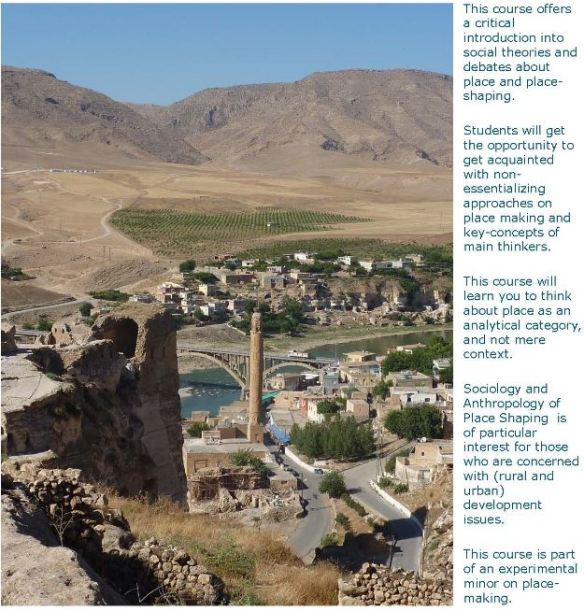
Introduction into Sociology and Anthropology of Place Shaping – optional course and free choice minor

Poster RSO-56806Starting Monday 17 Februray 2014,  in the 4th educational period of Wageningen University, the optional course RSO-56806 Introduction into Sociology and Anthropology of Place Shaping will be offered again in collaboratyion with Cultural Geography Group and Land Use Planning Group. For more information on the course contact the course coordinator Joost Jongerden: joost.jongerden@wur.nl

The course can be the first of four succeeding courses in period 5 and 6 up to a total of 24 ects as part of the free choice minor ‘Place and space in planning and development‘ open to BSc-students from WU and other high education institutes, such as the Van Hall Larenstein University of Applied Sciences.

The course offered as part of the minor are:

  • Period 4: RSO-56806 Sociology and Anthropology of Place-Shaping, whole days
  • Periode 5: RDS-30306 Sociological Theories of Rural Transformations, morning or GEO-23306 Cultural and istorical Geography, afternoon
  • Period 6: LUP-33306 Methods for strategic planning, whole days in week 34-39 and LUP-32306 Studio strategic planning, whole days in weeks 40-43

For more information contact minor coordinator Dirk Roep: dirk.roep@wur.nl