Inspiring encounters in the Westerkwartier

On Wednesday evening, I participated in a Plattelandscafé (countryside-café) at the Natuurboerderij Lammerburen (nature development farm) in Oldehove, Westerkwartier, Groningen. The aim of the gathering was to present results of past projects, ongoing projects and project ideas aimed at ensuring the sustainability of the predominantly rural Westerkwartier. Jan Oomkes, chairmen of the LAG Westerkwartier (LEADER) and alderman of Zuidhorn municipality, opened the evening with a summary of activities in the Westerkwartier, including activities of the citizen action group (WSI), the Westerkwartier as LEADER-region, the community house in Grootegast and numerous projects which have been realised using money from the EU (LEADER), the Rural Area Programme of the province of Groningen as well as the different municipalities. Thereafter, the word was given to different project leaders and the present 60 visitors were informed about ongoing projects and activities.

With regard to my upcoming DERREG  (see previous post) research activities on rural business networks and the support of rural initiatives and regional learning in the Westerkwartier, the presented projects were highly interesting. For instance, one suggested project idea described the construction of hiking routes through the Westerkwartier, improving the touristic infrastructure and stimulating tourism as a new economic source for the region. Potentially, the project would thus provide possibilities for farmers to engage in side activities such as farm cafés and touristic accommodation and would help to establish networks between different stakeholders of similar interest. A further interesting project that was introduced is a new network for local business women (Wichterwest). Since the DERREG project aims to put special emphasis on the role of women in rural development, the newly formed network would be an interesting idea to study and could act as a best practise example for other rural areas throughout Europe.
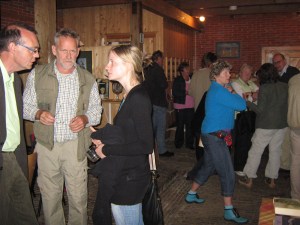
Conversations at the plattlandscafé

Conversations at the plattlandscafé

The evening was accompanied by guitar music- including a self-composed song about the Westerkwartier-, drinks and snacks. The inspiring atmosphere provided a good opportunity for everyone to exchange thoughts and ideas about the development of the Westerkwartier. Considering the enthusiasm of the people present at the gathering and their commitment to the development of their region, the event was also for me a motivating experience, highlighting once again the significance of research towards ensuring the sustainability of rural regions in the era of globalization.

Rural development driven by unfolding rural webs

Today the main outcomes of the EU-funded project ETUDE were presented by our colleagues Jan Douwe van der Ploeg (scientific coordinator of ETUDE), Rudolf van Broekhuizen (project-coordinator) and Henk Oostindie (senior researcher).  Main finding is that neither policy, nor markets or grass root rural development activities are by itself decisive for successful rural development, but the web of different and increasingly interlinked networks. Or as Jan Douwe van der Ploeg states:

Successful rural development is rooted in a myriad of encounters, transactions, interactions and networks that link people, resources, activities and markets. (Source: E-magazine by British Publisher, pp. 64-65). 

Van der Ploeg & Marsden (in ‘Some Final Reflections’, the concluding chapter in the book ‘Unfolding webs’ , p 227) refer to these rural web as emerging counter-structures: 

because rural development processes (that are grounded upon and resulting from this web) are essentially transitional: they represent a major shift that takes many years to occur and which proceeds through changing conditions of invisibility and confusion. Visibility, coherence and comprehension only occur during, and as an effect of, this transition. We also refer to the rural web as a counter-structure because it increasingly helps to deal with complexity (especially Chapter 8 of this Volume), creating simultaneously new patterns of coherence. All this relates to the contested nature of rural development: what might be highly meaningful in terms of the rural web, might be insignificant or even ludicrous at the level of the dominant structure. What we are beginning to conceptually explain here, therefore, are the particular dynamic qualities (both new coherences and contestations) of web formation. These are, indeed, built out of the seeming contradiction between creating counter-structures to prevailing conditions, at the same time as re-creating new coherences out of these very deviations and ruptures.

The project has come to a closure. The findings and recommendations will soon be published in a second book. Earlier publications, such as the chapters of the first book ‘Unfolding webs’, edited by Jan Douwe van der Ploeg & Terry Marsden and published by Royal Van Gorcum, and deliverables (e.g. case study reports) can be downloaded at the ETUDE-website.

For more information on the outcomes you can contact one of the colleagues.

Land abandonment in Galicia

By Marlies Meijer (MSc-student)

Land Abandonment in Galicia

Land abandonment in Galicia

As I wrote earlier, I am balancing between the multiple realities of Galicia. Now, several weeks later I’m still balancing. Off course everything is different than the assumptions and hypotheses I had in the Netherlands. The rural situation here is complex and has many faces. For the moment I am trying to untangle the different storylines I encounter here. Hopefully one or two are nice enough to work out and to connect to a more theoretical storyline. It is a delicate job, which can only be completed in Spanish (I never realised that almost closed scientific communities existed because of language barriers) and with as less generalisation as possible, as ‘everything is different is Galicia’. It also implies that I have to let go of my Dutch reality and leave behind the loose ends I developed back home.

Land abandonment  – One of the storylines I encountered is land abandonment. Almost 25 % of the Galician countryside is abandoned, with far-reaching effects. In the Netherlands we would call an abandoned parcel new nature or verrommeld (messy). Here it implies higher chances for forest fires and agricultural devaluation. Rural Galicia exists of many small farms, with small parcels and above all many land owners. Most landowners simply own land, they do not live there, nor do they use the land for (agricultural) production. Because of low costs it is possible to own land, and leave it more or less abandoned. Most owners do not want to sell their land, they prefer to keep it as a capital resource for economically bad times, or in case its value increases because of urban expansion or afforestation. Some owners are simply not aware of the fact that they own land. Because of a malfunctioning administrative system and a lack of a clear spatial policy these situations can occur everywhere and to everyone, only no one knows exactly where.

On the other hand most farmers or peasants are not able to buy extra land. Their resources are limited. In the past decades the most substantial farmers already invested in milk quota, machinery and other devices in order to catch up with the rest of Europe.

The result is a situation where spatial and rural developments are fixated. Measures are developed to loosen the situation; for instance a land bank to facilitate renting land to other users, in order to mobilise the land market. But also these measures encounter problems.

On the one hand, Galicia struggles with policies from the past and large measures (top down) that are needed to change and improve the rural situation. Modernisation, like elsewhere in Europe, did not take place in Galicia. Notwithstanding the problems it brought to other countries, it is a phase needed in this country to improve the quality of life on the countryside. On the other hand, we do live in an era where bottom-up approaches and local participation are preferred, also in Galicia this is an hot item. How these two extremes are intertwined seems to me an interesting starting point for further research in Galicia.

Regional identity and wine walks in the Alsace region (Fr)

I recently traveled to France for a short walking spring break. In the north eastern part of the country I visited the Alsace region. I stayed in the area left of the city of Colmar near the village called Munster (well known for its ‘smelly’ cheese). Although the break was a way of resetting my brain, I couldn’t stop myself from observing some interesting things.

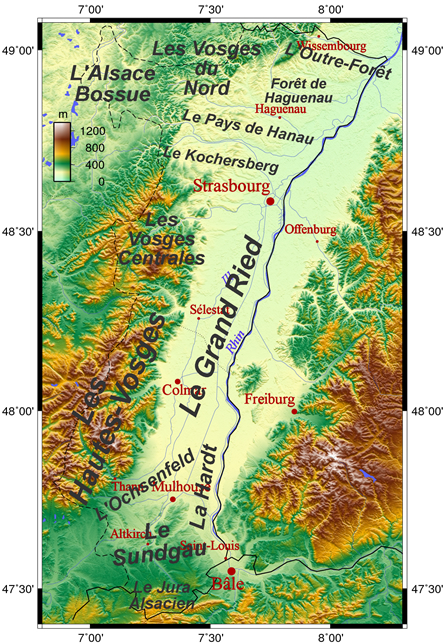
The Alsace region
Although the Alsace is French, the area is characterized by many German influences. Not surprisingly because the area changed hands many times. The area has a strong regional identity which expresses itself physically, culturally and historically (architecture (timber framed houses), landscape, dialect, kitchen and regional products). The stork can be seen as the region’s main symbol and almost disappeared in the 1970’s. The region put a lot of effort in bringing baThe Alsace region (Wikipedia)ck the bird (by starting breeding programs) and now storks can be found on roofs of houses and public buildings everywhere. All these things are characteristic to the Alsace region.
Wine walks
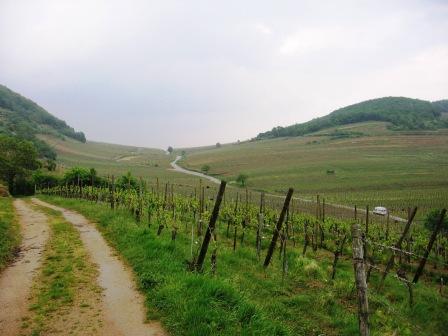
An important and unnoticeable regional product is wine (Vin d’Alsace) like Riesling, Gewürztraminer and Pinot Blanc. Since Roman times the Alsace has a strong tradition in growing grapes and over time has developed as a centre of viticulture. The area has an excellent terroir: good weather, climate, fertile soils and sunny slopes. Part of the rocky hilltops every small piece of the area is cultivated for growing grapes. This viticulture can bee seen as the (historical) backbone of this region into which over time whole sets of other activities got interwoven: visiting historical villages, local products / food, touristic walks etc. Central to this all is the wine and the attractiveness of the region. On my break I explored one of these really nice walks near the village of Kaysersberg. The walk started in climbing a woody and rocky hill and lead through the village of Riquewihr and via extensive vineyards back to were we started. In the vineyards information panels were placed to give information growing techniques, pruning, different varieties and the winemaking process. During the walk we stopped at several wine farmers / cooperatives for some refreshments and wine tasting. 

These wine walks are an interesting way of using regional identity and products for regional development. The combination of activities, services and goods attracts tourists, strengthens the regional economy and contributes to the vitality and livability of this specific region. I got the impression the Alsace region is very succesful in this!

Wine walk

DERREG-website is online

The website of the EU-funded research project DERREG (see blog of January 22) is now online: www.derreg.eu. Basic information about the project is now available and further information will be published as the project proceeds.