Urban agriculture in Red Hook, Brooklyn NY

STA72194I took opportunity to visit New York City while on my way to my friend Jessica in Ithaca. Fortunately, I had the opportunity to ‘go local’ because Mikey, a friend of her agreed to show me around. We went on bikes exploring Brooklyn, a great experience. I soon learned that you only have to remember one thing; you are on your own, there are no rules in urban jungle traffic.

We visited an urban farm in Southern Brooklyn, in the Red Hook neighborhood, a predominantly black and low income community. The Added Value farm is experiencing its third growing season. The farm is located on a run down playground, still visible as a grey spot on Google earth, but now a green oasis, with a small hoop house nursery and a composting section.

STA72196The playground is still there but most of it is covered, underneath 18 inches of rich compost soil. All vegetables you can imagine are growing here, except carrots which go too deep. The produce is sold at the weekly farmers market at the spot and serves a twenty member CSA. The farm now neighbors a gigantic new and heavily opposed IKEA outlet. The outlet symbolizes the start of gentrification of the neighborhood, of which we saw an example at the waterfront, where abandoned industry buildings have been converted into lofty apartments. As more white people move in, rents and living costs increase, which forces the current inhabitants to move to other, cheaper parts of the city.

 The controversy around the outlet is one of the factors influencing the struggle of the farm to reach out to its immediate neighborhood community Donna explained. She is one of the farm workers and kindly showed us around. Showing and explaining the farm to whoever passes by is an important aspect of the openness of the place; the gate is always open while work is going on. Without a programmatic structure such as the youth education program, it has been hard to reach the neighborhood. For many the farm is still a bridge too far in the daily struggle to make a living while on a totally different diet due to the lack of affordable fresh produce and lost cooking skills.  
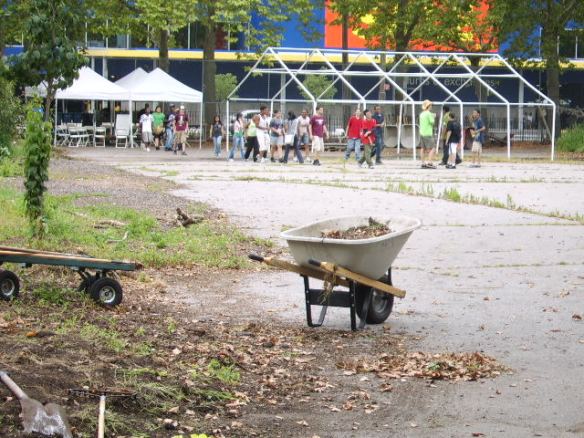
STA72195Donna is one of 4 farm interns. We met the manager briefly on his way to a meeting. There are also 4 youth workers employed on the farm. One of them was working with a new group of teenagers from the Bronx, who were introducing themselves to each other at the start of their Summer Youth Intensives. Weeding, harvesting, learning about vegetables and composting. But it all starts at a very basic level. Because more than anything else, the farm program is trying to teach these kids a different set of values. Learning the benefit of working as a team. Learning that it is not about the show, wearing appropriate working clothes. Turning compost; doing the dirty jobs. Respect for each other and for every living creature. The value of sharing. The taste of fresh basil.

 The skeptics (see blog Han) or the question alone really, about whether or not urban agriculture can actually provide enough produce to feed an entire city is the narrow economist argument of linear industrial thinking. The remnant of a past modernist era which by default end up in cost efficiency, scale enlargement and mass production solutions. At the cost of soil fertility and hard working people, Marx already taught us in the 19th century. Urban agriculture is about so much more than “only” providing “a bit” of fresh and healthy food.
To eliminate our networking desert

How to share experiences with people working in establishing local food systems in other places? What is going on where? In Iowa, the Leopold Center for Sustainable Agriculture, serves as a linking pin around building local food systems. Today I joined a meeting of the Regional Food Systems Working Group. This group is a Community of Practice of around a hundred people who meet four times a year to network, learn and share with other Iowans from all over the state, but today, there were also quite a few visitors from other states. Because it seems there is a lot going on in Iowa, compared to some other (Midwestern) states.

The Leopold center is a research and education center of ISU established under the Groundwater Protection Act of 1987 committed to systemic change in agriculture. Currently, there are three programs around the themes of marketing food systems, ecology and policy. Next to the center’s outreach through workshops, network meetings, seminars, and the like, it provides grants to researchers and educators of all Iowa universities and to private and nonprofit agencies throughout the state. These project grants, 33 this year, worth over 700.000 dollar in total, are a very important catalyst for furthering sustainable agriculture. Projects range from research on nitrogen management to improve water quality, developing alternative swine production systems, targeting perennial conservation practices, analysis of the value chain of local produce to targeting on-farm energy needs through renewable energy.

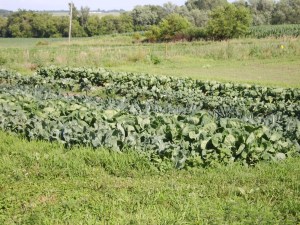
one of the fields on the Small Potatoes Farm

One of the fields on the Small Potatoes Farm

Today the center presented their ongoing work in local food. For example they are putting together a resource guide which will give an overview of all organizations and programs working in local food. We also reviewed a draft on local food procurement information about regulations around raw agricultural products. There are still a lot of myths and fears around the use of local raw agricultural products in commercial institutions, but there are no laws prohibiting direct sale from a producer to an institution.

The Community of Practice brings together various regional food initiatives. Those initiatives gave short presentations and updates on their activities before the more interactive sessions started. For example the Hometown Harvest initiative in Southeast Iowa started a feasibility study to come to a farmer owned food coop and announced a new website and logo. The Northern Iowa Food and Farming partnership shared their experience on how to set up local food distribution among various producers. And the Southwest Iowa Food and Farming Initiative is building a database mapping all local producers and potentially interested consumers as part of the first step in building a food system. The initiative in Marshall town, COMIDA also presented their ongoing work, for example their seminar with Ken Meter (see blog.)

These quarterly meetings are very important for the people working in the regional food initiatives. “I come here and hear about what others do which gives me new ideas” one of the participants said. “Sharing here is a big source of information” and, “things are changing fast now”. There is more acceptance nowadays, that whereas some continu to target the world, others actually want to feed their neighbor.

Allium Sativum L.

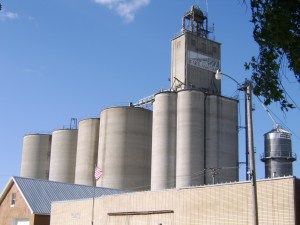
The corn grain elevator of Minburn

The grain elevator, a corn symbol in every town

I drove to Minburn yesterday where I spent a great day at the Small Potatoes Farm. I past the road to the farm without noticing and stopped at the post office, next to the grain elevator, to ask for directions. A good choice because the post office, I soon realized is the epic center of this tiny town. So a few minutes before my arrival, the news was announced by the post office, calling to the farm that a tall Dutch lady was coming over.

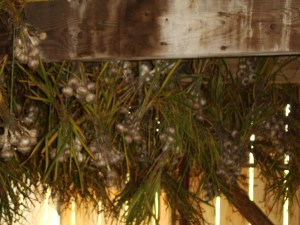
We harvested more than 5 different varieties of garlic. If it would have been not such wet weather so far, the harvest would have been in already around the 4th of July. And even now, the land was quite wet, which meant that the garlic bulbs came out with big lumps of soft black earth hanging in their roots. We pulled, collected, cleaned and trimmed the garlic bulbs after which they were let to dry hanging in the barn, in bundles of eight. Each variety had its own place in order not to mix them up, and we indicated what we hung on a map. Of some varieties we only harvested a basket full, just to grow more seed.

STA72112

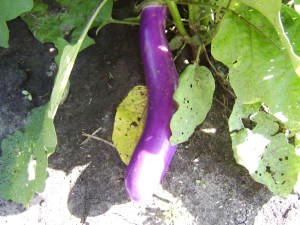
The Small Potatoes Farm grows an incredible amount of different vegetables and different varieties. These include different kinds of: squash, melon, potato, eggplant, peppers, tomatoes, lettuces, unions, leek, cabbage, beets, kale, beans, strawberries, asparagus and herbs. The total amount of hectares available for production is around 4.5, however at any point in time, there is 1.5 hectares in production while the other acres have a cover crop such as buckwheat to increase soil quality and organic mass. STA72126

When you see the rows of different crops weaving in the wind, you wouldn’t think there is much mathematics involved. However, the production planning system is a complicated multi dimensional puzzle. While rotating land out and into production and rotating the right kind of crops after one another to minimize disease, there also has to be a certain kind of yield available every week throughout the season to give the CSA members their vegetable share. And, of course, this share demands a certain kind of diversity too. A puzzle for winter times,  when a thick pack of snow is covering the land.

Hopi Agriculture

Kachina dolls

Kachina dolls

The Hopi have many spiritual and ceremonial places and events. We experienced one of these events, a Kachina dance in a village on Third Mesa. In the months of April, May and June, the ‘day dances’ take place. From February until July these dances involve Kachinas. The Kachinas are the spiritual essence for the Hopi, their appearance connects the Hopi to their ancestral spirits, the elements and the universe. The Kachinas are believed to live at the San Francisco Peaks, they appear from February to July in different types of dances. All dances are connected in some way to rain and harvest. As rain is the limiting factor, their religious and ceremonial life cannot be separated from agriculture and food and being Hopi.

The Hopi strongly hold to their ceremonies and traditions and tribal rules. After some experiences with unethical use of material gathered by visitors, one is reminded everywhere that taking pictures or notes of the ceremonies, the people, the villages and the landscape are forbidden. Doing research in this area is also subject to tribal rules. The data collected cannot be possessed by the researcher/ university. It remains with the Hopi and each usage of material has to be negotiated and agreed upon.

Hopi agriculture and gathering were once the sole source of sustenance. Mainly dependent on rain in the high arid dessert of Arizona, the Hopi planted corn, beans, squash, cotton and gourds that were particularly resistant to the drought and pests of the area. We saw cornfields where the corn is now approx 30 centimeter high. It has been a good spring so far, with quite a bit of rain. Corn is planted very deep, with a planting stick around 6 seeds are sown together up to 18 inches deep into the soil. The depth of the hole depends on judgment in terms of soil moisture. Many corn plants growing together could push through the sandy soil. And each bundle of seeds stands 4 footsteps from each other. In between beans are sown as well as squash around the edges.

Hopi ceremony requires a number of different kinds of Hopi corn, blue, white, yellow, red, purple and mixed. There are at least twelve types of Hopi corn, each with separate ceremonial functions. Grinding corn is a particularly important ritual act for women. At menarche, young girls have a grinding ceremony where they make piki, a wafer-thin flat bread made from blue corn and water. Piki bread is part of the food that the women cook for the various dances and rituals. We saw a piki bread cooker, a thick flat back stone over a fire. Courage and skill is needed to cook the bread because the women cover their hand in the batter and quickly whip their hand over the extremely hot stone. The result is a super thin rolled bread.

Canyon de Chelly, where de Navajo farm

Canyon de Chelly, where de Navajo farm

Times of change?

At the Changing Lands Changing Hands conference in Denver, Jess Gilbert reminded us in his opening speech of the agricultural policies that were put in place with the New Deal policy in the depression of the thirties. Henry J. Wallace was the driving force behind a set of progressive and innovative policies, many of them, still existing today. One of the policies was aimed at land reform establishing 100 new communities from nothing all throughout the country. The state bought the land, built houses and health centers for poor shared croppers. A loaning program offered 100 to 150 families to buy the land, house and tools in one community. Much of the organization was coordinated in tens of different cooperatives per community.

The experiment ended in World War II but the places became strongholds in the civil rights movement of the sixties. What the example illustrates is how powerful a working combination of bottom up and top down can be; activism among the shared croppers and visionary leadership of the ruling elite. Our current time has been compared with the time of the Great Depression, for the severity of the financial and economic crisis. And so maybe the analogy also has to be, that this can be a time of progressive social change.

Not everybody here at this conference is a believer of such ‘sociologist talk’. At the end of one of the sessions, an agricultural economist said me that we can not get around the market forces dictating what farmers will do. “And I don’t see anyway in how that is going to change.”

The session was about farm viability and business transfer. Session presenters all stressed the need for financial management. “Farmers try to produce their way out of trouble” one of them said, but it is not production what counts, “it is financial management which makes the farm profitable”. The session was aimed at the ‘real’ farmer. Statistics were misleading, the agricultural economist said. It was said that the US has around 2 million farmers. Not true, according to him, maybe 200.000 could qualify as a farmer, if you would be able to distinguish them from hobby and small farmers as well as those who are registered for tax reasons.

And besides that, “all this fuss about corporations nowadays I don’t understand, these are still family farms” he said, “who put their business in business models to manage them”. These several million worth ‘family farms’ are, like any other industrial operation, a high capital investment, high sales volume and low profit margin operation. Future successors certainly cannot do without financial training.