Suburban Ag

Land use planning and housing development can bring farming and food production closer to (sub)urban citizens. Similar to trends in the Netherlands, suburban agriculture is taking form in new developments projects. There are two pathways. First, development organised by citizens in co-housing projects such as the Ecovillage in Ithaca. Co-housing projects often involve the creation of an ‘intentional community’ of people who have chosen to live and work together in a lifestyle that reflects their shared core values. Projects often include a community owned and operated farm.

Intentional communities rebel against two dominant American features; individualism and property rights/ownership. Both features are reflected in the overall perspective on land use planning and housing development here. In order to understand it, Dutch assumptions on land use planning need to be left behind.  In most places, state and county legislators refrain from ‘interfering’ with land ownership. Without zoning or specific designations, any land, no matter how far from an urban centre, represents a bundle of rights. For example water rights (see blog), and more importantly ‘development rights’. Development takes place where developer and landowner agree. Around cities, this causes a large ring of ‘urban sprawl’; fragmentation of land and a random patchwork of malls, offices, agricultural land, housing and roads without any visible coherence. Although farmers, who farm in the middle of this, oppose to the developments, they oppose to land use planning at the same time; nobody wants to give up their right to sell their rights.

A second type of suburban agriculture, therefore, is often led by private or public land trusts.  This means that land use planning is applied on the coherent whole of land owned by the trust on a certain location. Some parts are developed for housing, other parts for farming and other parts for nature conservation. A good example of this is Prairie Crossings, set up in 1987 by a group of citizens. This can only take place if development rights are taken off the land even though it is not used for building (‘easement’) to prevent future unwanted development. Rights are taken off by conservation easements in two ways; by being sold or being donated to the trust (the latter for receiving advantagous tax breaks). Whereas until 10 years ago, easements were only for nature conservation, nowadays there are agricultural easements possible too now environmentally sustainable farming is becoming a practice.

It is remarkable how absent the state is in land use planning. Planning in the Netherlands, such as Reconstruction Law land use planning, including the movement of entire farms for preserving natural habitats, equals to an unthinkable intrusion of property rights here.

Urban Ag

Concern about our food, the quality, the exploitation of farmers and workers in the production chain and how it affects our health has induced conscious and political consumerism. But making a statement with the wallet supporting sustainable production might only be the first step. Once food conscious is awakened, it is a small step to grow your own food. Probably also fuelled by the recession, the demand for seeds has skyrocketed recently. The Washington Post (19-6) comments that

“After years in the doldrums, the consumer demand for vegetable seeds has abruptly climbed at a rate even industry veterans have never seen.”

Growing your own food is rapidly becoming a trend as part of an urban agriculture movement. There is a continuous emergence of new initiatives. For example, initiatives which somebody called “Gleaning social networks”; groups who harvest from public places and private places. Wild edibles, such as nuts, berries, fallen fruit, mushrooms and herbs are collected, sometimes to be distributed among the poor. In LA, 120.000 pounds of fruit was harvested within the city last year. Recently Amsterdam was mapped for its wild edibles.

Another type of urban agriculture initiative is “peer-to-peer agriculture”, initiatives which are about sharing land, tools and other resources for more efficient use. For example, how to find an allotment if there are waiting lists? Through internet people can search for pieces of land or gardens which might be (partly) used by someone willing to grow food.

With the rise of more and more urban agriculture initiatives and local food production, new farmers are born each day. These examples show that our idea of what a farm is will soon need serious reconsideration.

Day labor and immigrant rights

The fifteen day travel throughout the south western part of the US came to an end yesterday when we arrived in Ames again. I met many wonderful people. We drove through seven states which gave me a taste for the radically different landscapes existing here. STA71965On our way home we stopped briefly at the Mesa Verde National Park to experience the Canyon landscape and the remnants of Ancestral Puebloan life, far before ‘white man’ came to this country. Until the late 1200s, ancestors of the Hopi and other pueblo tribes lived here in elaborated stone buildings in the sheltered alcoves of the canyon walls.

In Denver we joined Gabriela Flora, who works for AFSC in a voice-raiser event for immigrant workers. AFSC stands for the American Friends Service Committee, founded by the Quakers in 1917. The organization carries out service, development, social justice and peace programs throughout the world. One of their projects is Coloradans for Immigrant Rights, which allies in support of immigrant rights.

This is important because I learned that day labor – waiting on street corners to be picked up each day – is not a foregone phenomenon. Immigrant day laborers are a vulnerable group, often victim of exploitation by employers and harassment by the police. The various hardships they endure to sustain families back home were shown in a short film. The film followed the lives of a few of the mostly Hispanic day laborers in their struggle to make a living in highly insecure circumstances. One of the many problems for these workers is employers who do not pay at the end of the day or week. The AFSC helped immigrants to organize themselves in the now independent Centro Humanitario. The center provides education and help in many kinds. For example, through the center, the workers can ask for help in trying to trace employers and outstanding payments. After the film questions could be asked to the workers who figured in the film. They expressed a strong wish to be really (legally) part of the US one day, to be able to walk the street without fear, to be able to participate in the society as full members. Just like the stories of those working in the processing plants of the agro-industry, their stories show how much an immigration reform is needed.

Hopi Agriculture

Kachina dolls

Kachina dolls

The Hopi have many spiritual and ceremonial places and events. We experienced one of these events, a Kachina dance in a village on Third Mesa. In the months of April, May and June, the ‘day dances’ take place. From February until July these dances involve Kachinas. The Kachinas are the spiritual essence for the Hopi, their appearance connects the Hopi to their ancestral spirits, the elements and the universe. The Kachinas are believed to live at the San Francisco Peaks, they appear from February to July in different types of dances. All dances are connected in some way to rain and harvest. As rain is the limiting factor, their religious and ceremonial life cannot be separated from agriculture and food and being Hopi.

The Hopi strongly hold to their ceremonies and traditions and tribal rules. After some experiences with unethical use of material gathered by visitors, one is reminded everywhere that taking pictures or notes of the ceremonies, the people, the villages and the landscape are forbidden. Doing research in this area is also subject to tribal rules. The data collected cannot be possessed by the researcher/ university. It remains with the Hopi and each usage of material has to be negotiated and agreed upon.

Hopi agriculture and gathering were once the sole source of sustenance. Mainly dependent on rain in the high arid dessert of Arizona, the Hopi planted corn, beans, squash, cotton and gourds that were particularly resistant to the drought and pests of the area. We saw cornfields where the corn is now approx 30 centimeter high. It has been a good spring so far, with quite a bit of rain. Corn is planted very deep, with a planting stick around 6 seeds are sown together up to 18 inches deep into the soil. The depth of the hole depends on judgment in terms of soil moisture. Many corn plants growing together could push through the sandy soil. And each bundle of seeds stands 4 footsteps from each other. In between beans are sown as well as squash around the edges.

Hopi ceremony requires a number of different kinds of Hopi corn, blue, white, yellow, red, purple and mixed. There are at least twelve types of Hopi corn, each with separate ceremonial functions. Grinding corn is a particularly important ritual act for women. At menarche, young girls have a grinding ceremony where they make piki, a wafer-thin flat bread made from blue corn and water. Piki bread is part of the food that the women cook for the various dances and rituals. We saw a piki bread cooker, a thick flat back stone over a fire. Courage and skill is needed to cook the bread because the women cover their hand in the batter and quickly whip their hand over the extremely hot stone. The result is a super thin rolled bread.

Canyon de Chelly, where de Navajo farm

Canyon de Chelly, where de Navajo farm

Four corners Indian country

Since Saturday I am staying in Keams Canyon, in the Hopi Reservation in Arizona. For the last ten years, Cornelia Flora has been doing research and extension work with a colleague from Arizona State University, Matt Livingston and organizations at the Reservation. This visit therefore includes some meetings on current projects.

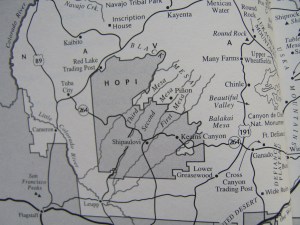
Hopi Indians are a pueblo tribe living in 13 villages located on the 2472320 acres (just over a million hectares) of the Hopi Reservation in north-central Arizona. With their ancestors coming from the south, they are sometimes categorized under as Anasazi; southern based tribes sharing a coming language root.  However, we learned in the Archeology Museum in Blending, Utah, that this is a name taken over into English from Navajo. In Navajo (themselves coming from north) it means something like ‘ancient enemy’. A more correct way to talk about the different tribes that came from the south, therefore, is Ancestral Puebloans. The Hopi Reservation is surrounded by the Navajo Reservation and there is an Apache Reservation nearby.

STA71894The Hopi villages are mostly located on three peninsular “mesas” that are the southwestern “fingers” of Black Mesa, high ridges elevated around a 1000 meters above the Canyon land plateaus. The Hopis are the oldest continuous inhabitants of northern Arizona; some of their ancestors may have lived in the region as early as A.D. 700 (Linford 2005).


“I never saw so much empty land”, I remarked to Matt in the car yesterday. Indeed, books talk about this desert land as some of the most desolate country in the United States. “It might seem empty to you” Matt replied, “but it is not for the Hopi”. It might not seem ‘productive’ in any Western economic sense, but this land represents many things for them. “There can be trails or holy places where their shrines live”. And, “their cattle graze here and they cultivate their indigenous ground races maize” Matt explained. In such an extensive way that it is hardly visible for the eye! With approx 300 millimeters rainfall a year and no rivers in the neighborhood they are adapted to their circumstances, quite different from the Dutch wetlands….

Hopi CookbookOne of the projects is centered around Hopi food. The aim of the project is to help communities to understand Hopi traditional food, to collect best practices about growing and gathering food as well as to appreciate the spiritual aspect of food. It is an awareness raising project, helping people realize what they already know. One of the result so far has been a Hopi traditional cook book and follow up activities are now planned, such as intergenerational cooking workshops.